How Modern CNC Cutting Machines Work: Technical Specs Guide
Explore the core technical specifications and mechanics of CNC cutting machines, from servo motors and G-code to thermal and mechanical cutting heads.
The Kinematic Architecture: Drive Systems & Tolerances
The foundational accuracy of any CNC cutting machine relies on its kinematic drive system, which converts the rotational force of electric motors into precise linear motion. Modern industrial systems predominantly utilize AC synchronous servo motors, such as the Yaskawa Sigma-7 series, paired with high-resolution absolute encoders. A standard 24-bit absolute encoder resolves over 16 million positions per revolution, effectively eliminating the homing sequence required by older incremental encoders and reducing startup time.
The linear motion is achieved through two primary mechanical configurations, dictated by the machine's footprint:
- Ground Ballscrews: Used primarily in micro-machining and smaller-format routers (up to 4x4 feet). They offer exceptional rigidity and near-zero backlash (typically <0.0002 inches). However, they are limited by the critical speed of the screw shaft, which can induce harmonic vibration (whip) on longer axes.
- Helical Rack-and-Pinion: The standard for large-format CNC plasma and laser tables (e.g., 5x10 or 6x12 foot beds). Unlike spur gears, helical gears maintain continuous tooth engagement, reducing backlash to approximately 0.001–0.002 inches while allowing high traverse speeds exceeding 1,500 inches per minute (IPM).
On wide gantry systems, the Y-axis is driven by two independent servo motors (one on each side of the bridge). The CNC controller must utilize a 'master-slave' or 'gantry synchronization' algorithm to ensure both motors accelerate and decelerate identically. A mismatch of just 0.005 inches in positional feedback between the two motors will cause the gantry to skew, resulting in squareness errors and accelerated wear on the linear guide rails (typically THK or Rexroth profile rails).
Motion Control & G-Code Interpretation
The CNC controller acts as the machine's brain, translating CAD/CAM-generated toolpaths into electrical signals. The foundational language remains G-code, governed by standards such as the NIST RS274NGC interpreter specification. However, modern cutting requires far more than basic point-to-point movement.
Advanced controllers, like the Hypertherm EDGE Connect or Siemens SINUMERIK ONE, utilize dynamic look-ahead algorithms. When cutting complex contours with thousands of micro-segments, a basic controller would decelerate to a near-stop at every node, causing burn marks on plasma cuts or dross on laser cuts. A high-end controller scans 2,000 to 5,000 blocks of G-code ahead of the current position. It calculates the optimal velocity profile, managing 'jerk' (the rate of change of acceleration) to maintain a constant cutting speed through sharp corners without exceeding the mechanical limits of the gantry.
Height Control Subsystems
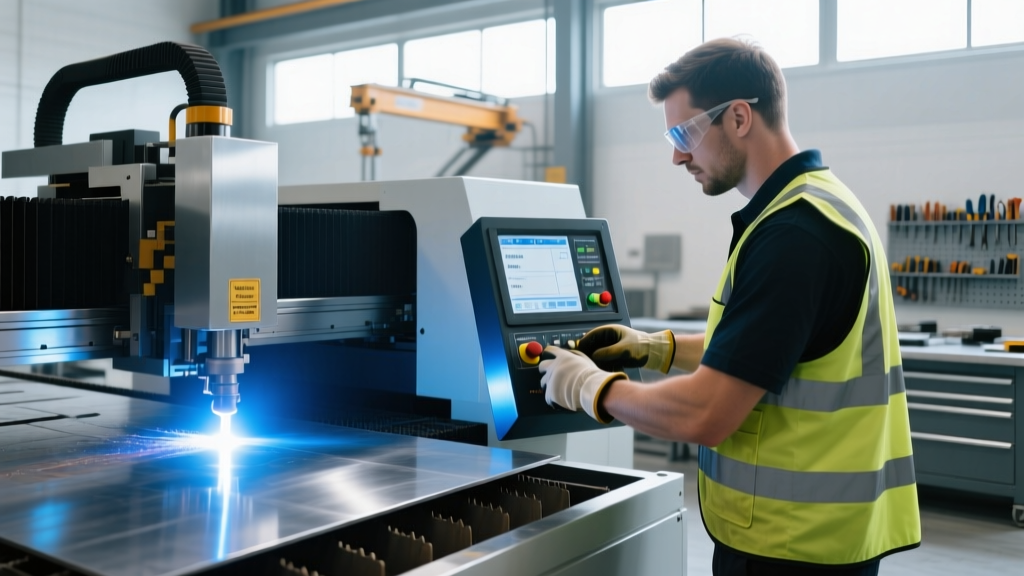
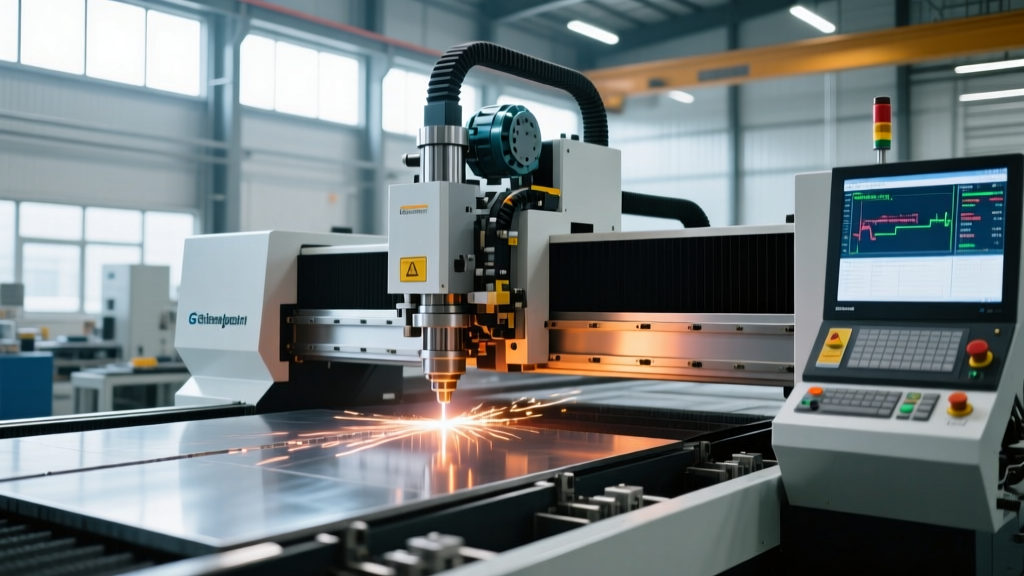
In thermal cutting, maintaining the exact standoff distance between the torch/nozzle and the material is critical. CNC cutting machines employ specialized height controllers (THC) that sample arc voltage (in plasma) or capacitive proximity (in laser/routing) at frequencies up to 1,000 Hz. This allows the Z-axis to compensate for warped sheet metal or thermal bowing in real-time, preventing torch crashes and ensuring consistent kerf width.
Cutting Head Technologies: Thermal vs. Mechanical Specs
The cutting mechanism defines the machine's material capabilities, edge quality, and operational costs. Below is a technical comparison of the three dominant industrial cutting processes.
| Specification | Fiber Laser (12kW) | High-Def Plasma (260A) | Abrasive Waterjet (60kpsi) |
|---|---|---|---|
| Wavelength / Medium | 1064 nm (Solid State) | Ionized Gas (O2/N2/H35) | Water + 80-Mesh Garnet |
| Typical Kerf Width | 0.10 mm - 0.25 mm | 1.2 mm - 1.8 mm | 0.75 mm - 1.0 mm |
| Positional Tolerance | ± 0.05 mm | ± 0.20 mm | ± 0.10 mm |
| Max Cut Speed (1/4" Steel) | ~ 12,000 mm/min | ~ 2,800 mm/min | ~ 450 mm/min |
| Heat Affected Zone (HAZ) | Minimal (0.1 - 0.3 mm) | Moderate (1.5 - 3.0 mm) | None (Cold Cutting) |
Deep Dive: Fiber Laser Reflectivity Management
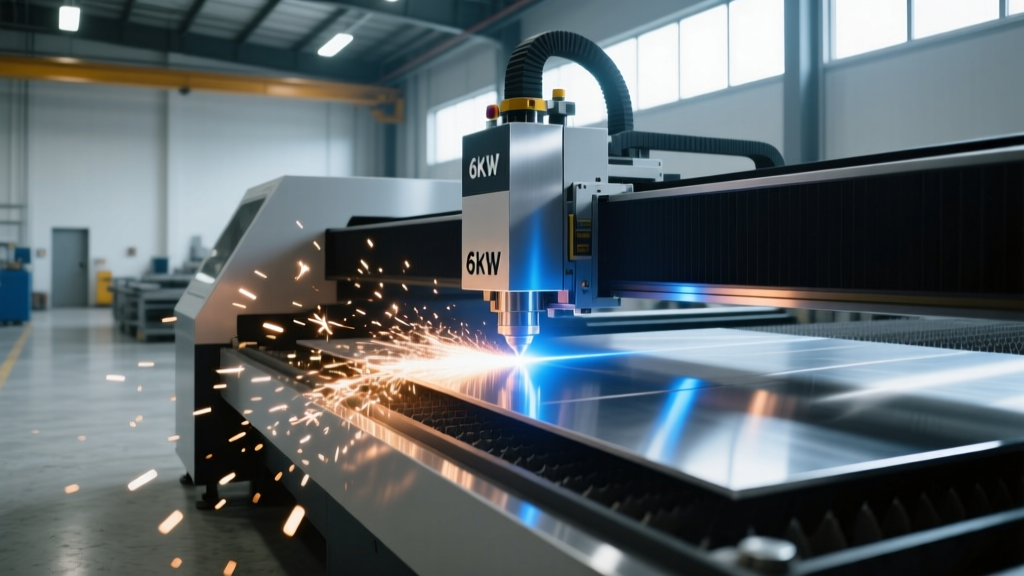
The 1064 nm wavelength of modern fiber lasers (such as those from IPG Photonics or TRUMPF) is highly absorbed by mild steel and aluminum. However, when cutting highly reflective metals like copper or brass, the unabsorbed beam can reflect back into the cutting head, destroying the collimating lens and the fiber optic cable. Modern machines mitigate this via 'back-reflection sensors' that halt the beam in milliseconds if a reflection spike is detected, combined with specialized nitrogen assist gas pressures exceeding 300 PSI to physically blow the molten reflective material out of the kerf before it can deflect the beam.
Deep Dive: Plasma Consumable Life Cycle
According to Hypertherm's plasma cutting fundamentals, the lifespan of a plasma torch consumable (specifically the hafnium electrode and copper nozzle) is measured in pierces, not just arc-on time. A standard 130A air-plasma system may yield 200–400 pierces. In contrast, a liquid-cooled, high-definition oxygen plasma system cutting mild steel can achieve 1,500 to 2,000+ pierces per set. The liquid cooling prevents the hafnium emitter from melting away rapidly during the intense thermal shock of the pilot arc transfer.
Material Handling & Fume Extraction Engineering
A machine's cutting speed is irrelevant if material loading and fume extraction bottleneck the production cycle.
Shuttle Tables and Automation
Industrial CNC cutting machines utilize dual-zone shuttle tables. While the machine cuts on Zone A, the operator unloads finished parts and loads raw sheet metal on Zone B. Heavy-duty pneumatic chain drives swap the pallets in 30 to 45 seconds. For lights-out manufacturing, these are upgraded to automated tower storage systems with vacuum-cup gantry loaders that can feed raw material and remove skeletons without human intervention.
Downdraft Fume Extraction Metrics
Thermal cutting generates hazardous sub-micron particulate matter. Proper ventilation is not just a comfort feature; it is a strict regulatory requirement outlined by OSHA's welding and cutting fume standards.
To calculate the required exhaust fan capacity for a downdraft table, use the industry standard of 250 to 300 Cubic Feet per Minute (CFM) per square foot of cutting area. For a standard 5x10 foot (50 sq ft) plasma table, the dust collection system must pull a minimum of 12,500 CFM. Furthermore, the table must be divided into pneumatic zoned dampers that open only in the section directly beneath the torch, ensuring the suction velocity is concentrated where the fumes are generated rather than dissipated across the entire bed.
Decision Framework: Matching Specs to Production Needs
Selecting the right CNC cutting machine requires moving beyond brochure speeds and calculating the true cost-per-part based on operational realities. Use this framework to evaluate potential investments:
- Evaluate the Secondary Operations Cost: Fiber lasers produce a near-finished edge that rarely requires grinding or machining before welding or powder coating. Plasma leaves a slight bevel and dross on thicker materials (>1/2 inch) that requires secondary cleanup. If your downstream process requires pristine edges, the higher capital cost of a laser is offset by eliminated labor in the grinding bay.
- Calculate True Consumable Cost-Per-Foot: Waterjet machines have zero HAZ and cut any material, but the operational cost of high-pressure pump seals, orifices, and garnet abrasive is exceptionally high (often $15–$25 per hour in consumables alone). Reserve waterjets for thick aerospace alloys, titanium, or materials where thermal alteration is strictly prohibited.
- Assess Nesting Efficiency vs. Kerf Width: When cutting high volumes of small parts from expensive stainless steel, the 0.1mm kerf of a fiber laser allows parts to be nested millimeters apart, drastically improving material yield compared to the 1.5mm kerf of a plasma cutter. A 2% improvement in material yield on 304 stainless steel can pay for the machine upgrade in under 18 months.