2026 Cutting CNC Machine Innovations: AI and Ultra-High-Power Lasers
Explore 2026 cutting CNC machine trends, from 100kW fiber lasers and AI nesting to IoT plasma consumables. Upgrade your fab shop with data-driven insights.
The Shift to Cognitive Cutting CNC Machine Architectures
The era of the passive cutting CNC machine is over. In 2026, fabrication facilities are no longer purchasing equipment that merely executes G-code; they are investing in cognitive manufacturing nodes. Driven by the principles outlined in the NIST Advanced Manufacturing frameworks, modern thermal and abrasive cutting systems now feature closed-loop feedback mechanisms, real-time kerf compensation, and autonomous material handling. The transition from mechanical precision to algorithmic optimization has fundamentally altered the return on investment (ROI) calculations for heavy plate and sheet metal processing.
For shop floor managers and manufacturing engineers, understanding these hardware and software convergences is critical. A new cutting CNC machine must be evaluated not just on its maximum cutting speed, but on its ability to integrate with factory-wide IoT ecosystems, predict consumable failures, and autonomously adjust to material inconsistencies.
Ultra-High-Power Fiber Lasers: Breaking the 100kW Barrier
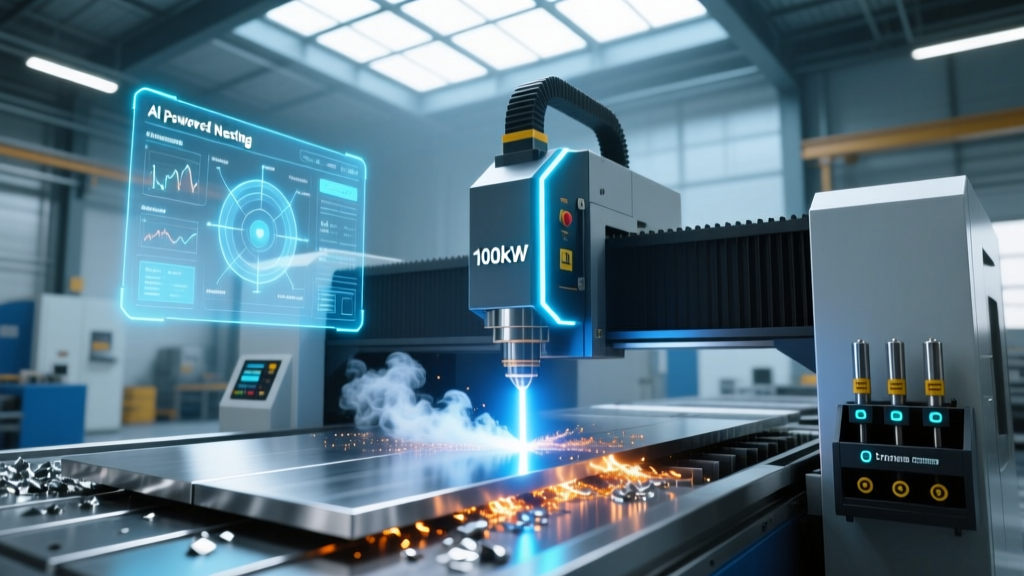
While 12kW to 30kW fiber lasers dominated the market over the last half-decade, 2026 has seen the commercial maturation of 100kW and 120kW ultra-high-power (UHP) fiber lasers from manufacturers like Bodor, HGTECH, and Trumpf. This is not merely a brute-force increase in photon density; it represents a fundamental shift in cutting physics.
Data Highlight: 100kW vs 30kW on 30mm Mild Steel
- 30kW Fiber Laser: Cuts at ~1.8 meters/min using Oxygen assist. Requires frequent nozzle changes due to spatter.
- 100kW Fiber Laser: Cuts at ~6.5 meters/min using Nitrogen assist. Produces an oxide-free edge, eliminating secondary grinding operations.
- Kerf Width: Maintains a remarkably tight 0.45mm kerf even at 50mm thickness, preserving material yield.
- Cost Per Part: Despite higher initial capital expenditure, the cost per part drops by 41% due to the elimination of secondary finishing and a 260% increase in throughput.
According to industry analysis published by The Fabricator, the adoption of UHP lasers is cannibalizing traditional plasma and oxy-fuel markets for plate processing up to 50mm thick. The ability to cut thick aluminum and copper—materials that historically reflected lower-wavelength laser light—has been solved by the sheer power density of 100kW resonators, which instantly vaporize the reflective surface layer before beam reflection can damage the optics.
AI Vision Systems Replacing Mechanical Probing
One of the most significant time-sinks in sheet metal processing is material alignment. Traditional cutting CNC machine setups rely on mechanical touch probes to find the edge of a warped or skewed sheet, a process that takes 15 to 30 seconds per load. In 2026, AI-driven machine vision systems, such as Bystronic’s ByVision and Mazak’s intelligent camera arrays, have rendered mechanical probing obsolete.
These systems use stereoscopic cameras and deep learning algorithms to map the exact topography and edge boundaries of a sheet in under 1.2 seconds. If a 4x8-foot sheet of 16-gauge stainless steel is loaded with a 3-degree skew and a 4mm vertical warp, the AI instantly recalculates the nesting layout and adjusts the Z-axis focal height map on the fly. This eliminates edge-cutting errors and reduces machine idle time between sheets by up to 85%.
Dynamic Nesting and Scrap Reduction
Modern CAM software integrated directly into the cutting CNC machine controller now utilizes reinforcement learning for dynamic nesting. Instead of relying on static, pre-programmed nests, the machine’s AI analyzes the real-time inventory of offcuts and remnant sheets in the shuttle table. It will autonomously reorder the cutting queue to utilize a 2x3-foot remnant for a smaller bracket order, reducing raw material scrap by an average of 12% to 18% annually.
Predictive IoT in Plasma and Waterjet Systems
Thermal and abrasive cutting processes are inherently destructive to their own consumables. However, the integration of edge-computing IoT sensors has transformed maintenance from a reactive chore into a predictive science.
Plasma: Arc Voltage and Consumable Telemetry
Advanced high-definition plasma systems, such as the latest iterations of Hypertherm’s XPR X-Definition series, now feature embedded arc voltage and gas flow telemetry. By monitoring the micro-fluctuations in arc voltage (measured in millivolts) and the pressure drop across the swirl ring, the cutting CNC machine can predict electrode and nozzle wear with 98% accuracy. The system alerts the operator to replace the consumable cartridge during the next sheet load, preventing the catastrophic failure of a nozzle mid-cut, which would otherwise scrap a $2,000 piece of HARDOX steel.
Waterjet: Acoustic Emission and Mixing Tube Wear
In abrasive waterjet cutting, the mixing tube degrades asymmetrically, causing the kerf to taper and the cut to drift. 2026 waterjet cutting CNC machine models are equipped with acoustic emission (AE) sensors mounted near the cutting head. These piezoelectric sensors 'listen' to the frequency of the abrasive stream hitting the garnet. A shift in the acoustic signature indicates internal tube grooving. The machine automatically applies a software-based taper compensation (adjusting the 5-axis bevel head by fractions of a degree) to counteract the physical wear until the tube is replaced, maintaining a +/- 0.05mm tolerance over a 150-hour lifespan.
2026 Technology Selection Matrix
Choosing the right cutting CNC machine requires matching the technology to your specific material profile and secondary operation requirements. The table below outlines the current capabilities of the big three cutting technologies in 2026.
| Feature | UHP Fiber Laser (100kW) | High-Def Plasma (400A) | 5-Axis Waterjet (90k PSI) |
|---|---|---|---|
| Max Optimal Thickness | 50mm (Mild Steel) | 75mm (Mild Steel) | 200mm+ (Any Material) |
| Heat Affected Zone (HAZ) | Minimal (Nitrogen assist) | Moderate to High | Zero (Cold cutting) |
| Bevel Cutting Capability | Up to 45° (Requires specialized head) | Up to 50° (Standard on 5-axis) | Up to 60° (Taper compensation) |
| Operating Cost / Hour | $35 - $55 (Gas + Power) | $45 - $70 (Consumables + Gas) | $60 - $95 (Garnet + Pump maint.) |
| Secondary Finishing | Rarely required | Often required for weld prep | Never required |
ROI Framework for Upgrading Your Cutting CNC Machine
Capital equipment purchases in 2026 must be justified through rigorous data analysis. The SME Fabricating Technologies guidelines recommend evaluating upgrades based on the 'Cost of Inaction' rather than just the sticker price of the new machine. Use this framework to assess your facility:
- Audit Secondary Operations: If your current plasma or lower-wattage laser requires a dedicated operator with a hand grinder to clean up dross or HAZ before welding, calculate the fully burdened labor cost of that operator. A 100kW cutting CNC machine utilizing nitrogen assist eliminates this step, often paying for the machine upgrade in 18 months through labor reallocation alone.
- Measure Material Yield Loss: Export your nesting logs from the past 90 days. If your scrap rate exceeds 18%, the integration of AI-driven dynamic nesting and camera-based edge detection on a new machine will yield immediate material savings.
- Calculate Downtime Variance: Track the hours lost to mechanical probing, nozzle changes, and mixing tube recalibrations. Modern IoT-equipped machines reduce these micro-stoppages by up to 60%, increasing overall equipment effectiveness (OEE) from an industry average of 65% to over 85%.
The cutting CNC machine landscape in 2026 rewards facilities that treat cutting not as an isolated island of production, but as a data-rich, autonomous node. By leveraging UHP lasers, AI vision, and predictive IoT, manufacturers can achieve unprecedented throughput while driving the cost per part to historic lows.