How AI and IoT Are Transforming CNC Machine Operator Work in 2026
Discover how AI, cobots, and IoT are redefining CNC machine operator work in 2026. Explore new skills, digital twins, and salary impacts.
The Evolution of the Shop Floor: From Manual Tweak to Supervisory Control
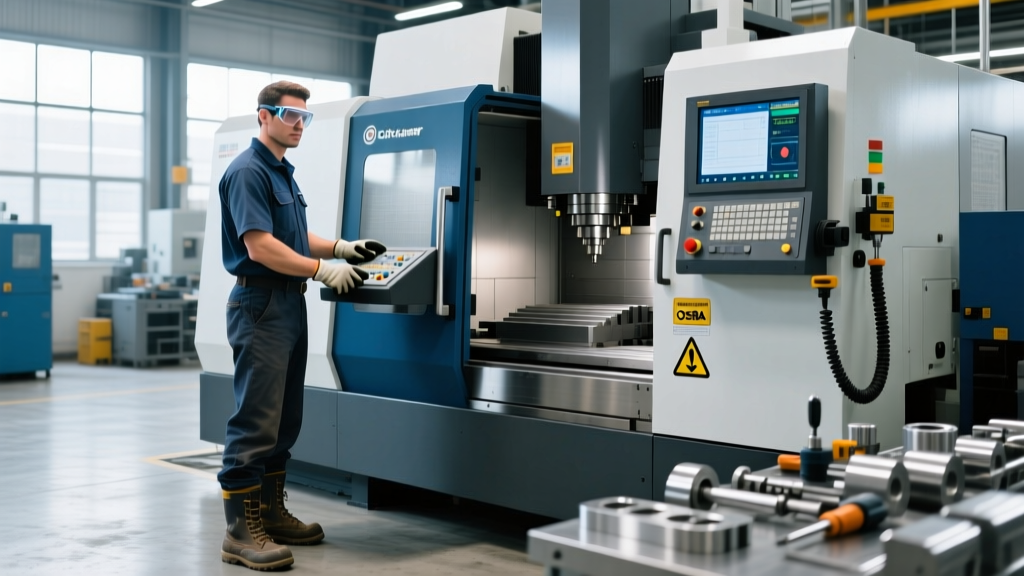
The fundamental nature of cnc machine operator work has undergone a radical transformation. In 2026, the modern machinist is no longer defined solely by their ability to manually calculate G-code offsets or physically haul 50-pound steel billets into a vise. Instead, the role has evolved into a hybrid of manufacturing execution, data analytics, and robotics supervision. As machine tools become nodes on a decentralized network, operators are transitioning from direct machine manipulators to fleet supervisors.
2026 Industry Snapshot:- Setup Time Reduction: Digital twin simulations have reduced first-article setup times by an average of 42%.
- Spindle Crash Prevention: IoT-driven acoustic emission sensors have decreased catastrophic spindle crashes by 68% in smart factories.
- Wage Premium: Operators certified in MTConnect data literacy and cobot programming command a 22% higher base salary than traditional manual operators.
AI-Assisted Programming and the Death of Manual Toolpath Calculation
Historically, optimizing a toolpath for difficult materials like Inconel 718 or titanium Ti-6Al-4V required years of tribal knowledge and manual feed/speed adjustments. Today, AI-driven CAM modules have shifted this burden. Software suites like Mastercam 2026 utilize machine-learning algorithms that analyze historical cutting data to predict tool wear and dynamically adjust chip thinning calculations in real-time.
For the operator, this means the focus shifts from verifying basic geometry to managing process boundaries. When running a 5-axis simultaneous contouring operation on a DMG MORI monoBLOCK, the operator's work involves monitoring the AI's suggested spindle load limits and validating the digital twin's collision avoidance parameters before executing the cycle.
Siemens Sinumerik ONE and the Digital Twin Standard
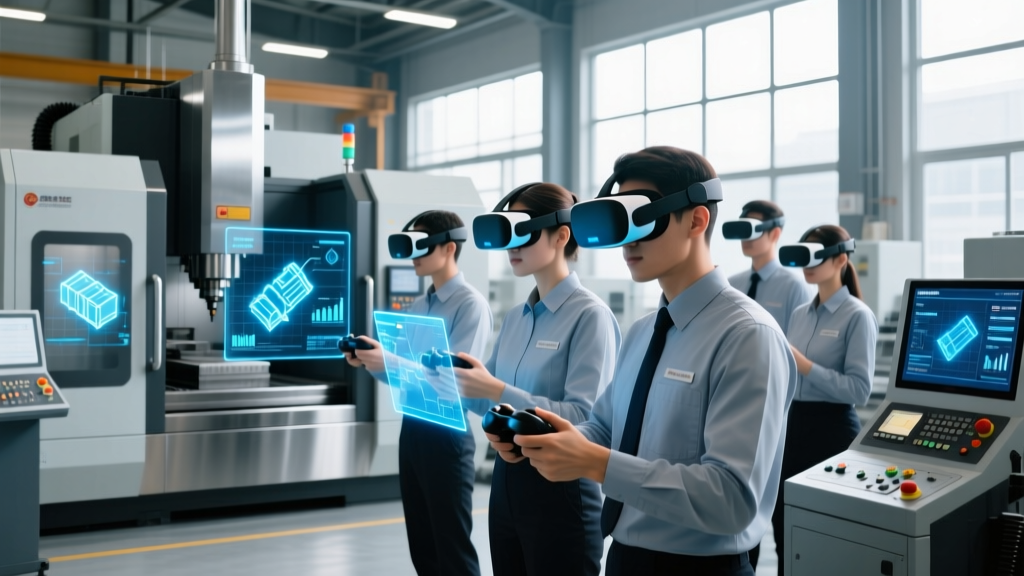
The integration of hardware and software digital twins, pioneered by platforms like Siemens Sinumerik ONE, allows operators to run 'Create MyVirtualMachine' simulations directly on the shop floor. Instead of performing a risky dry run with the spindle locked, operators execute the virtual twin, verifying exact kinematic movements, tool holder clearances, and cycle times down to the millisecond. This eliminates the traditional 'prove-out' anxiety and allows a single operator to safely oversee four or five multi-pallet machining centers simultaneously.
Collaborative Robotics: The Operator's New Apprentice
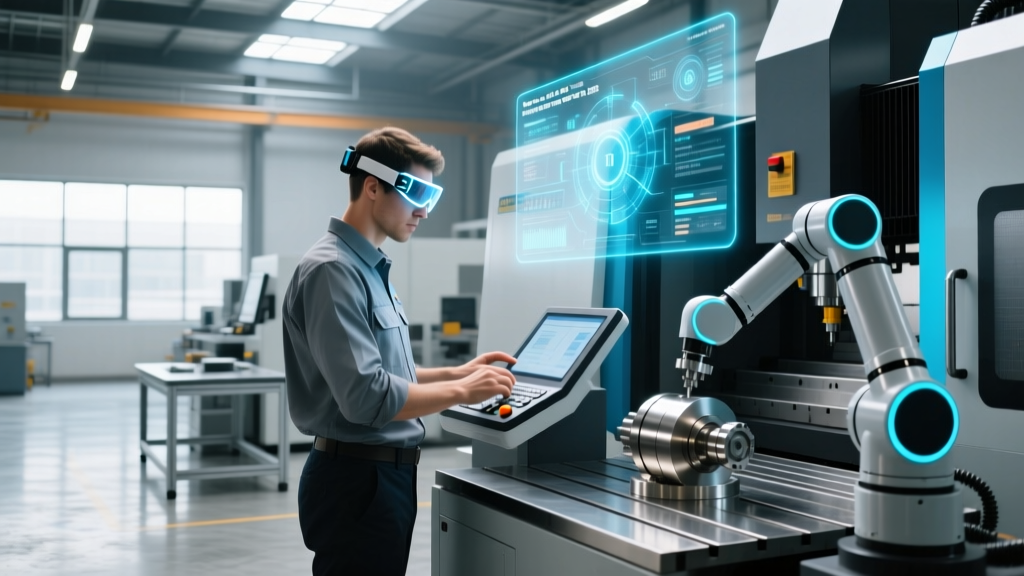
The physical toll of CNC machine operator work has been drastically reduced by the deployment of high-payload collaborative robots (cobots). Unlike traditional caged industrial robots that require extensive safety fencing and dedicated PLC programming, modern cobots are programmed via intuitive drag-and-drop teach pendants.
Consider the Universal Robots UR20. With a 20kg payload capacity and a 1,750mm reach, the UR20 is specifically engineered for heavy-duty machine tending. An operator's workflow now includes:
- Waypoint Teaching: Physically guiding the cobot arm to the raw material rack, the machine vise, and the finished parts bin.
- Gripper Calibration: Setting pneumatic pressure limits on dual-gripper end-of-arm tooling (EOAT) to ensure delicate aerospace components are not marred during transfer.
- Exception Handling: Responding to cobot fault codes when a raw casting features excessive flash that prevents proper seating in the fixture.
'The modern CNC operator doesn't load parts; they manage the logistics of the cell. My job is to ensure the cobot, the tool presetter, and the 5-axis mill are communicating flawlessly via OPC-UA protocols.' — Lead Manufacturing Cell Supervisor, Tier 1 Aerospace Supplier.
Comparative Analysis: Traditional vs. Smart Factory Operator Work
The table below illustrates the exact shift in daily tasks and required competencies between legacy machine shops and 2026 smart manufacturing environments.
| Task Category | Legacy Shop Floor (Pre-2020) | 2026 Smart Factory Environment |
|---|---|---|
| First Article Prove-Out | Single-block execution, hand on feed override, visual inspection. | Digital twin simulation, automated laser tool setting, in-cycle probing. |
| Tool Wear Management | Manual offset adjustments based on post-process CMM data. | Real-time spindle load monitoring with automated macro-driven wear offsets. |
| Material Handling | Manual loading, deburring, and washing. | Cobot tending, automated ultrasonic washing, AGV delivery. |
| Downtime Troubleshooting | Calling maintenance, waiting for mechanical diagnosis. | Reviewing IoT vibration analysis dashboards to predict bearing failure. |
IoT and MTConnect: The Operator as a Data Analyst
The adoption of the MTConnect standard has been the most significant invisible shift in CNC machine operator work. MTConnect provides a universal, open-source language for machine tools to broadcast their operational state. Operators now spend a significant portion of their shift interacting with edge-computing dashboards (such as MachineMetrics or Scytec DataXchange).
Real-World Application: Acoustic Emission and Chatter Detection
When roughing deep pockets in 17-4 PH stainless steel, harmonic chatter can destroy a $400 carbide endmill and scrap a $10,000 forging. In 2026, operators utilize acoustic emission (AE) sensors mounted directly to the spindle housing. These sensors sample vibration frequencies at 100kHz. If the AE dashboard detects the specific frequency signature of chatter onset, the operator's work involves tweaking the CAM software's variable helix engagement angles or adjusting the spindle speed map to move out of the resonant frequency zone. This requires a deep understanding of machining physics, not just button-pushing.
Warning: The 'Data Blindspot' TrapMany shops invest heavily in IoT sensors but fail to train operators on data interpretation. An operator who ignores a 12% gradual increase in Z-axis servo motor current over a three-week period will inevitably face a catastrophic ball-screw failure. Data is only valuable when the operator possesses the diagnostic framework to act on it.
Actionable Upskilling Roadmap for the 2026 Machinist
To remain competitive and command top-tier compensation, CNC operators must actively pursue cross-disciplinary skills. The following roadmap outlines the exact certifications and knowledge bases required to transition from a manual operator to a Smart Factory Technician.
- Step 1: Master Machine Connectivity (MTConnect/OPC-UA). Understand how to extract data from a Fanuc 31i-B5 control and route it to a local server. Learn to read XML data streams to identify machine states (Active, Idle, Alarm).
- Step 2: Cobot Kinematics and Safety Standards. Complete manufacturer-specific training (e.g., Universal Robots Academy) focusing on payload center-of-gravity calculations and ISO/TS 15066 collaborative safety force limits.
- Step 3: Advanced Metrology Integration. Learn to program Renishaw Equator gauging systems and integrate their feedback loops directly into the CNC control's macro variables for automated thermal compensation.
- Step 4: Obtain Recognized Credentials. Pursue advanced certifications from the National Institute for Metalworking Skills (NIMS), specifically targeting their Smart Factory and CNC Programming credentials, which are heavily weighted by modern aerospace and medical device manufacturers.
The Future of the Profession
The romanticized image of the lone machinist covered in cutting fluid, manually turning handwheels, is a relic of the past. The CNC machine operator work of 2026 is a highly technical, digitally integrated profession. Those who embrace AI toolpath verification, collaborative robotics, and IoT-driven predictive maintenance are not just securing their jobs—they are elevating the entire manufacturing sector, ensuring that the physical goods powering the global economy are produced with unprecedented precision and efficiency.