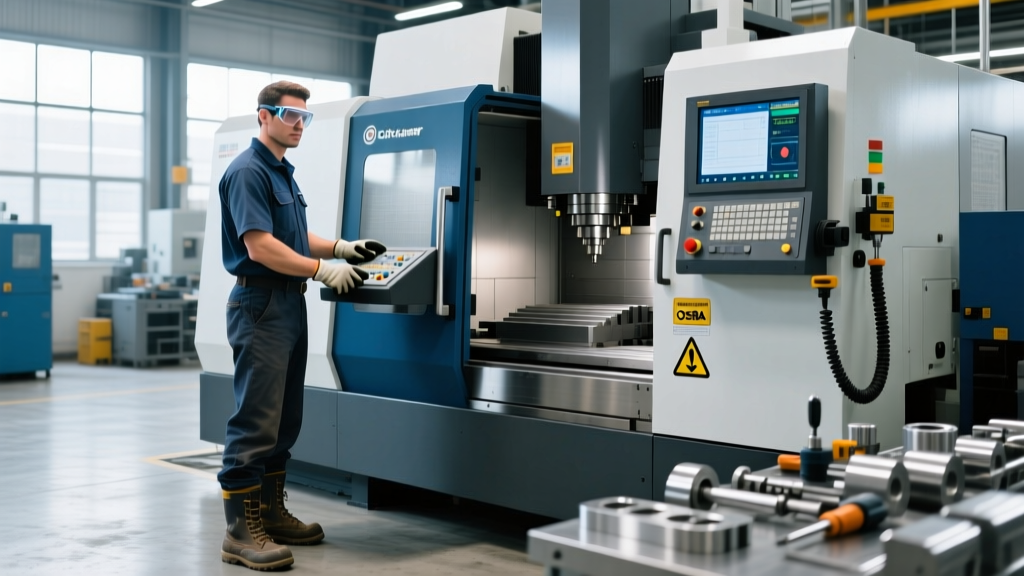
Crafting a CV for CNC Machine Operator Roles: Safety & Compliance
Learn how to highlight OSHA certifications, ISO compliance, and safety metrics on your CV for CNC machine operator roles to stand out to top manufacturers.
The Economic Reality of CNC Hiring: Why Safety Trumps Speed
When aerospace, medical device, and automotive manufacturers review a CV for CNC machine operator positions, they are not just looking for someone who can reduce cycle times by four seconds. They are looking for risk mitigation. A single spindle crash on a 5-axis DMG Mori or Mazak Integrex can result in $80,000+ in immediate repair costs, while an OSHA Lockout/Tagout (LOTO) violation carries fines exceeding $16,000 per serious instance. Consequently, hiring managers prioritize candidates who demonstrate a rigorous, documented approach to safety standards and quality compliance.
Most machinists submit generic resumes listing machine brands and G-code proficiency. To secure top-tier roles in AS9100 or ISO 13485 certified facilities, your CV must explicitly detail your competency in hazard identification, machine safeguarding, and regulatory compliance. This guide breaks down exactly how to structure a safety-first CV that passes Applicant Tracking Systems (ATS) and impresses plant managers.
⚠️ The Cost of a Bad Hire: According to the Occupational Safety and Health Administration (OSHA), hazardous energy control (LOTO) violations consistently rank in the top 10 most cited standards annually. Manufacturers know that an operator who bypasses safety interlocks to save time is a massive liability. Your CV must prove you are a safeguard, not a risk.1. The Professional Summary: Establishing the Safety Hook
Your professional summary is the first 3-4 lines of your CV. Do not waste this space with vague statements like "Hardworking machinist looking for a new opportunity." Instead, immediately establish your safety credentials and compliance framework experience.
Weak Summary (Avoid):
"Experienced CNC operator with 5 years of experience running Haas and Fanuc mills. Good at reading blueprints and keeping the shop clean. Looking to grow my career."
Compliance-Driven Summary (Use):
"NIMS-certified CNC Milling Operator with 6 years of experience in AS9100 Rev D aerospace environments. Proven track record of maintaining 100% OSHA compliance across 12-machine cells, executing rigorous daily LOTO procedures, and leading 5S workplace audits. Adept at configuring Fanuc Dual-Check Safety (DCS) zones and routing non-conforming materials via MRB protocols."
2. Certifications & Compliance Training Matrix
Top manufacturing facilities require verifiable proof of safety and quality training. Create a dedicated "Certifications & Compliance" section immediately following your summary. Use a structured format to list your credentials, the issuing body, and the year of completion.
| Certification / Training | Issuing Body | Relevance to CNC Operations |
|---|---|---|
| OSHA 30-Hour General Industry | OSHA / Authorized Provider | Advanced hazard recognition, machine guarding, and material handling. |
| NIMS CNC Milling: Setup & Ops | National Institute for Metalworking Skills | Validates standardized, safe setup procedures and tool proving methods. |
| ISO 9001:2015 Internal Auditor | ASQ or equivalent | Demonstrates understanding of QMS, corrective actions, and traceability. |
| Crane & Rigging / Forklift Cert | National Commission (NCCCO) | Essential for safe loading of heavy vises, tombstones, and raw stock. |
3. Translating Daily Safety Practices into High-Impact CV Bullets
The core of your CV is the "Professional Experience" section. Hiring managers and the Bureau of Labor Statistics note that modern machinists do far more than push cycle start; they manage complex, high-risk workflows. You must translate routine safety practices into quantifiable achievements.
The "Before & After" Bullet Point Transformation
Use the following comparison to upgrade your experience bullets from generic tasks to compliance-driven achievements:
- ❌ Generic: Cleaned machines and followed safety rules.
✅ Compliance-Driven: Executed daily Total Productive Maintenance (TPM) and 5S audits on a 5-axis Mazak Variaxis, identifying and resolving 14 potential hydraulic leak hazards before they caused slip incidents or machine downtime. - ❌ Generic: Changed tools and set work offsets.
✅ Compliance-Driven: Performed safe tool proving and work coordinate setting using Renishaw OMP60 probes, strictly adhering to single-block and rapid-override protocols to eliminate setup crashes, maintaining a 36-month zero-crash record. - ❌ Generic: Inspected parts and filled out paperwork.
✅ Compliance-Driven: Conducted First Article Inspections (FAI) per AS9102 standards, properly segregating non-conforming aerospace titanium components into the Material Review Board (MRB) cage to prevent accidental downstream assembly.
4. Highlighting Machine-Specific Safety Protocols
Modern CNC controls feature sophisticated, software-defined safety perimeters. If you know how to configure, respect, or troubleshoot these systems, you possess a highly specialized skill set that must be highlighted on your CV.
Control-Specific Safety Keywords to Include:
- Fanuc: Dual-Check Safety (DCS) configuration, Safe Zone Limit (SZL) setup, T-code interlocks.
- Haas (NGC): Visual Quick Code (VQC) safety macros, wireless intuitive probing system (WIPS) collision avoidance, auto air gun interlocks.
- Siemens (Sinumerik): Safety Integrated (SI) functions, Safe Operating Stop (SOS), Safe Cam (SCAM) configuration for automated part loaders.
- Mazak (SmoothG/Mazatrol): Mazak Safety Zone, virtual machining collision verification, intelligent thermal shield monitoring.
By listing these specific control-level safety features, you signal to the engineering and maintenance teams that you understand the machine at a systems level, not just as a button-pusher.
5. Optimizing for Applicant Tracking Systems (ATS)
Large defense contractors (e.g., Lockheed Martin, RTX) and Tier-1 automotive suppliers use ATS software to filter CVs before a human ever reads them. If your CV lacks specific compliance terminology, it will be automatically rejected. Integrate the following keywords naturally into your skills section and experience bullets:
| Safety & Environmental | Quality & Compliance | Operational Standards |
|---|---|---|
| Lockout/Tagout (LOTO) | AS9100 Rev D / ISO 9001 | Total Productive Maintenance (TPM) |
| Hazard Communication (HazCom) | First Article Inspection (FAI) | 5S Methodology / Lean Mfg |
| Machine Guarding / Light Curtains | Statistical Process Control (SPC) | Standardized Work Instructions |
| SDS (Safety Data Sheets) / Coolant Mgmt | Material Review Board (MRB) | Root Cause Analysis (8D / 5-Why) |
6. Final Formatting and Submission Rules
Even the most safety-conscious CV will fail if it is poorly formatted. Adhere to these strict submission parameters to demonstrate your attention to detail—a critical trait for any compliance-driven machinist.
- File Format: Always export and submit your CV as a PDF unless a Word document is explicitly requested. PDFs lock in your formatting and prevent ATS parsing errors.
- File Naming Convention: Never submit a file named "Resume.pdf". Use a professional, traceable format:
FirstName_LastName_CNC_Operator_Safety.pdf. - Exclude Photographs: In the US, UK, and Canada, including a photo on a manufacturing CV violates standard HR compliance and anti-discrimination protocols. It signals a lack of awareness regarding corporate hiring standards.
- Quantify Your Metrics: Wherever possible, use exact numbers. "Reduced scrap by 12%" is good; "Reduced titanium scrap by 12.4% over 6 months by implementing standardized tool-life tracking" is exceptional.
Summary Checklist Before You Apply
Before submitting your CV for CNC machine operator roles in regulated industries, verify the following:
- [ ] Does the summary explicitly state your safety and compliance framework experience (e.g., AS9100, OSHA)?
- [ ] Are your NIMS, OSHA, or ISO certifications listed with their issuing bodies?
- [ ] Have you replaced generic "operated machine" bullets with specific, safety-focused achievements (LOTO, MRB, FAI)?
- [ ] Did you include control-specific safety features (Fanuc DCS, Haas WIPS) relevant to the job description?
- [ ] Is the document saved as a properly named PDF?
By treating your CV as a compliance document rather than a simple work history, you align yourself with the priorities of modern manufacturing leadership. You transition from being viewed as a replaceable laborer to a critical guardian of the shop floor's most valuable assets: its people, its multi-million-dollar machinery, and its regulatory standing.