Matching Equipment to Your CNC Machine Operator Job Description
Learn how to align your CNC machine operator job description with specific equipment purchases, from 3-axis mills to 5-axis mill-turn centers.
Capital equipment investments in modern manufacturing routinely exceed $250,000 per machine. Yet, a critical failure point occurs when shop managers purchase advanced CNC machinery but rely on a generic, outdated hiring template. Buying a 5-axis mill-turn center but posting a standard CNC machine operator job description guarantees high scrap rates, spindle crashes, and underutilized asset potential. The human interface must match the technical envelope of the equipment.
When procuring new machinery, your equipment selection must directly dictate the skills, certifications, and responsibilities outlined in your hiring documentation. This guide breaks down how to tailor a CNC machine operator job description based on the specific class of CNC equipment your shop is integrating into its production floor in 2026.
3-Axis Vertical Machining Centers: The High-Speed Workhorse
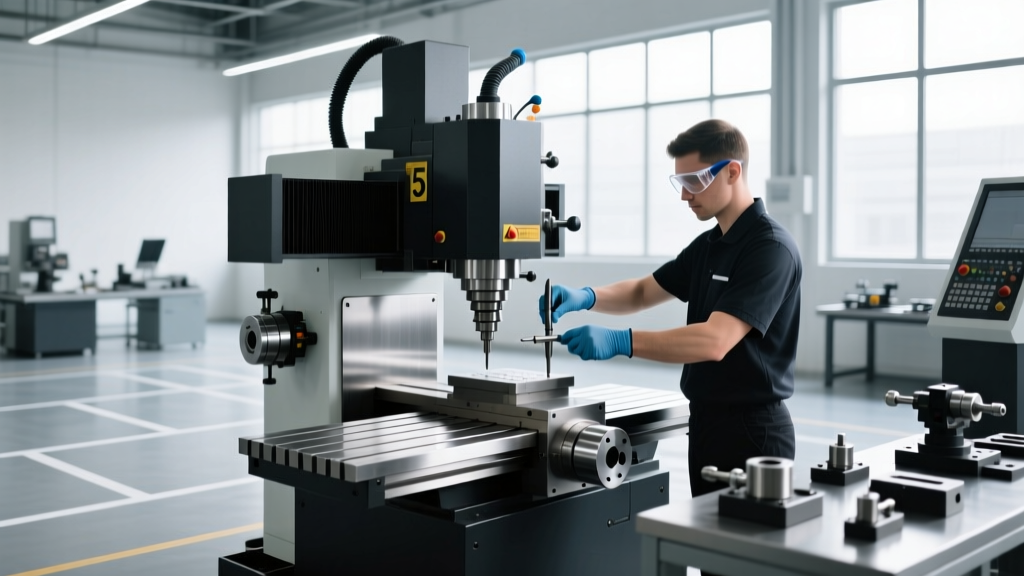
For shops investing in high-speed 3-axis Vertical Machining Centers (VMCs) like the Haas VF-2SS or the DMG MORI CMX 600V, the operational focus shifts toward rapid material removal, tight tolerance holding, and automated probing. While 3-axis machining is foundational, modern high-speed variants require specific technical competencies that must be explicitly stated in the job description.
Hiring Insight: Do not just ask for '3-axis experience.' Specify the spindle speeds and tooling interfaces your new machine utilizes to filter out candidates who have only operated low-speed, manual-feed legacy machines.Critical Job Description Additions for High-Speed VMCs
- Spindle Dynamics: Require demonstrated knowledge of tool balancing (e.g., ISO 1940-1 G2.5 standards) and harmonic chatter mitigation for spindles operating above 12,000 RPM.
- Macro Programming: Mandate proficiency in custom macro B programming for in-cycle Renishaw or Blum tool and part probing routines.
- Workholding & Fixturing: Specify experience with hydraulic or pneumatic tombstone fixturing and the management of multiple G54-G59 coordinate work offsets in high-mix production environments.
According to workforce data from the U.S. Bureau of Labor Statistics, machinists who possess advanced metrology and probing skills command a significant wage premium, reflecting the cost-saving value they bring to high-speed VMC operations.
Mill-Turn and 5-Axis Centers: The Complex Geometry Tier
Procuring a multi-axis mill-turn center, such as the Mazak Integrex i-200S or the Okuma Multus U3000, fundamentally changes the skill matrix required on the floor. These machines perform complete part machining in a single setup, requiring the operator to think simultaneously in turning and milling paradigms. A generic CNC machine operator job description will entirely miss the mark for this equipment class.
Mapping Machine Features to Job Description Phrasing
| Equipment Feature | Required Operator Skill | Exact Job Description Phrasing |
|---|---|---|
| B-Axis Contouring | Simultaneous 4/5-axis toolpath verification | 'Must verify 5-axis CAM toolpaths (Mastercam/GibbsCAM) for B-axis collision avoidance and gouge checking prior to first-run.' |
| Lower Turret Sync | Multi-channel G-code synchronization | 'Experience managing upper and lower turret synchronization codes (e.g., G100/G101 wait codes) to optimize cycle times without tool interference.' |
| Conversational CNC | Controller-specific conversational logic | 'Proficiency in Mazatrol SmoothAi or OSP conversational programming for rapid on-machine geometry modifications.' |
When operating mill-turn centers, the cost of a programming or setup error is catastrophic. The job description must emphasize verification and simulation skills just as heavily as manual setup skills. Candidates must be comfortable utilizing the machine's native 3D simulation environments to dry-run complex mill-turn cycles.
Swiss-Type CNC Lathes: The Micro-Precision Niche
If your equipment selection includes Swiss-type automatic lathes like the Tsugami B0385 or the Citizen Cincom L12, you are entering the realm of micro-machining, medical implants, and aerospace pins. Swiss machines operate on fundamentally different mechanical principles than standard VTLs or VMCs, primarily due to the guide bushing and sliding headstock design.
Crash Risk Alert: A setup error on a Swiss-type machine involving the guide bushing or sub-spindle synchronization can result in $20,000+ in immediate mechanical damage. Your hiring criteria must prioritize meticulous setup verification over raw speed.Swiss-Specific Competencies to Mandate
- Guide Bushing Management: The operator must understand how to properly set guide bushing clearances (typically 0.0002' to 0.0005' depending on bar stock diameter) to prevent material whipping and ensure surface finish integrity.
- Sub-Spindle Phase Shifting: Require hands-on experience with C-axis phase shifting and sub-spindle synchronization for accurate back-working operations and part pick-off.
- Bar Feeder Integration: Specify familiarity with hydrodynamic or hydrostatic bar feeders (e.g., Iemca or LNS), including the management of bar end-cuts, remnant extraction, and oil mist lubrication systems.
Controller-Specific Certification Requirements
The CNC controller is the brain of the equipment. Aligning your CNC machine operator job description with the specific controller brand installed on your new purchase drastically reduces onboarding time. According to training frameworks outlined by the Society of Manufacturing Engineers (SME), targeted certifications validate a candidate's baseline competency before they touch the shop floor.
Controller to Certification Matrix
| Controller Brand / Model | Common Machine Pairings | Recommended Job Description Mandate |
|---|---|---|
| Fanuc 31i-B5 / 0i-TF Plus | Robodrill, Tsugami, Mori Seiki | Fanuc Certified Programmer or equivalent NIMS credential in multi-axis turning. |
| Siemens Sinumerik 840D sl | DMG MORI, 5-Axis Gantry Mills | Siemens ShopMill/ShopTurn certification; deep knowledge of TRAORI (5-axis transformation) cycles. |
| Heidenhain TNC7 | Hermle, Mikron, Grob | Heidenhain conversational programming (Klartext) mastery; state-of-the-art collision monitoring setup. |
Aligning Compensation Tiers with Equipment Complexity
A highly specific CNC machine operator job description must be paired with an accurate compensation strategy. If you demand Mazatrol 5-axis proficiency and sub-spindle synchronization skills, you cannot offer entry-level 3-axis wages. Based on 2026 manufacturing labor market conditions, shops must structure their wage bands to reflect the equipment complexity outlined in the job description.
- Tier 1 (Standard 3-Axis VMC/Lathe): $24.00 - $32.00 / hour. Focus on G-code editing, standard tool offsets, and basic CMM inspection.
- Tier 2 (4-Axis / Mill-Turn Centers): $36.00 - $48.00 / hour. Requires CAM verification, multi-channel synchronization, and advanced workholding design.
- Tier 3 (Swiss-Type / Simultaneous 5-Axis): $42.00 - $58.00+ / hour. Demands micro-tooling expertise, guide bushing calibration, and complex kinematic understanding.
Manufacturing extension partnerships, such as those supported by NIST MEP, frequently advise small-to-medium enterprises that aligning wage bands with specific machine capabilities reduces turnover by ensuring operators are not frustrated by under-compensation for highly technical work.
The Final Checklist for Shop Managers
Before publishing your next hiring requisition, cross-reference your recent capital equipment purchases against this checklist to ensure your CNC machine operator job description is fully optimized:
- Identify the Controller: Did you specify the exact CNC control brand and model (e.g., Fanuc 31i, not just 'Fanuc')?
- Define the Axis Complexity: Does the description explicitly state the requirement for B-axis, Y-axis, or sub-spindle experience?
- Mandate the CAM/Software: Have you listed the specific CAM software (Mastercam, FeatureCAM, Esprit) used to generate the machine's toolpaths?
- Specify the Metrology: Are in-machine probing (Renishaw/Blum) and post-process CMM requirements clearly detailed?
- Match the Wage: Does the posted salary band align with the 2026 market rate for the specific machine tier you are staffing?
Treating your job description as a direct extension of your equipment selection strategy ensures that the moment your new machinery is commissioned, you have the precise human capital required to run it profitably, safely, and to its maximum technical potential.