Upgrading Your CNC Machine Operator Training Program With VR
Discover how VR, digital twins, and AI are transforming the modern CNC machine operator training program to reduce crashes and accelerate onboarding.
The Financial Reality of Modern CNC Onboarding
A single spindle crash on a 5-axis trunnion machine during an operator's first month can cost a machine shop between $18,000 and $45,000 in replacement parts, realignment labor, and lost production time. Historically, the standard cnc machine operator training program relied on the 'buddy system'—pairing a novice with a senior machinist for dry runs with the spindle locked and the rapid override dial turned to zero. In 2026, this legacy approach is financially unsustainable and technologically obsolete.
The skills gap in precision manufacturing demands faster, safer, and more scalable onboarding. Modern training programs are abandoning purely physical trial-and-error in favor of immersive virtual reality (VR), kinematic digital twins, and AI-driven adaptive learning. By shifting the initial 80 hours of machine familiarity into a virtual environment, shops are reducing first-year scrap rates by up to 74% while accelerating the timeline to independent setup.
⚠️ The True Cost of a 5-Axis CrashColliding an HSK63A spindle during a G43.4 (RTCP) move on a machine like the Haas UMC-750 doesn't just break the tooling. It compromises the rotary table bearings and requires factory-level laser calibration. Average downtime: 3 to 6 weeks. Average repair cost: $32,500. Virtual training eliminates this variable entirely.
Core Technologies Redefining the Training Stack
Upgrading your curriculum requires integrating three distinct technological layers that bridge the gap between CAM programming and physical machine operation.
1. Virtual Reality (VR) Spatial G-Code Visualization
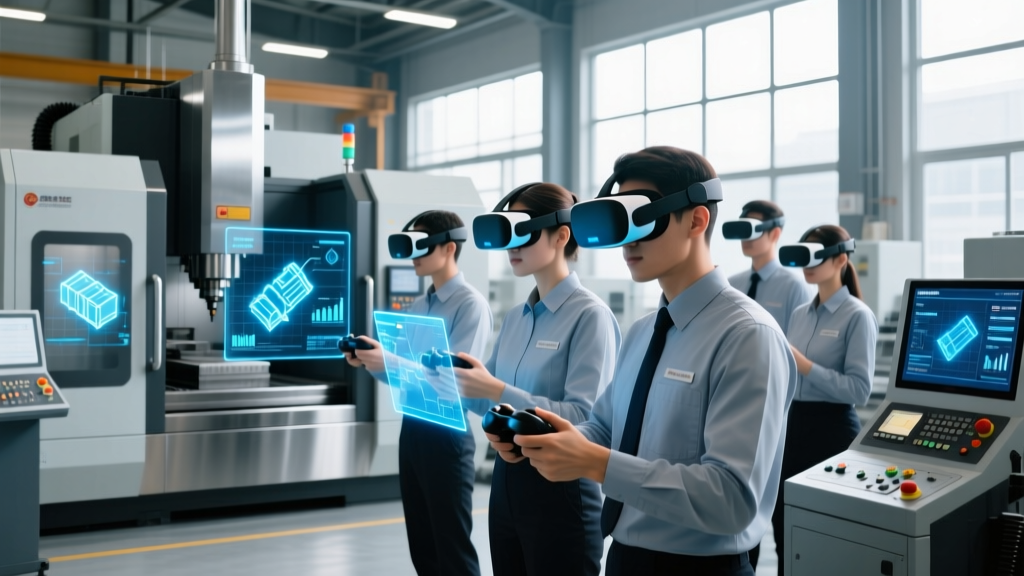
Reading G-code on a 2D monitor fails to convey the spatial realities of 5-axis simultaneous machining. Modern training programs utilize headsets like the Meta Quest 3 or HTC Vive XR Elite paired with custom Unity-built CNC environments. Trainees can walk around a 1:1 scale digital replica of a Mazak Variaxis i-600, physically leaning in to inspect the tool vector during complex contouring moves.
When a trainee inputs a G01 linear interpolation versus a G02/G03 helical arc, the VR environment renders the toolpath envelope in real-time. This spatial awareness is critical for understanding tool holder clearance, particularly when using extended-reach hydraulic chucks or heat-shrink tooling in deep cavity milling. Trainees learn to visualize the invisible 'keep-out' zones around the trunnion table before they ever touch a physical pendant.
2. Digital Twins and Kinematic Simulation
VR provides spatial awareness, but digital twins provide mathematical certainty. Software platforms like CGTech VERICUT and Siemens SINUTRAIN create an exact kinematic replica of the shop's specific machine tools, including the precise travel limits, axis acceleration curves, and controller logic of a Fanuc 31i-B5 or Siemens SINUMERIK ONE system.
In a tech-enabled training program, operators don't just simulate the toolpath; they simulate the entire machine environment. They load virtual workholding, set virtual work offsets (G54-G59), and execute virtual tool changes. If a trainee forgets to retract the Z-axis before commanding a rapid table rotation (B-axis move), the digital twin registers a collision, logging the exact G-code line and timestamp for the instructor to review. This builds muscle memory for the specific Human Machine Interface (HMI) without risking physical hardware.
3. AI-Driven Adaptive HMI Quizzing
The newest frontier in operator training involves AI algorithms that track keystroke latency and eye movement on simulated control panels. If a trainee consistently hesitates for more than 2.5 seconds before pressing the 'Cycle Start' button or frequently misnavigates the Haas NGC offset menu, the AI flags this hesitation. The system then automatically generates targeted micro-drills, forcing the operator to complete 50 rapid-fire offset adjustment scenarios until the hesitation metric drops below the acceptable threshold.
Traditional vs. Tech-Enabled Training: A Cost & Time Matrix
The transition to a tech-heavy curriculum requires upfront capital, but the return on investment materializes within the first two cohorts of trainees. The following matrix compares legacy onboarding against a 2026 tech-enabled cnc machine operator training program.
| Performance Metric | Legacy "Buddy" System | Tech-Enabled VR / Digital Twin |
|---|---|---|
| Time to First Independent Setup | 14 - 18 Weeks | 5 - 7 Weeks |
| Year-One Spindle Crash Rate | 12% - 18% of Trainees | < 2% of Trainees |
| Material Waste (Scrap) per Trainee | $2,400 / year | $350 / year |
| Machine Uptime Lost to Training | 110 Hours / Trainee | 15 Hours / Trainee |
| Upfront Tech Investment per Seat | $0 | $3,500 - $6,200 |
Step-by-Step Integration Guide for Machine Shops
Implementing these technologies requires a phased approach to ensure alignment with recognized industry credentialing standards, such as those outlined by the National Institute for Metalworking Skills (NIMS).
- Audit Your Current Machine Kinematics: Before purchasing simulation software, catalog the exact controller models, axis travel limits, and rotary table configurations of your shop floor. A digital twin of a DMG MORI DMU 50 is useless if your shop operates Okuma MU-4000V machines. Procure machine-specific simulation licenses.
- Establish the 'Virtual Gate' Policy: Mandate that no trainee is permitted to load physical stock into a machine until they have successfully completed 20 consecutive crash-free setups in the digital twin environment. This gatekeeping removes emotion from the evaluation process.
- Map VR Modules to NIMS Credentials: Align your VR spatial awareness drills with specific NIMS CNC Milling Operations credentials. For example, use VR to test the trainee's ability to identify the correct probing cycles for establishing a part center, directly supporting the NIMS 'CNC Milling: Job Setup' standard.
- Deploy AI HMI Simulators for Shift Handoffs: Utilize AI-driven control panel simulators to train operators on safe startup and shutdown procedures, focusing on alarm clearing and macro-variable resetting, which are common failure points during shift changes.
"The shops that are winning the talent war in 2026 aren't just offering higher hourly wages; they are offering a safer, more technologically advanced training environment. When a new hire puts on a VR headset and walks through a digital twin of the exact machine they will be running, their confidence and retention rates skyrocket."
— Workforce Development Director, Precision Machined Products Association (PMPA)
Hardware and Software Stack Requirements
To run a high-fidelity tech-enabled training program, your IT infrastructure must support real-time rendering and complex kinematic calculations. Below is the recommended baseline stack for a 5-seat training cell.
- VR Headsets: Meta Quest 3 (128GB) or HTC Vive XR Elite. Cost: ~$499 - $1,099 per unit. Ensure they are configured in 'Virtual Desktop' mode to stream directly from the workstation.
- Simulation Workstations: Custom builds featuring NVIDIA RTX 4080 (or higher) GPUs, minimum 64GB DDR5 RAM, and 2TB NVMe SSDs. Digital twin software like VERICUT is highly CPU-thread dependent for toolpath verification. Cost: ~$2,800 per workstation.
- Core Simulation Software: CGTech VERICUT or Mastercam with Machine Simulation add-ons. Ensure your post-processor developer provides the exact kinematic model file (.stl and configuration parameters) for your specific machines. Cost: $8,000 - $15,000 base license, plus annual maintenance.
- Controller Emulation: Siemens SINUTRAIN or Fanuc CNC GuidePro. These provide the exact software environment of the physical HMI, allowing operators to practice typing MDI commands and navigating macro variables. Cost: $500 - $1,200 per seat license.
Sourcing Authoritative Curriculum Standards
Technology is merely the delivery mechanism; the curriculum must be rooted in verified industrial standards. When building your virtual training modules, cross-reference every task with the Manufacturing Institute's Skills Certification framework and NIMS duty rosters. Ensure your VR scenarios require the trainee to not only avoid crashes but to actively select the correct cutting speeds and feeds for specific materials, such as 304 stainless steel versus 6061-T6 aluminum, utilizing the Taylor Tool Life equation within the simulation. By marrying immersive hardware with rigorous, standardized metallurgical and geometric principles, your facility will produce operators who are not just safe, but fundamentally elite.