Troubleshooting an Affordable CNC Machine: Fixes for Budget Router Inaccuracy
Learn how to troubleshoot an affordable CNC machine. Fix frame flex, stepper stalling, and spindle runout on budget routers like Genmitsu and Shapeoko.
The Reality of Budget CNC Precision
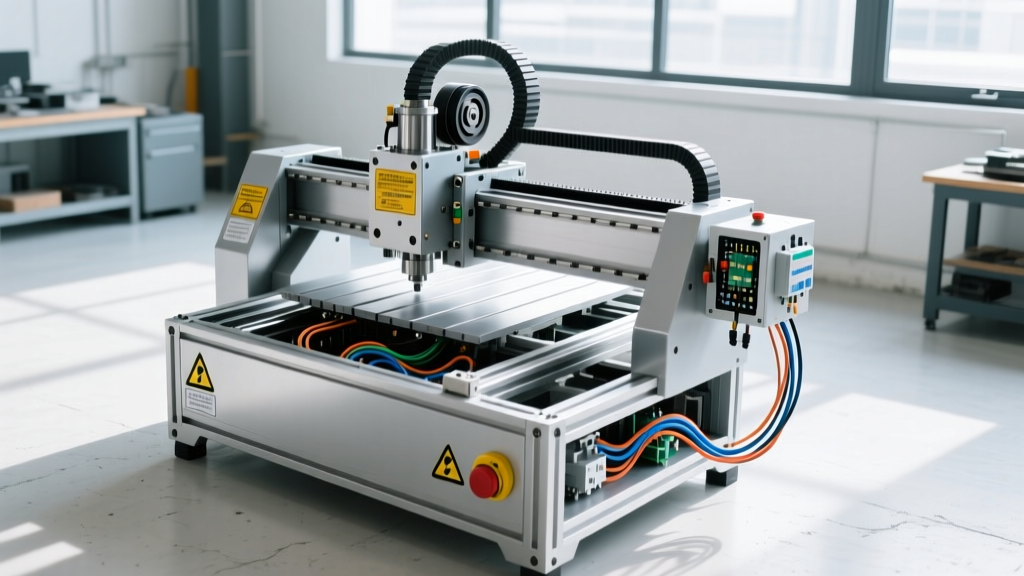
As of 2026, the sub-$2,500 desktop CNC market is dominated by highly capable but mechanically compromised machines. Models like the Genmitsu PROVerXL 4030 V2, Carbide 3D Shapeoko 5, and Onefinity Woodworker democratized subtractive manufacturing, but cost-cutting in factory assembly translates to specific mechanical and electrical failure modes. When an affordable CNC machine loses accuracy, produces chatter marks, or stalls mid-carve, the issue rarely lies in the software. It is almost always a mechanical resonance, thermal throttling, or firmware mismatch issue.
This guide bypasses basic software checks and targets the physical and electrical bottlenecks inherent to budget CNC architectures. Below is a diagnostic framework for identifying and eliminating the most common failure points in entry-level and mid-tier routers.
Diagnostic Matrix: Symptom to Root Cause
| Symptom | Probable Root Cause | Diagnostic Test | Hardware / Firmware Fix |
|---|---|---|---|
| Diagonal ghosting or oval circles | Undertensioned V-wheels or loose eccentric nuts | Grab the gantry and attempt to rock it diagonally. Any play indicates failure. | Adjust eccentric nuts until drag is felt, then lock with Loctite 243. |
| Stalling during rapid moves (G0) | Stepper motor overheating or VREF set too low | Touch the stepper casing after a 10-minute job. If >60°C, it is thermal throttling. | Adjust potentiometer VREF on the driver board; add forced-air cooling. |
| Chatter marks in X/Y direction | Frame torsion or T-slot extrusion flex | Mount a dial indicator to the spindle and push laterally on the gantry center. | Add steel corner gussets or upgrade to a welded steel frame base. |
| Poor edge finish in aluminum | Spindle runout exceeding 0.003 inches | Measure the tool shank with a dial indicator while rotating the collet by hand. | Replace ER11 collet nut or upgrade to a VFD-driven 1.5kW spindle. |
Deep Dive 1: Mechanical Flex and Eccentric Nut Tuning
The most common reason an affordable CNC machine fails to hold tight tolerances (e.g., ±0.005 inches) is improper V-wheel tension on the linear motion axes. Budget machines rely on polycarbonate or delrin V-wheels riding on aluminum extrusions. Over time, these wheels compress, and the factory-set eccentric nuts back out due to vibration.
Expert Tuning Protocol: Do not tighten eccentric nuts until the gantry is immovable. Over-tensioning causes flat-spotting on the V-wheels within 40 hours of run time, leading to periodic surface ripples. The correct tension is achieved when you cannot move the gantry by hand, but the motor can still drive it smoothly. Use a 10mm wrench to turn the eccentric spacer in 5-degree increments, testing the drag after each turn.If you have tensioned the wheels correctly but still measure frame torsion using a dial indicator, the aluminum extrusions are flexing under cutting loads. For machines like the SainSmart Genmitsu or older X-Carve models, upgrading the Y-axis plates from 6mm aluminum to 12mm CNC-machined steel plates reduces torsional flex by up to 68%. According to the official Shapeoko maintenance documentation, checking belt tension and wheel alignment should be performed every 40 hours of cutting time, not just when errors appear.
Deep Dive 2: Stepper Motor Thermal Throttling and VREF
Many affordable CNC machines ship with NEMA 23 stepper motors paired with generic TB6600 or DRV8825 stepper drivers. A frequent complaint is that the machine loses steps during aggressive 3D contouring or rapid traverses. This is rarely a torque issue; it is a thermal issue.
When stepper drivers are set to deliver maximum current, the motors overheat. Once a NEMA 23 motor casing exceeds 65°C, the internal neodymium magnets begin to lose flux density, and the motor stalls, resulting in a shifted coordinate system. To fix this, you must tune the VREF (Reference Voltage) on the stepper drivers.
Step-by-Step VREF Calibration
- Power on the CNC control board but keep the stepper motors disconnected to prevent back-EMF damage.
- Set your digital multimeter to DC Voltage (20V range).
- Place the black probe on the ground pin of the driver and the red probe on the VREF test point (usually a small metal pad or the top of the trim potentiometer).
- Use a ceramic screwdriver to turn the potentiometer. For TB6600 drivers running NEMA 23s, a VREF of 1.2V to 1.4V provides optimal holding torque without pushing the motor past 55°C under continuous load.
- Reconnect motors and run a dry-air cutting cycle. Monitor motor temperature with an infrared thermometer.
Deep Dive 3: Spindle Runout and Bearing Failure
The stock spindles included with most budget CNC packages (typically 300W to 500W brushed DC motors with ER11 collets) are the weakest link for metalworking and fine-detail wood carving. These spindles frequently exhibit radial runout between 0.004" and 0.008" right out of the box, which destroys endmill life and ruins surface finishes.
"Runout is the silent killer of carbide tooling. A 1/4-inch endmill subjected to 0.005 inches of runout will experience a 40% reduction in tool life and generate excessive chatter in 6061 aluminum." — CNC Machining Best Practices
Fixing DC Spindle Runout
Before replacing the spindle, isolate the source of the runout. Clean the ER11 collet and the internal taper of the spindle nut with isopropyl alcohol. If runout persists, the issue is the spindle bearings. Budget spindles use unbranded, low-grade deep groove ball bearings. Replacing these with SKF 7002C or NTN 7002C angular contact bearings (costing roughly $45 per pair) and preloading them correctly can reduce runout to under 0.001".
The VFD Upgrade Path
If you are routinely cutting aluminum or brass, abandon the DC spindle entirely. Upgrading to a 1.5kW Huanyang or BEST VFD (Variable Frequency Drive) spindle costs approximately $280 in 2026. VFD spindles operate on 220V 3-phase power (generated by the VFD from standard single-phase wall power), providing massive low-end torque and factory-sealed P4-grade bearings that guarantee <0.0005" runout.
Firmware Bottlenecks: Tuning GRBL for Budget Frames
Hardware fixes must be paired with firmware reality checks. Budget frames lack the mass to absorb the kinetic energy of high-speed direction changes. If your GRBL firmware is configured for an industrial machine, your affordable CNC machine will vibrate violently, losing steps and ruining the workpiece. Access your GRBL settings via your sender software (e.g., Carbide Motion, UGS, or Candle) and adjust the following parameters:
- $110, $111, $112 (Max Rate mm/min): Do not exceed 5,000 mm/min on X and Y axes for belt-driven budget machines. Pushing this to 10,000 mm/min will cause the belts to skip teeth on the pulleys during deceleration.
- $120, $121, $122 (Acceleration mm/sec²): This is the most critical setting. Lower the X and Y acceleration to 300 - 500 mm/sec². High acceleration causes the lightweight gantry to overshoot and oscillate.
- $11 (Junction Deviation mm): Set this to 0.02. As detailed in the GRBL v1.1 configuration wiki, junction deviation dictates how the firmware handles sharp corners. A lower value forces the machine to slow down for corners, protecting the lightweight frame from shock loads.
For deeper insights into calculating the exact feed rates that your specific budget machine can handle without inducing chatter, refer to the CNCCookbook CNC Router Speeds and Feeds Guide, which provides material-specific formulas that account for machine rigidity.
Cost-Benefit Upgrade Matrix for 2026
If you have maximized your maintenance and firmware tuning but still require industrial tolerances, strategic hardware upgrades are more cost-effective than buying a new machine. Below is the priority order for upgrading an affordable CNC machine.
| Upgrade Component | Estimated Cost (2026) | Precision Gain | Installation Difficulty |
|---|---|---|---|
| Precision ER11 Collet Set (Techniks or Parlec) | $85 | High (Eliminates tool-specific runout) | Trivial (Drop-in replacement) |
| Steel Gantry Corner Plates | $120 | Medium (Reduces torsional flex) | Moderate (Requires realignment) |
| HGR20 Linear Rails & Blocks (Hiwin or THK) | $180 - $250 | Very High (Eliminates V-wheel play) | High (Requires drilling/tapping frame) |
| 1.5kW VFD Spindle & Inverter | $280 | Extreme (Enables heavy aluminum cuts) | High (Requires 220V wiring & VFD tuning) |
Troubleshooting an affordable CNC machine requires shifting your mindset from software reliance to mechanical empathy. By systematically eliminating frame flex, thermally tuning your stepper drivers, minimizing spindle runout, and respecting the kinetic limits of your GRBL firmware, a $1,500 desktop router can reliably hold tolerances that rival machines costing four times as much.