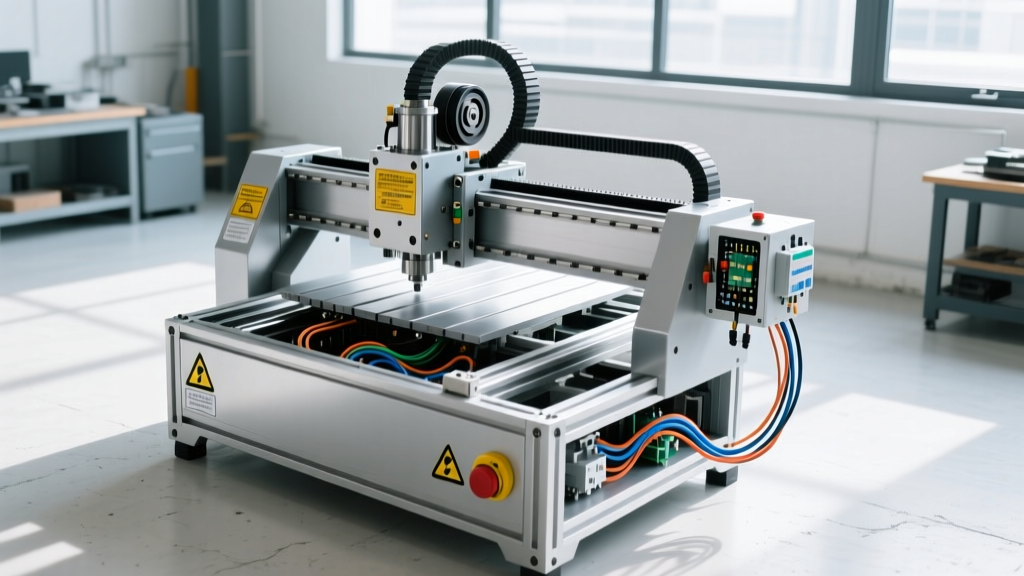
DIY CNC Machine Safety Standards: A Compliance Guide for Builders
Building a DIY CNC machine? Discover essential safety standards, electrical compliance, and mechanical guarding to protect your garage shop from hazards.
A 24,000 RPM spindle ejecting a broken 1/4-inch carbide end mill generates enough kinetic energy to penetrate standard acrylic shielding and cause severe injury. Yet, when hobbyists and small-shop fabricators build a DIY CNC machine, safety is often an afterthought, overshadowed by debates over stepper motor torque and ballscrew lead accuracy. While commercial machines must adhere to strict CE Machinery Directive or OSHA guidelines, home-built routers and mills operate in a regulatory gray area. This does not mean the physics of a crash or the risks of an electrical fault are any less lethal. To protect yourself, your property, and your liability, integrating industrial safety standards into your DIY CNC build is non-negotiable.
The Regulatory Gray Area: Do DIY Builds Need CE or UL Marks?
Legally, if you are building a machine strictly for personal use in your private garage, you are not required to obtain a CE mark or UL certification. These certifications are mandated for equipment placed on the commercial market or used in regulated industrial workplaces. However, the moment you produce parts for sale, invite paying students to use the machine, or file an insurance claim after a garage fire caused by your CNC router, the lack of adherence to recognized safety standards becomes a massive liability.
WARNING: The Insurance TrapMost homeowner insurance policies contain clauses voiding coverage for damages resulting from 'unpermitted or non-compliant commercial-grade equipment' operated in a residential zone. If your DIY CNC plasma table causes an electrical fire and the investigator finds unshielded 220V wiring and bypassed safety interlocks, your claim will likely be denied. Adhering to OSHA Machine Guarding Guidelines and NFPA electrical codes provides a documented defense of due diligence.
Mechanical Guarding: Adapting ISO 23125 for Home Routers
ISO 23125 outlines safety requirements for turning and milling machines, specifically regarding the containment of ejected workpieces, broken tools, and high-pressure coolant. The most common failure in DIY CNC builds is the use of standard cast acrylic (PMMA) for enclosures. Acrylic is brittle; upon high-impact from a shattered end mill or a workpiece thrown from a poorly secured vise, it shatters into razor-sharp shards.
The correct material is Polycarbonate (PC), specifically grades like Lexan Margard, which features a hard-coat that resists scratching from abrasive dust and coolant exposure. For a DIY CNC router cutting aluminum or steel, the enclosure must withstand significant impact energy.
| Shielding Material | Impact Resistance | Failure Mode | Estimated Cost (24x48 Sheet) |
|---|---|---|---|
| Cast Acrylic (PMMA) 1/4" | Low (15x glass) | Catastrophic shattering | $45 - $60 |
| Standard Polycarbonate 1/4" | High (250x glass) | Dents, deep scratching | $90 - $110 |
| Lexan Margard (PC) 6mm | Very High (250x glass) | Dents, maintains visibility | $145 - $180 |
Furthermore, guard interlocking is critical. If the machine can continue to run with the enclosure door open, the guard is merely a suggestion. Utilize industrial limit switches, such as the Omron D4N series, wired in series with your hardware E-Stop loop to cut spindle power instantly when the enclosure is breached.
Electrical Compliance: NFPA 70 (NEC) and Safe Torque Off (STO)
The most dangerous flaw in 90% of DIY CNC machines is the reliance on software-based Emergency Stops. Wiring a red push-button to a GPIO pin on an Arduino or Ethernet SmoothStepper, and relying on Mach4 or LinuxCNC to halt the machine, is a critical safety violation. If the PC experiences a buffer overrun, USB latency spike, or OS crash, the software E-stop becomes completely unresponsive while the spindle continues to cut or the gantry slams into the hard limit.
True compliance requires a hardware-based safety relay circuit that operates entirely independent of the PC. Modern Variable Frequency Drives (VFDs) and servo drives feature Safe Torque Off (STO) terminals. When the STO circuit is broken, the drive physically removes power from the IGBTs, making it impossible for the motor to generate torque, regardless of software commands.
Step-by-Step: Wiring a Compliant Hardware E-Stop Loop
- Install a Safety Relay: Use a dedicated safety relay like the Siemens Sirius 3SK1121-1AB30. This monitors the E-stop button for short circuits and wire breaks.
- Wire the E-Stop Button: Use a category 0 or category 1 E-stop button with dual NC (Normally Closed) contacts. Wire both channels to the safety relay inputs.
- Integrate Door Interlocks: Wire your Omron enclosure door switches in series with the E-stop button on Channel 1.
- Connect to VFD STO: Route the safety relay's output contacts directly to the STO (or Enable) terminals on your VFD and stepper motor drivers.
- Control Circuit Interruption: Wire a secondary set of safety relay contacts to a main contactor that drops power to the spindle contactor and 24V control power supply, ensuring a total system halt.
Dust Collection and NFPA 652 Explosion Risks
Hobbyists frequently route MDF, phenolic plastics, and aluminum. These materials generate fine particulate dust that is highly combustible. According to the NFPA 652 Standard on Combustible Dust, when fine dust is suspended in air within an enclosed space (like a dust collector bin or PVC piping), a single static spark can trigger a deflagration or explosion.
Data Point: The Static ThreatStandard PVC dust collection pipes can generate up to 15,000 volts of static electricity as high-velocity dust particles scrape against the inner wall. This is more than enough to arc and ignite an MDF dust cloud. OSHA Combustible Dust Hazards guidelines explicitly warn against ungrounded plastic conveyance systems.
To mitigate this, DIY builders must abandon standard PVC plumbing. You must use either grounded galvanized steel ducting (with all joints secured via copper grounding wire) or specialized anti-static Polyurethane (PU) flex hose. Anti-static PU hose contains a rigid copper wire helix that must be stripped at both ends and bonded to the machine chassis and the dust collector ground. Additionally, ensure your dust collector is rated for the correct CFM (Cubic Feet per Minute). A standard 4-inch port requires a minimum of 400-500 CFM to maintain the 4,000 FPM (Feet Per Minute) duct velocity required to keep heavy aluminum chips from settling and clogging the line.
DIY CNC Safety Compliance Cost Breakdown
Upgrading a standard OpenBuilds LEAD 1010 or PrintNC style machine from 'hobby-grade' to 'industrial-lite' safety compliance requires an upfront investment, but it prevents catastrophic financial and physical losses. Below is a realistic 2026 pricing breakdown for essential safety retrofits.
| Safety Component | Specification / Model | Approx. Cost (USD) |
|---|---|---|
| Hardware Safety Relay | Siemens Sirius 3SK1 (Dual Channel) | $165.00 |
| E-Stop Station | Schneider Electric Harmony XALK (2 NC) | $55.00 |
| Enclosure Shielding | Lexan Margard 6mm (1/4") - 3 Panels | $435.00 |
| Door Interlocks | Omron D4N Limit Switches (x2) | $48.00 |
| Anti-Static Dust Hose | 50ft PU Flex Hose w/ Copper Helix | $210.00 |
| Total Estimated Safety Retrofit Cost | $913.00 | |
Frequently Asked Questions (FAQ)
Do I need an interlock on my DIY CNC laser enclosure?
Yes, absolutely. For Class 4 lasers (anything over 500mW, including standard 40W CO2 and diode modules), an enclosure interlock wired to cut the laser tube power supply or diode PWM signal is mandatory to prevent permanent retinal damage from reflected beams. Use switches with positive-opening NC contacts to prevent defeat by tape or magnets.
Can I use a standard household 120V GFCI outlet as my main safety shutoff?
No. A GFCI protects against ground faults and electrical shock, but it does not protect against mechanical hazards, spindle crashes, or runaway stepper motors. A GFCI should be used for shock protection, but it must be paired with a dedicated E-Stop safety relay loop for mechanical and operational safety.
How do I safely ground my VFD to prevent bearing fluting?
VFDs output high-frequency PWM waves that can capacitively couple onto the spindle shaft, discharging through the bearings and causing 'fluting' (micro-pitting). You must use a shielded VFD cable where the braided copper shield is clamped to the VFD chassis ground and the spindle housing using 360-degree EMC cable glands, not just a pigtail wire.