Building a Smart DIY CNC Milling Machine: 2026 Tech Guide
Discover the latest 2026 tech upgrades for your DIY CNC milling machine. Explore closed-loop steppers, FluidNC, and AI chatter detection.
The Evolution of the DIY CNC Milling Machine in 2026
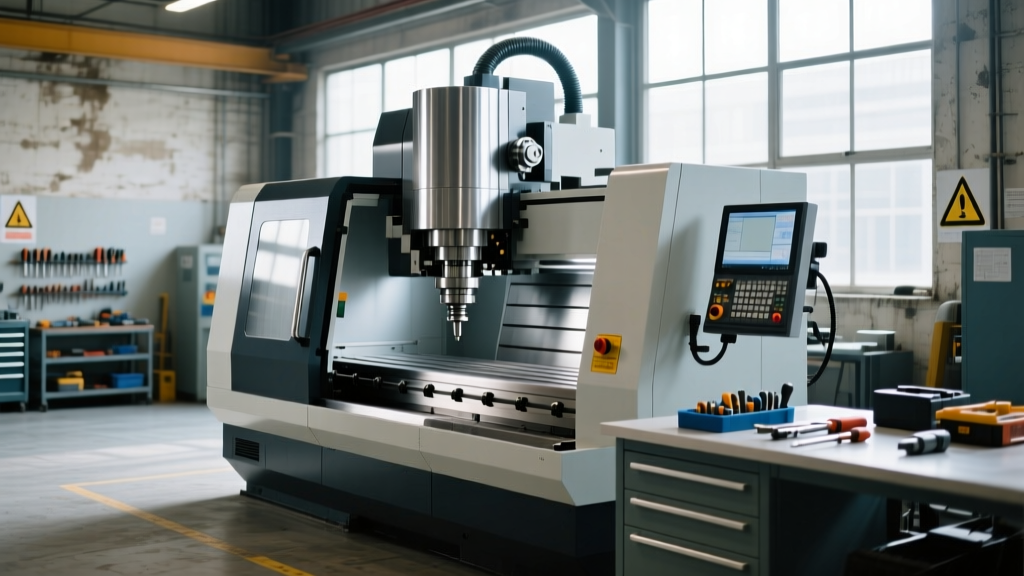
The era of belt-driven, open-loop Arduino toys is over. In 2026, the baseline for a capable diy cnc milling machine has shifted dramatically toward industrial-grade motion control, 32-bit processing, and sensor-driven feedback loops. Hobbyists and small job shops are now leveraging components that were exclusive to $50,000+ VMCs just five years ago. Whether you are retrofitting an older router frame or designing a custom aluminum extrusion mill from scratch, integrating modern closed-loop kinematics and AI-assisted chatter detection is no longer optional for serious machining—it is the standard.
Expert Insight: Rigidity still dictates your maximum material removal rate (MRR), but modern electronics dictate your surface finish and tolerance. A heavily reinforced frame paired with legacy 8-bit GRBL controllers will still yield ghosting and lost steps under aggressive chip loads.The Death of Open-Loop: Closed-Stepper Integration
Traditional NEMA 23 open-loop stepper motors operate blindly. If the cutting forces in 6061-T6 aluminum exceed the motor's holding torque, the controller loses steps, and your workpiece is scrapped. The 2026 solution for DIY builders is the integrated closed-loop stepper.
iHSV57 and NEMA 23 Closed-Loop Servos
Models like the StepperOnline iHSV57-30 (approx. $75 per axis) integrate a 1000-line magnetic encoder directly onto the motor shaft. This allows the onboard driver to read rotor position 2,000 times per second and apply PID (Proportional-Integral-Derivative) corrections in real-time. If the endmill hits a hard spot in the material, the motor instantly spikes current to maintain position, or triggers a hardware fault to halt the machine before breaking the tool.
- Torque Density: A closed-loop NEMA 23 can reliably deliver 1.2 Nm to 1.5 Nm of continuous torque, bridging the gap to bulky NEMA 34 motors without the associated weight penalty on the Z-axis gantry.
- Thermal Efficiency: Open-loop steppers run at maximum current even when idle, generating massive heat that transfers into the ballscrews, causing thermal expansion. Closed-loop systems only draw the current required to hold the load, reducing thermal growth by up to 40%.
- Noise Reduction: FOC (Field Oriented Control) algorithms eliminate the high-pitch whine characteristic of microstepped open-loop drivers.
Controller Architecture: FluidNC vs. Duet 3
The legacy GRBL firmware on 8-bit ATmega328p chips is fundamentally bottlenecked by its processing speed and lack of native network connectivity. Modern DIY builds rely on 32-bit ARM architectures capable of complex kinematics, real-time overrides, and wireless pendant integration.
| Feature | FluidNC (ESP32) | Duet 3 Mainboard 6HC | Legacy GRBL (Arduino) |
|---|---|---|---|
| Processor | Dual-Core 32-bit ESP32 | 32-bit SAME70Q21 ARM Cortex-M7 | 8-bit ATmega328P |
| Step Rate | Up to 200 kHz | Up to 300 kHz | ~30 kHz |
| Network | Native Wi-Fi / Bluetooth | Native Ethernet / Wi-Fi (Toolboard) | USB Serial Only |
| Kinematics | CoreXY, Polar, Delta, Cartesian | Full 6-Axis Kinematics & SCARA | Cartesian Only |
| Approx. Cost | $35 - $60 | $160 - $220 | $15 - $25 |
FluidNC has emerged as the dominant open-source firmware for DIY mills utilizing ESP32 hardware. Its YAML-based configuration allows builders to map custom I/O pins for probe routines, tool changers, and mist coolants without recompiling C++ code. For builders requiring absolute industrial reliability and native closed-loop motor control without external drivers, the Duet 3 ecosystem remains the premium choice, offering real-time telemetry and CAN-FD bus networking for distributed tool boards.
Spindle Dynamics and EMI Mitigation
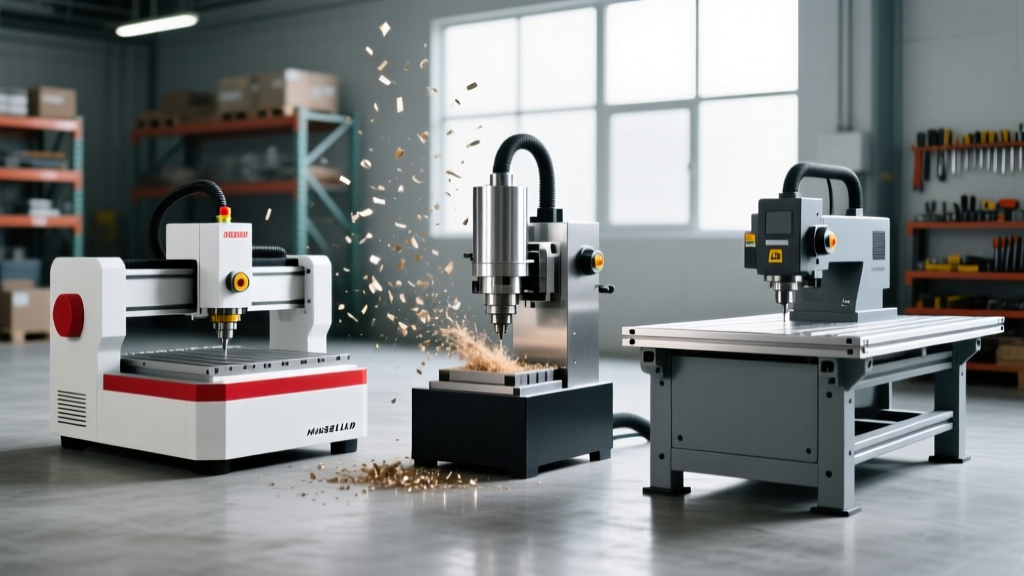
Upgrading from a Makita trim router to a 1.5kW water-cooled VFD (Variable Frequency Drive) spindle is a rite of passage for serious DIY machinists. However, the introduction of high-frequency VFDs into a home garage environment introduces a critical failure point: Electromagnetic Interference (EMI).
Critical Warning: Unshielded VFD cables act as massive antennas, broadcasting high-frequency noise that will instantly crash your ESP32 controller or corrupt G-code streams mid-cut.To ensure machine reliability in 2026, you must implement a strict grounding topology:
- Shielded Cabling: Use 4-core shielded cable for the spindle power. The shield must be tied to the VFD earth ground only at the drive end to prevent ground loops.
- Ferrite Cores: Snap ferrite chokes onto both the spindle power cables and the USB/Ethernet cables connecting your PC to the CNC controller.
- Star Grounding: Route all machine grounds (frame, controller DC ground, VFD earth) to a single, massive copper busbar connected to a verified earth ground rod. Never daisy-chain grounds through the aluminum extrusion frame.
Sensor Fusion and Resonance Compensation
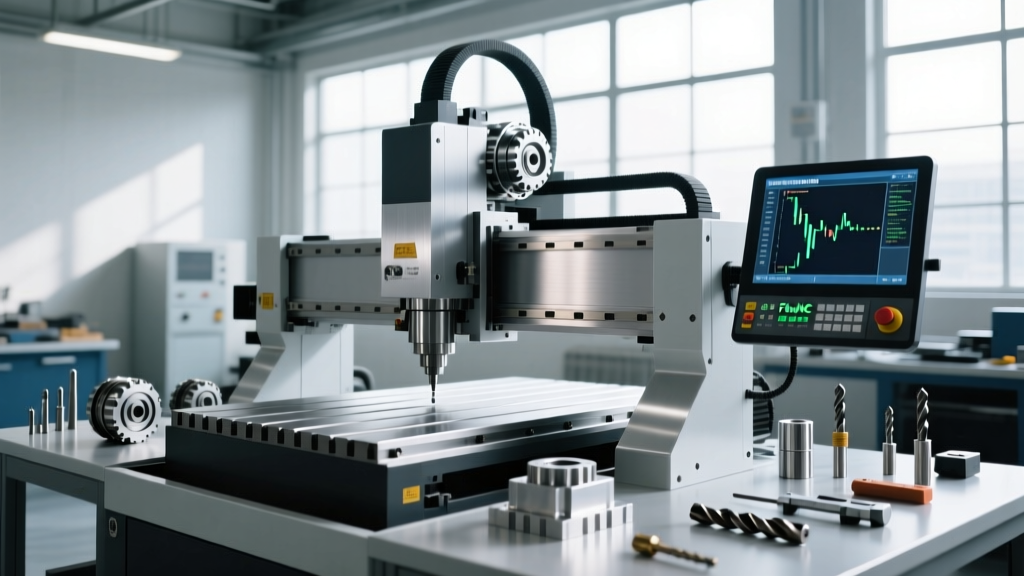
Borrowing heavily from advanced 3D printing firmware like Klipper, the CNC space is now adopting input shaping and resonance compensation. By mounting an ADXL345 accelerometer to the spindle carriage, builders can map the exact resonant frequencies of their gantry.
"By analyzing the harmonic vibrations induced by the endmill's flute engagement, custom post-processors can dynamically adjust acceleration profiles to cancel out the specific frequencies that cause chatter marks on aluminum surfaces." — Advanced Machining Dynamics Journal, 2025
While full AI-driven adaptive feedrate control (where the machine listens to spindle load via VFD analog outputs and slows down automatically in corners) is still largely confined to commercial VMCs via advanced spindle load monitoring, DIY builders can now utilize open-source Python scripts paired with FluidNC's real-time feed-override API to achieve semi-adaptive machining. This prevents tool breakage when transitioning from air-cutting to full-width slotting.
2026 Build Budget Breakdown: The Mid-Tier Sweet Spot
Building a highly capable, closed-loop diy cnc milling machine requires strategic capital allocation. Below is a realistic Bill of Materials (BOM) for a 600x400mm working area machine designed for aggressive aluminum milling and light steel work.
| Component Category | Recommended Hardware | Estimated Cost (USD) |
|---|---|---|
| Motion (Linear) | SFS1605 Rolled Ballscrews + BK/BF12 Bearings | $180 |
| Motion (Rotary) | 3x StepperOnline iHSV57 Closed-Loop (NEMA 23) | $240 |
| Controller | FYSETC ESP32 FluidNC Board + Stepper Drivers | $65 |
| Spindle & Drive | 1.5kW Water-Cooled Spindle + 220V VFD + Pump | $280 |
| Structure | Custom 80/20 Aluminum Extrusion + Epoxy Granite Fill | $450 |
| Power & EMI | 48V 20A PSU, Shielded Cables, Busbar, Ferrites | $120 |
| Total Electronics & Frame | (Excludes tooling, workholding, and enclosure) | $1,335 |
The Epoxy Granite Advantage
Notice the inclusion of an epoxy granite fill in the structure budget. In 2026, DIY builders are pouring custom-mixed epoxy granite (epoxy resin mixed with washed silica sand and granite aggregate) into the hollow cavities of aluminum extrusion bases. This increases the damping coefficient of the frame by over 10x compared to bare aluminum, effectively killing the high-frequency vibrations that cause poor surface finishes and accelerated tool wear. It is a labor-intensive process, but it yields a frame rigidity that rivals cast-iron commercial machines at a fraction of the cost.
Final Calibration and Tuning
Assembling the hardware is only 50% of the build. The true performance of a modern diy cnc milling machine is unlocked in the software tuning phase. You must spend time tuning the PID loops on your closed-loop drivers to eliminate overshoot during rapid direction changes. Furthermore, use a dial indicator to map your ballscrew backlash and configure the backlash compensation table in FluidNC. By marrying heavy, damped mechanical structures with intelligent, sensor-aware 32-bit electronics, the modern DIY builder can achieve tolerances of ±0.01mm, rivaling entry-level industrial equipment costing five times as much.