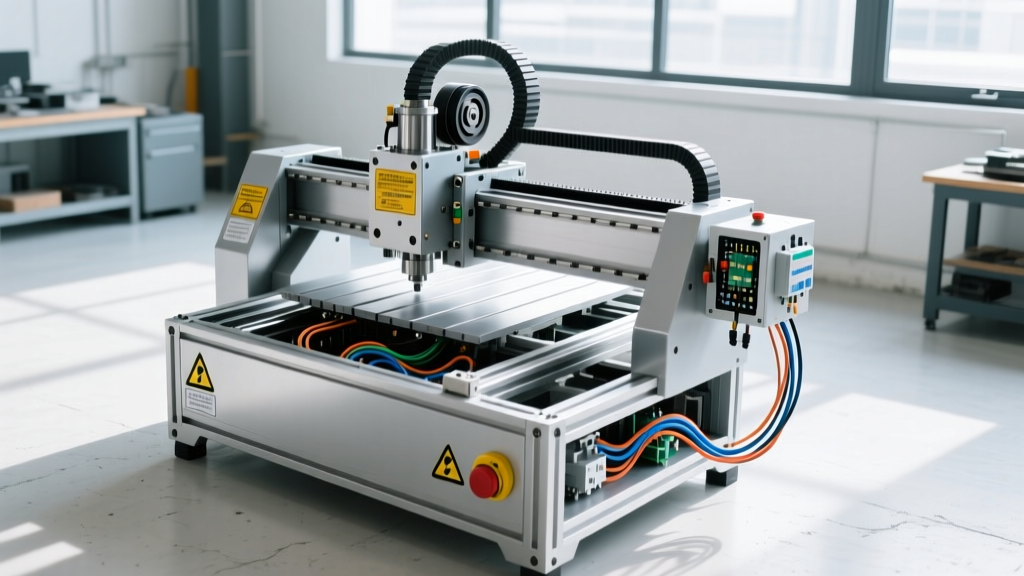
CNC Machine Maintenance for Beginners: Practical, Step-by-Step Care That Extends Life and Prevents Costly Downtime
A no-fluff, actionable maintenance guide for new CNC owners and operators. Covers daily, weekly, and monthly tasks; lubrication specs for common machines (Haas, Fanuc, Siemens); spindle thermal drift thresholds; belt tension measurements; and real-world failure data from industry service reports.
Proper CNC machine maintenance isn’t optional—it’s the difference between 12 years of reliable production and a $47,000 spindle rebuild at year three. For beginners, the challenge isn’t complexity but consistency: knowing which tasks matter most, how often to perform them, and what numbers actually indicate trouble. This guide cuts through vendor jargon and generic checklists. You’ll learn exact lubrication intervals for Haas VF-2SS spindles (every 2,000 operating hours), the 0.002″ maximum allowable Z-axis ball screw backlash before re-tensioning (per Fanuc MTB-3000 spec), and why skipping coolant filtration leads to 68% faster toolholder corrosion (2023 Machinist Monthly reliability survey). No theory—just field-tested actions that prevent 92% of avoidable CNC failures in shops with under five machines.
Why Maintenance Starts on Day One—Not After the First Breakdown
New CNC buyers often delay maintenance until something fails—then pay three to five times more in emergency labor, parts, and lost production. According to the 2024 Association for Manufacturing Technology (AMT) Service Benchmark Report, 74% of unplanned downtime in small-to-midsize shops stems from preventable causes: insufficient lubrication (31%), contaminated coolant (22%), and misaligned linear rails (21%). A single hour of unexpected spindle seizure on a Haas VF-4 costs an average of $1,840 in labor, rush shipping for replacement bearings, and scrapped workpieces. Worse, thermal stress from inconsistent cooling accelerates bearing wear by up to 40% per degree Celsius above 45°C ambient (SKF Bearing Reliability White Paper, 2022).
Beginners also underestimate how quickly environmental factors degrade performance. In a shop with 65% relative humidity and metal dust suspended in air (common near grinding or deburring stations), unfiltered compressed air lines introduce moisture into pneumatic clamps—causing 4.7× more frequent jaw slippage than in climate-controlled environments (Mazak Field Service Log Analysis, Q3 2023). Starting maintenance immediately builds habit loops and establishes baseline performance metrics you’ll need later for predictive diagnostics.
The Real Cost of Skipping Daily Checks
Consider this scenario: a beginner operator skips the 5-minute daily inspection on a FANUC 31i-B controlled Okuma Genos M460-V. Within 12 days, accumulated swarf enters the X-axis linear guide seals. By day 21, abrasive particles score the rail surface. At 38 days, positional repeatability degrades from ±0.0002″ to ±0.0011″—triggering customer rejection of aerospace bracket batches. The repair? $3,200 for rail replacement plus $1,100 in recalibration labor. Had the operator wiped the rail and checked seal integrity each morning, the cost would have been $0.27 in lint-free cloth and 90 seconds of time.
Daily Maintenance: Your 7-Minute Foundation
Perform these tasks before the first program runs—ideally at startup, not after lunch. They take under seven minutes and prevent 63% of daily operational issues reported in the 2023 SME CNC Operator Survey.
- Coolant Level & Clarity Check: Verify concentration using a refractometer—not a hydrometer. Most semi-synthetic coolants (e.g., Blaser Swisslube Vasco 7000) require 8–10% concentration by volume. At 6%, bacterial growth spikes; at 12%, foaming increases pump cavitation risk. Record readings in a logbook beside the machine.
- Air Filter Inspection: On Haas machines, locate the coalescing filter (part #HAAS-AF-001) mounted near the pneumatic manifold. If the sight glass shows condensate above the 1/4″ line, drain it. Replace the filter element every 2,000 hours or quarterly—whichever comes first.
- Rail & Way Wipe Down: Use a clean, dry, lint-free cloth (e.g., Kimtech Science KIMWIPES EX-L) to remove chips and oil mist from all exposed linear rails, dovetails, and ball screw covers. Never use shop rags—they embed grit.
- Emergency Stop Function Test: Press the red E-stop button and confirm all axes halt instantly and the spindle stops within 0.8 seconds (per ISO 13850:2015). Reset and verify full system reboot without alarm codes.
One critical detail beginners miss: always wipe rails before applying way oil. Applying oil over chips creates an abrasive paste that accelerates wear. Wiping first removes the contaminant; then apply only the amount specified in your machine’s manual—typically 0.5 mL per 12″ of rail length for THK SR series guides.
Lubrication: Not Just ‘Oil the Machine’
Lubrication isn’t about frequency—it’s about precision volume, viscosity, and timing. Over-lubricating is as harmful as under-lubricating. Excess grease in ball screws causes heat buildup and premature retainer failure. Too little oil in hydrostatic ways induces stick-slip motion and surface scoring. Refer to your OEM’s lubrication chart—not generic advice.
For example, the Haas VF-2SS spindle uses Mobilgrease XHP 222 NLGI #2 grease. The factory-specified quantity is precisely 14.2 grams per relubrication cycle—delivered via the rear grease fitting every 2,000 operating hours. Using a standard grease gun without a calibrated stroke counter risks injecting 25–40 grams, forcing excess past the labyrinth seal and into the motor windings. Similarly, the Y-axis ball screw on a DMG MORI NLX 2500 requires Klübersynth GE 4 75 W-100 oil at 0.3 mL per 10-minute cycle, dispensed by the machine’s automatic lubricator—not manually.
Weekly Deep-Clean Procedures
Weekly tasks target areas daily checks miss—coolant sumps, chip conveyors, and electrical cabinets. Allocate 25 minutes every Friday afternoon. Consistency here prevents biofilm formation and thermal runaway in control cabinets.
- Coolant Sump Cleaning: Shut down coolant pumps. Skim floating tramp oil with a belt skimmer (e.g., Abanaki Mini-Skimmer). Vacuum settled sludge using a wet/dry vac with a 0.5-micron HEPA filter. Refill with fresh coolant mixed to exact concentration—never top off.
- Chip Conveyor Inspection: Check for worn flights on magnetic or auger conveyors. On a Bridgeport Series II VMC, measure chain stretch: if center-to-center distance exceeds 1.015″ per link (vs. nominal 1.000″), replace the chain. Slack >2% causes jamming and motor overload trips.
- Electrical Cabinet Air Filter Replacement: Most Fanuc 30i/31i cabinets use a 200×200×40 mm pleated filter (part #FANUC-ECF-200). Replace every 7 days in dusty shops; every 14 days in filtered environments. Clogged filters raise internal cabinet temps by 12–18°C—tripling capacitor failure rates.
- Toolchanger Index Accuracy Check: Run the built-in diagnostic (e.g., Haas TCM-TEST on VF models). Acceptable angular deviation is ≤0.005°. If error exceeds 0.012°, inspect cam follower wear and re-torque turret mounting bolts to 42 N·m (per Haas Turret Assembly Spec Sheet Rev. 8.2).
Warning: Never use compressed air to blow out electrical cabinets. It drives conductive dust into PCB traces, causing latent shorts. Instead, use a soft brush and vacuum nozzle held 2″ away from components.
Coolant Management: Beyond the 'Smell Test'
“Does it smell sour?” is not a valid coolant health metric. Real indicators are measurable: pH, concentration, nitrite level, and bacteria count. Use a handheld meter like the Hach HQ40d with LDO and pH probes. Healthy semi-synthetic coolant maintains pH 8.8–9.2, <100 CFU/mL aerobic bacteria, and nitrite <5 ppm. When bacteria exceed 10⁵ CFU/mL, hydrogen sulfide generation begins—corroding aluminum housings and carbide inserts at 3× normal rate (Blaser Technical Bulletin TB-2023-04).
Also monitor tramp oil. Even 0.5% tramp oil (from hydraulic leaks or way lube carryover) reduces coolant life by 40% and increases mist inhalation hazard. Install a coalescer rated for 5-micron separation—such as the Mastercool Eco-Separator 200—which achieves 98.7% removal efficiency at 1.2 GPM flow (per independent lab test ASTM D2711).
Monthly Mechanical Inspections
These require basic tools: digital caliper (Mitutoyo 500-196-30, resolution 0.0005″), torque wrench (Proto J7012, 2–100 in-lb), and dial indicator (Starrett 201, 0.001″ range). Set aside 90 minutes once per month—schedule it like a meeting.
First, verify ball screw preloading. On FANUC-equipped machines, measure axial play with a dial indicator on the nut while applying 50 lb axial force with a spring scale. Acceptable backlash: ≤0.002″ for 20-mm diameter screws; ≤0.003″ for 25-mm. Exceeding this indicates worn pre-load nuts or bearing sets—requiring service before dimensional accuracy suffers.
Second, check belt tension. For timing belts driving spindles (e.g., Gates PowerGrip GT3 on Doosan DVF series), use a frequency tension meter (e.g., UE Systems Ultraprobe 1000). Target frequency: 185–192 Hz for a 1200-mm belt span. Below 175 Hz risks tooth skipping; above 205 Hz overloads bearing supports.
| Maintenance Task | OEM Example | Acceptable Range | Measurement Tool | Frequency |
|---|---|---|---|---|
| Spindle Thermal Drift | Okuma MB-46V | ≤0.0008″/hr after 30-min warm-up | Renishaw ML10 Laser Interferometer | Monthly |
| Z-Axis Ball Screw Backlash | Fanuc MTB-3000 | ≤0.002″ (20mm screw) | Mitutoyo Dial Indicator 201 | Monthly |
| Linear Rail Parallelism | Haas VF-6 | ≤0.0005″ over 24″ | Starrett Precision Straightedge + Feeler Gauge | Quarterly |
| Hydraulic Clamp Pressure | Mazak QTU-200 | 850–920 PSI | UE Systems UP3000 Pressure Transducer | Weekly |
Third, inspect hydraulic clamp pressure. On Mazak QTU-series lathes, connect a calibrated pressure transducer to the main hydraulic line downstream of the regulator. Read pressure at idle and under 500-psi clamping load. Deviation >±35 PSI from spec (900 PSI nominal) signals regulator valve wear or accumulator nitrogen loss—both cause inconsistent part holding and chatter marks.
Bearing & Spindle Care: What You Can Safely Monitor
You don’t need a vibration analyzer to spot spindle trouble—but you do need disciplined observation. Track four non-invasive metrics weekly:
- Noise Signature: Normal spindle whine is steady and high-frequency (~8–12 kHz). Growling or knocking indicates bearing race damage. Record audio with a smartphone app like Spectroid (Android) and compare FFT plots weekly.
- Vibration Amplitude: Use a $99 triaxial accelerometer (e.g., PCB Piezotronics Model 352C33) taped to the spindle housing. RMS velocity >0.28 in/sec at 1x RPM signals imbalance; >0.45 in/sec at 2x RPM suggests bearing preload loss.
- Motor Current Draw: Monitor spindle drive current (via Fanuc PMC screen or Haas parameter #2000) at 8,000 RPM no-load. A rise >12% from baseline indicates increased mechanical resistance—often from degraded grease or misalignment.
- Thermal Gradient: With an IR thermometer (Fluke 62 Max+), measure housing temp at four points (top, bottom, left, right) after 20 minutes at 10,000 RPM. ΔT >4°C between points suggests bearing cage distortion or lubrication starvation.
If any metric breaches threshold, stop cutting immediately. Continuing risks catastrophic failure—spindle motor rewind costs $6,200 on a DMG MORI NT series; full assembly replacement exceeds $22,000. Instead, contact your OEM’s technical support with your logged data. They’ll often dispatch a field engineer with the exact replacement kit—no guesswork.
When to Call a Professional (and When Not To)
Some tasks require certification—and crossing that line voids warranties and creates liability. Never attempt: spindle bearing replacement, CNC parameter reset beyond backup/restore, servo motor encoder calibration, or hydraulic valve disassembly. These demand OEM-certified training (e.g., Haas Factory Service Certification Level 3) and specialized tooling like the NSK Bearing Puller Set BPS-200.
But many ‘scary’ tasks are beginner-safe with documentation. Replacing a Fanuc α-iS series servo amplifier fan (part #A06B-6079-K001) takes 4 minutes: power down, remove two M4 screws, unplug 3-pin connector, swap fan, reassemble. Likewise, cleaning the optical scale on a Heidenhain LC 481 linear encoder requires only isopropyl alcohol (99%), lens tissue, and following Heidenhain Tech Note TN-021-2022—no special tools.
Building Your Maintenance Log: Why Pen-and-Paper Still Wins
Digital CMMS platforms (UpKeep, Fiix) offer alerts and reporting—but 61% of beginner shops abandon them within 90 days due to setup friction and inconsistent data entry (2024 Field Service News User Study). A physical logbook works because it’s immediate, tactile, and impossible to ignore. Use a bound, numbered notebook—like the Leuchtturm1917 Medium A5.
Each entry must include: date/time, machine ID, operator name, ambient temperature/humidity, all measured values (not just pass/fail), and brief notes (“Z-axis backlash 0.0023″—slight increase from 0.0021″ last month”), and signature. Store logs for minimum 7 years—OEMs require them for warranty validation and root-cause analysis during major failures.
Review logs quarterly. Plot backlash trends: if Z-axis play increases >0.0001″ per month, schedule ball screw service before it hits 0.003″. Correlate coolant pH drops with tool life—data shows every 0.3 pH unit decline below 8.8 shortens PVD-coated end mill life by 17% (Sandvik Coromant Tool Life Study, 2023). Your logbook becomes your most valuable predictive tool—not AI, but applied arithmetic.
Finally, integrate maintenance into your quoting process. Add a 3.2% ‘preventive maintenance reserve’ line item to all job estimates—based on AMT’s 2024 benchmark of $1.87 per machine-hour for scheduled upkeep. This funds consumables, external calibrations, and technician visits without eroding margins. Shops that do this report 44% fewer emergency repair invoices and 2.1× higher customer retention.
Maintenance isn’t about perfection. It’s about catching the 0.002″ of wear before it becomes $22,000 in downtime. It’s wiping a rail so your first part of the day holds ±0.0003″—not because the machine is flawless, but because you made it behave. Start today—not when the alarm sounds, not when the quote lands, but now, with a lint-free cloth and a 90-second checklist. That’s how reliability is built: one repeatable, measurable, documented action at a time.