CNC Laser Cutting Machine Cost: 3 Industry Case Studies (2026)
Analyze real-world CNC laser cutting machine cost across aerospace, automotive, and job shops. Discover 2026 ROI data, hidden expenses, and fiber pricing.
Beyond the Sticker Price: Deconstructing Fiber Laser Investments
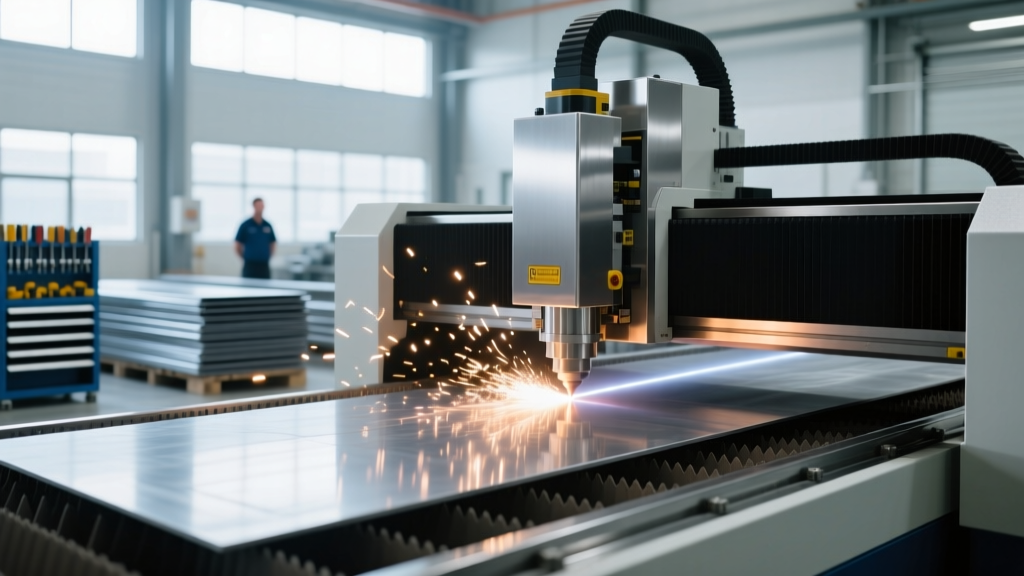
Evaluating the true financial impact of a fiber laser system requires looking past the initial purchase order. In 2026, the baseline CNC laser cutting machine cost for a mid-range 6kW to 10kW fiber system ranges from $280,000 to $550,000. However, fabricators who budget exclusively for the machine footprint inevitably face margin erosion from hidden operational expenditures (OpEx). Assist gas consumption, resonator degradation, nozzle wear, and material handling automation dictate the actual cost-per-part.
To provide actionable procurement intelligence, we analyzed three distinct manufacturing environments. These case studies isolate the capital and operational variables that dictate long-term profitability in metal fabrication.
2026 Fiber Laser CapEx Baseline
- Entry-Level (3kW - 4kW): $140,000 - $220,000 (Thin gauge sheet, job shops)
- Mid-Range (6kW - 8kW): $280,000 - $420,000 (General fabrication, up to 1/2" steel)
- High-Power (10kW - 12kW): $450,000 - $650,000 (Heavy plate, high-speed aerospace)
- Ultra-High (15kW - 24kW+): $700,000 - $1,200,000+ (Thick-plate beveling, shipbuilding)
Data synthesized from The Fabricator's laser cutting market analysis and Q1 2026 OEM pricing indexes.
Case Study 1: Aerospace Tier 2 Supplier (High-Mix, Tight Tolerances)
Application: Cutting thin-gauge aluminum (5052-H32), titanium sheets (Ti-6Al-4V), and Inconel for structural airframe brackets.
Selected Equipment: Trumpf TruLaser 5030 fiber (12,000W) with automated sheet loader.
Base CNC Laser Cutting Machine Cost: $715,000
The Operational Reality
Aerospace alloys demand extreme edge quality and minimal heat-affected zones (HAZ). This facility initially budgeted $500,000 for a 6kW machine but upgraded to a 12kW Trumpf system to utilize the BrightLine fiber technology, which drastically reduces micro-burring on thick aluminum and titanium.
The primary OpEx driver here is high-purity assist gas. Cutting titanium requires Argon or ultra-high-purity Nitrogen to prevent oxidation and embrittlement. While the 12kW resonator cuts 0.125" titanium at 180 IPM (inches per minute), the Argon consumption costs $42 per hour of cutting time.
"We underestimated the gas logistics. Switching from liquid bulk Nitrogen to an on-site Argon generator added $85,000 to our facility prep costs, but it reduced our per-part gas expense by 34% over an 18-month run."
— Director of Manufacturing, Pacific Northwest Aerospace Fabricator
Case Study 2: Custom Automotive Fabrication (Thick Plate, High Volume)
Application: Heavy-duty chassis components, suspension mounts, and skid plates using 1/4" to 3/4" mild steel and 6061-T6 aluminum.
Selected Equipment: Mazak Optiplex Nexus 3015 (10,000W) with dual-pallet shuttle table.
Base CNC Laser Cutting Machine Cost: $495,000
The Operational Reality
Thick-plate cutting generates massive thermal loads and produces significant slag. This automotive supplier prioritized machine rigidity and automated nozzle cleaning over raw wattage. The Mazak's 10kW IPG resonator provides ample power for 3/4" mild steel, but the true cost savings emerged from their material handling strategy.
By integrating a Bystronic ByTrans loading/unloading system ($110,000 add-on), the facility eliminated the 45-second manual sheet-swap time. Over a 24/7 operation, this recaptured 14 hours of beam-on time per week. However, thick-plate cutting accelerates consumable wear. The facility burns through $1,200 monthly in ceramic nozzles and protective lenses due to high-pressure oxygen spatter when piercing 3/4" steel.
Case Study 3: General Job Shop (Thin Gauge, Speed Focused)
Application: HVAC enclosures, electrical panels, and custom brackets (16ga to 1/4" mild steel and stainless).
Selected Equipment: Bystronic ByStar Fiber 4025 (6,000W) with 150-sheet tower.
Base CNC Laser Cutting Machine Cost: $340,000
The Operational Reality
For a high-volume job shop, speed on thin gauge material is the only metric that matters. This shop bypassed the 10kW trend, recognizing that a 6kW source cuts 14ga mild steel nearly as fast as a 10kW, but at a 30% lower capital cost and significantly lower electrical draw.
The paradigm shift for this shop was the complete elimination of bulk Nitrogen. They invested $38,000 in an Atlas Copco GA37+ rotary screw air compressor paired with a high-pressure dry receiver, delivering 150 CFM at 250 PSI. According to industry reports on fiber laser assist gas trends, compressed air cutting on thin-gauge stainless and mild steel yields edge quality virtually indistinguishable from Nitrogen, while reducing assist gas OpEx to near zero.
2026 Total Cost of Ownership (TCO) Matrix
The following matrix compares the 36-month operational costs across the three case studies, illustrating how OpEx often eclipses the initial CNC laser cutting machine cost.
| Cost Category (36 Months) | Aerospace (12kW Trumpf) | Automotive (10kW Mazak) | Job Shop (6kW Bystronic) |
|---|---|---|---|
| Base Machine CapEx | $715,000 | $495,000 | $340,000 |
| Automation & Handling | $90,000 | $110,000 | $145,000 |
| Assist Gas Infrastructure | $85,000 (Argon Gen) | $15,000 (Bulk N2/O2) | $38,000 (Air Comp) |
| Consumables (Nozzles/Lenses) | $28,500 | $43,200 | $14,100 |
| Assist Gas Spend (3 Yrs) | $112,000 | $84,000 | $9,500 (Electricity) |
| Total 36-Month Investment | $1,030,500 | $747,200 | $546,600 |
The Assist Gas Paradigm Shift: Air vs. Nitrogen
The most significant variable in modern laser OpEx is assist gas. Historically, shops relied on liquid Nitrogen for stainless steel to achieve oxide-free edges. In 2026, high-pressure compressed air (minimum 200 PSI, heavily filtered for moisture and particulates) has become the standard for materials under 1/4" thickness.
Actionable Insight: If your nest is primarily 14ga to 1/8" stainless and mild steel, do not sign a bulk Nitrogen contract. Reallocate $35,000 of your CapEx budget toward a dedicated, medical-grade filtration air compressor system. The ROI on compressed air cutting typically achieves payback within 9 to 14 months based on eliminated gas delivery fees and tank rental costs.Strategic Procurement Checklist for 2026
Before issuing a purchase order, run your specific application through this technical checklist to avoid post-installation bottlenecks:
- Audit Your Pierce Times: High wattage (12kW+) drastically reduces cutting speed but exponentially increases pierce speed on thick plate. If your nests require hundreds of pierces per sheet, prioritize wattage. If you cut long, continuous contours on thin sheet, a 6kW machine with a high-speed gantry is more cost-effective.
- Verify Resonator Brand & Warranty: IPG, nLIGHT, and Trumpf TruDisk are the dominant sources. Ensure the OEM includes a minimum 3-year warranty on the resonator and cutting head, as out-of-warranty replacements can exceed $60,000.
- Evaluate Nesting Software Licensing: OEM software is often limited. Budget $15,000 - $25,000 for advanced third-party nesting software (like SigmaNEST or Hypertherm ProNest) which utilizes true-shape nesting and common-line cutting to reduce material waste by up to 12%.
- Calculate Facility Power Requirements: A 10kW fiber laser requires a minimum 150-amp, 460V 3-phase dedicated drop. Upgrading shop electrical panels can add $20,000 to $45,000 in unforeseen contractor fees.
- Demand Chiller Redundancy: The water chiller is the most common point of failure. Specify a dual-circuit chiller with integrated redundancy to prevent a $5,000 pump failure from halting a $500/hour machine.
Related reading
CNC Machining Cost vs Alternatives: 3D Printing and Molding

Cheap vs Premium CNC Processing: What You’re Really Paying For — A Data-Driven Buying Guide