How Much Does a Small CNC Machine Cost? 2026 Pricing Breakdown
Discover exactly how much a small CNC machine costs in 2026. We break down pricing for desktop routers, mini mills, and hidden ownership expenses.
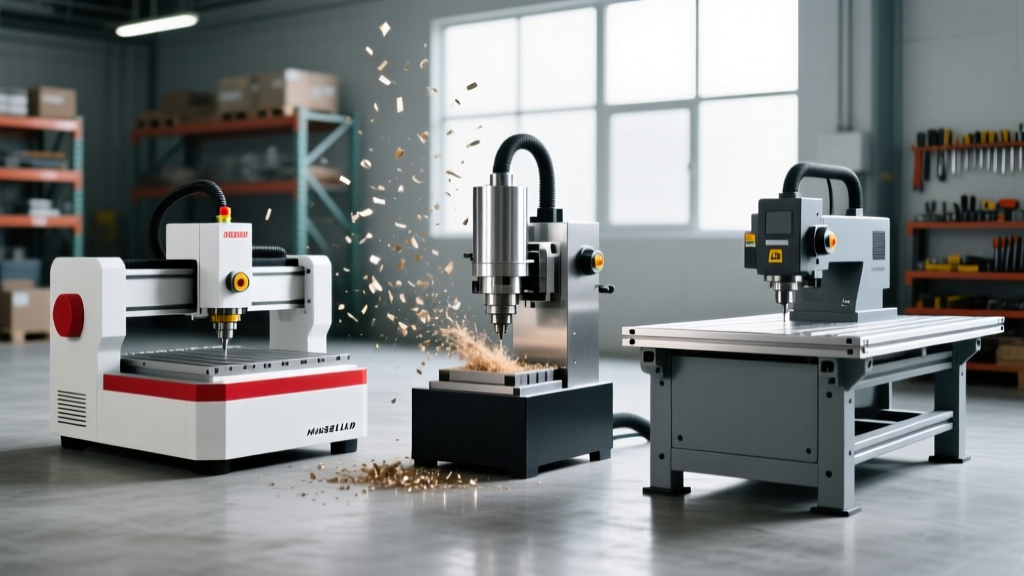
Answering the question of how much a small CNC machine costs requires looking past the manufacturer's base price. In 2026, the market for compact computer numerical control (CNC) equipment is strictly segmented by rigidity, spindle power, and controller sophistication. A desktop machine capable of engraving acrylic costs a fraction of a benchtop mill designed for machining 6061 aluminum or mild steel. To make a sound capital equipment decision, buyers must calculate the 'ready-to-cut' cost, which includes workholding, tooling, dust extraction, and CAM software licensing.
The True Cost Matrix: Small CNC Equipment in 2026
The table below outlines the realistic financial commitment required for different tiers of small CNC machinery, factoring in the essential accessories needed to actually make chips or cut parts on day one.
| Machine Category | Representative Models | Base Machine Price | Ready-to-Cut Cost | Primary Material Capacity |
|---|---|---|---|---|
| Hobbyist Desktop Router | Shapeoko 5 Pro, X-Carve | $1,200 – $2,500 | $2,000 – $3,500 | Wood, Plastics, Soft Aluminum |
| Prosumer / Light Industrial | Avid CNC 2x4, Bantam Tools | $3,800 – $8,500 | $5,500 – $11,000 | Aluminum, Brass, Hardwoods |
| Desktop CNC Mill (Mini Mill) | Tormach PCNC 440, Syil X7 | $5,500 – $7,800 | $9,000 – $14,000 | Steel, Titanium, Stainless |
Tier 1: Hobbyist & Desktop CNC Routers ($1,200 – $3,500)
Entry-level desktop routers rely on NEMA 23 open-loop stepper motors and extruded aluminum or steel tube frames. These machines typically utilize a handheld trim router (such as the Makita RT0701C) as the spindle. While excellent for sign-making, PCB milling, and woodworking, they lack the mass and Z-axis rigidity required for aggressive metal removal.
Edge Case Warning: When buying a sub-$2,000 router, verify the spindle runout. Cheap imported spindles often exhibit 0.002-inch to 0.004-inch runout, which will shatter micro-endmills (under 1/8 inch) when cutting aluminum or brass. Upgrading to a precision VFD spindle (like a 1.5kW Huanyang) adds $400 to $600 but is mandatory for non-wood materials.Popular Models and Pricing
- Carbide 3D Shapeoko 5 Pro: Starting around $2,199. Features a hybrid table (MDF with integrated T-tracks) and closed-loop stepper drivers on the Z-axis for better stall detection.
- Inventables X-Carve Pro: Priced near $3,000. Aimed at small production shops needing a turnkey solution with integrated dust control and a proprietary cloud-based CAM interface.
Tier 2: Prosumer & Light Industrial Routers ($3,800 – $11,000)
Step up to the prosumer tier, and the engineering shifts dramatically. Machines like the Bantam Tools Desktop CNC Milling Machine or 2x4 models from Avid CNC utilize NEMA 34 closed-loop servos, ball screws (instead of ACME lead screws), and high-frequency 2HP to 3HP spindles. This tier bridges the gap between weekend hobbyists and low-volume production job shops.
Avid CNC machines, for example, are renowned for their rack-and-pinion drive systems on the X and Y axes, allowing for rapid traverse rates exceeding 500 inches per minute (IPM). However, the base price of an Avid 2x4 standard system is roughly $4,500. To achieve a functional setup, buyers must add a 3HP HSD spindle ($1,800), a heavy-duty steel stand ($600), and a Variable Frequency Drive (VFD) controller, pushing the realistic total past $7,500 before a single endmill is purchased.
Tier 3: Desktop CNC Mills for Metals ($5,500 – $14,000)
If your objective is machining steel, stainless steel, or titanium, a router-style frame will fail. You need a true vertical milling machine architecture with cast-iron or heavily reinforced steel construction, way covers, and flood coolant compatibility. The undisputed leader in the small-format space is the Tormach PCNC 440.
'The transition from a desktop router to a benchtop mill is not just about power; it is about thermal stability and dampening. A 400-lb cast structure absorbs the harmonic vibrations generated when a 4-flute carbide endmill plunges into 1018 cold-rolled steel, preventing chatter and preserving tool life.' — Machining Dynamics Quarterly, 2025 Tooling Report
The Tormach PCNC 440 Ecosystem
The base PCNC 440 starts at approximately $5,490. However, Tormach's pricing model requires you to build the machine to your specifications. Essential upgrades include:
- Enclosure and Coolant System: $1,200 (Mandatory for steel to manage chips and heat).
- TTS (Tormach Tooling System) Toolholders: Unlike standard R8 collets, TTS allows for rapid tool changes without losing Z-height, crucial for production runs. Budget $400 for a starter set.
- Automatic Tool Changer (ATC): Adds roughly $2,500 but transitions the machine from manual prototyping to lights-out batch production.
The 'Ready-to-Cut' Reality: Hidden Ownership Costs
Novice buyers frequently exhaust their budget on the machine itself, leaving insufficient capital for the peripheral equipment required to hold tolerances. Factor the following into your 2026 procurement budget:
1. Precision Workholding
A machine is only as accurate as its workholding. A standard 4-inch Kurt-style milling vise (such as the Glacern or Kurt DX4) costs between $350 and $600. For routers, a T-slot clamp kit and sacrificial MDF spoilboards will cost around $150, but you will spend hours re-surfacing the bed.
2. Cutting Tooling Inventory
Industrial-grade solid carbide endmills from manufacturers like Harvey Tool or Kodiak Cutting Tools range from $25 to $85 per bit. A basic starter library (roughing endmills, ball-noses for 3D contouring, and chamfer mills) will easily consume $500 to $800. Avoid bulk, unbranded carbide sets from online marketplaces; inconsistent flute geometry will result in poor surface finishes and broken tools.
3. CAM Software Licensing
While the machine executes the G-code, Computer-Aided Manufacturing (CAM) software generates it. Autodesk Fusion 360 remains the industry standard for integrated CAD/CAM in the small shop sector. Note that while personal/hobbyist licenses remain free, commercial entities generating over $100,000 in annual revenue must purchase a commercial subscription, which currently sits at approximately $545 per year. Alternatives like Vectric VCarve Pro (ideal for 2.5D routing and sign-making) require a one-time perpetual license fee of around $350.
Pro-Tip on Dust Collection: Do not use a standard shop-vac for MDF or composite materials. The fine particulate will bypass standard filters and destroy the vacuum motor within months. Invest in a HEPA-rated dust extractor (like the Festool CT SYS or a Wen 3401 with upgraded micron bags) budgeted at $300 to $600 to protect your shop's air quality and machine linear bearings.Buyer's Decision Framework: Which Tier Fits Your Shop?
Use this diagnostic flow to finalize your equipment selection:
- Are you cutting exclusively wood, acrylic, or foam?
Choose a Tier 1 Hobbyist Router. Prioritize a large cutting envelope (e.g., 4x8 feet) over spindle power. A 1.5kW spindle is sufficient. - Do you need to machine 6061 Aluminum for functional prototypes or aerospace brackets?
Choose a Tier 2 Prosumer Router with a 3HP spindle and closed-loop servos, OR step up to a Tier 3 Mini Mill if Z-axis clearance and rigid tapping are required. - Are you cutting ferrous metals (Steel, Iron) or running high-volume production batches?
You must select a Tier 3 Desktop CNC Mill. Routers lack the torsional rigidity to handle the cutting forces of steel without deflecting, which ruins tolerances and destroys tooling.
Ultimately, understanding how much a small CNC machine costs means recognizing that the machine base is only 50% to 60% of your total capital expenditure. By budgeting accurately for tooling, workholding, and software in 2026, you ensure your new equipment is profitable from the very first cycle.
Related reading
CNC Tooling Pitfalls: 7 Costly Mistakes Buyers and Operators Make — And How to Avoid Them

Cheap vs Premium CNC Processing: What You’re Really Paying For — A Data-Driven Buying Guide