What Is a CNC Wire Cut Machine? WEDM vs. Laser Alternatives
Discover what a CNC wire cut machine is and compare Wire EDM tolerances, costs, and capabilities against fiber laser and abrasive waterjet alternatives.
The Core Mechanics: What Is a CNC Wire Cut Machine?
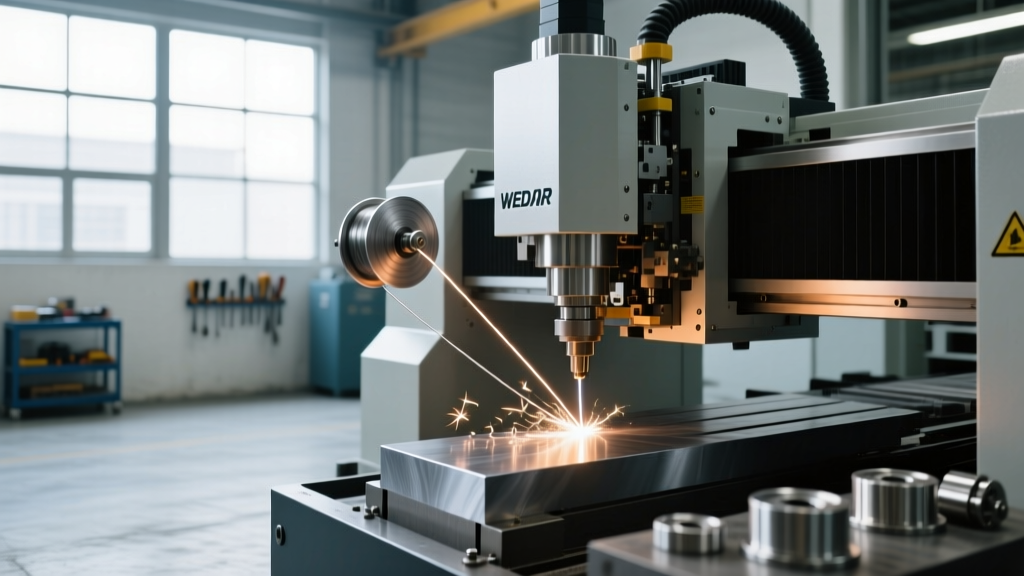
When researching advanced subtractive manufacturing, the fundamental question of what is CNC wire cut machine technology ultimately points to Wire Electrical Discharge Machining (WEDM). Unlike traditional milling or turning that relies on mechanical cutting forces, a CNC wire cut machine utilizes a continuously spooled, electrically charged metal wire as an electrode to vaporize conductive workpieces through controlled spark erosion.
The wire, typically ranging from 0.004 to 0.012 inches in diameter, is fed through the workpiece while submerged in or flushed with a dielectric fluid (usually deionized water). A high-frequency power supply generates sparks between the wire and the workpiece, reaching localized temperatures up to 18,000°F (10,000°C). This extreme heat instantly melts and vaporizes the material, while the dielectric fluid flushes away the microscopic debris and cools the cutting zone.
Critical WEDM Specifications (2026 Baseline)
- Positional Accuracy: ±0.00005 inches (1.2 µm) on high-end models like the Makino U6.
- Surface Finish: Ra 0.1 µm achievable after 3 to 4 automated skim cuts.
- Wire Consumption: 0.5 to 2.0 lbs per hour, depending on material thickness and cut speed.
- Auto-Threading Reliability: Modern systems (e.g., Fanuc RoboCut α-CiB series) achieve >99% threading success rates, even in submerged start holes.
Material Constraints: The Conductivity Rule
The most critical limitation of WEDM is that it can only machine electrically conductive materials. This includes tool steels, titanium, Inconel, aluminum, and copper alloys. If a material cannot conduct electricity, the spark gap cannot form, rendering the machine useless. For non-conductive materials like advanced ceramics, glass, or composites, manufacturers must pivot to alternative technologies, which we will analyze below.
WEDM vs. Fiber Laser Cutting: The Tolerance Battle
Fiber laser cutting has dominated the sheet metal industry due to its unprecedented speed on thin materials. However, when comparing a CNC wire cut machine to a high-power fiber laser (such as the Trumpf TruLaser 5030 fiber), the physics of thick-plate cutting reveal distinct trade-offs.
| Feature | Wire EDM (WEDM) | High-Power Fiber Laser |
|---|---|---|
| Max Practical Thickness | Up to 20 inches (500 mm) | Up to 1.5 inches (40 mm) for steel |
| Kerf Taper | Zero taper (straight wall) via CNC compensation | Noticeable taper on plates >0.5 inches |
| Heat-Affected Zone (HAZ) | Extremely shallow (recast layer removed via skim cuts) | Significant HAZ; alters metallurgy at cut edge |
| Cutting Speed (1" Steel) | ~4 to 6 inches per minute | ~40 to 60 inches per minute |
While fiber lasers are vastly superior for high-volume nesting of thin-gauge parts, they fail in applications requiring tight geometric tolerances through thick cross-sections. As detailed in Sodick's Wire EDM technology documentation, WEDM maintains a consistent kerf width from top to bottom, making it the undisputed choice for extrusion dies, stamping tools, and thick aerospace structural components where a ±0.0002-inch tolerance is mandatory.
WEDM vs. Abrasive Waterjet: Thickness and HAZ
Abrasive waterjet cutting (utilizing machines like the Omax 2652) solves the conductivity limitation of WEDM. By propelling a high-pressure stream of water mixed with garnet abrasive, waterjets can cut through titanium, glass, stone, and carbon fiber with equal ease. However, this mechanical erosion process introduces different physical limitations.
The Heat-Affected Zone (HAZ) Factor
Waterjet cutting is a cold process, meaning it produces zero HAZ. This is critical when cutting heat-treated tool steels or temper-sensitive aerospace alloys where thermal alteration could compromise the material's structural integrity. WEDM, despite its shallow penetration, still leaves a microscopic recast layer. While modern power supplies minimize this, and subsequent skim cuts remove it entirely, a single roughing pass on a wire cut machine will alter the surface metallurgy.
Tolerance and Surface Finish Degradation
Waterjets suffer from a phenomenon known as 'stream lag' or 'trailback' when cutting thick materials. The abrasive stream deflects backward as it penetrates deeper, creating a tapered cut and a rough, matte surface finish (typically Ra 3.0 to 6.0 µm). In contrast, a precision Wire EDM system from Makino can execute multiple automated skim passes, reducing the surface roughness to a mirror-like Ra 0.1 µm finish without requiring secondary grinding or polishing operations.
Operational Costs & Consumables Breakdown
Capital equipment costs vary wildly: a standard 2-axis WEDM might cost $120,000, while a 5-axis waterjet can exceed $250,000, and a 12kW fiber laser can surpass $500,000. However, the true cost of ownership lies in consumables and operational overhead.
Consumable Cost Analysis (Per Hour of Cutting)
- WEDM (Brass Wire): Coated or plain brass wire costs approximately $8 to $14 per pound. At a consumption rate of 1.5 lbs/hour, wire costs average $12 to $21 per hour. Deionized water and resin filters add roughly $3 per hour.
- Fiber Laser (Assist Gases): Cutting stainless steel requires high-purity nitrogen. Bulk liquid nitrogen delivery can cost $30 to $60 per hour of continuous cutting, making gas the primary operational expense.
- Waterjet (Garnet & Orifices): Garnet abrasive costs about $0.35 per pound, but a machine consumes 1.5 to 2.5 pounds per minute. This translates to $30 to $50 per hour in abrasive alone, plus frequent replacement of focusing tubes and mixing nozzles.
From a pure consumable standpoint, WEDM is significantly cheaper to operate per hour than abrasive waterjet cutting, though it is slower. The ROI on a wire cut machine is realized in high-value, low-volume parts where secondary finishing operations are eliminated.
The Procurement Decision Matrix
Choosing between these technologies requires matching your specific production requirements to the physical capabilities of the machines. Use this framework to guide your capital expenditure:
- Is the material electrically conductive?
- No: You must use Abrasive Waterjet. WEDM and Laser are physically incapable.
- Yes: Proceed to step 2.
- What is the material thickness?
- Under 0.75 inches (20mm): Fiber Laser is the most economical choice for speed and nesting efficiency.
- Over 2.0 inches (50mm): Fiber Laser quality degrades severely. Choose WEDM for tight tolerances, or Waterjet if tolerances of ±0.005 inches are acceptable.
- What is the required surface finish and tolerance?
- ±0.0002 inches and Ra < 0.4 µm: Wire EDM is the only single-setup solution. Waterjet and Laser will require secondary CNC milling or grinding to achieve these specs.
- ±0.005 inches and functional finish: Waterjet or Laser will suffice at a fraction of the machining time.
Understanding the precise limitations and strengths of WEDM compared to thermal and mechanical alternatives ensures that shops invest in the correct technology for their specific part geometries, ultimately protecting profit margins and reducing secondary processing bottlenecks.