How a CNC Machine at Work Leverages AI & IoT Sensors in 2026
Discover how a CNC machine at work leverages 2026 AI and IoT sensor trends to predict tool wear, reduce downtime, and optimize spindle loads in real time.
The Evolution of the CNC Machine at Work: From Manual to Telemetry
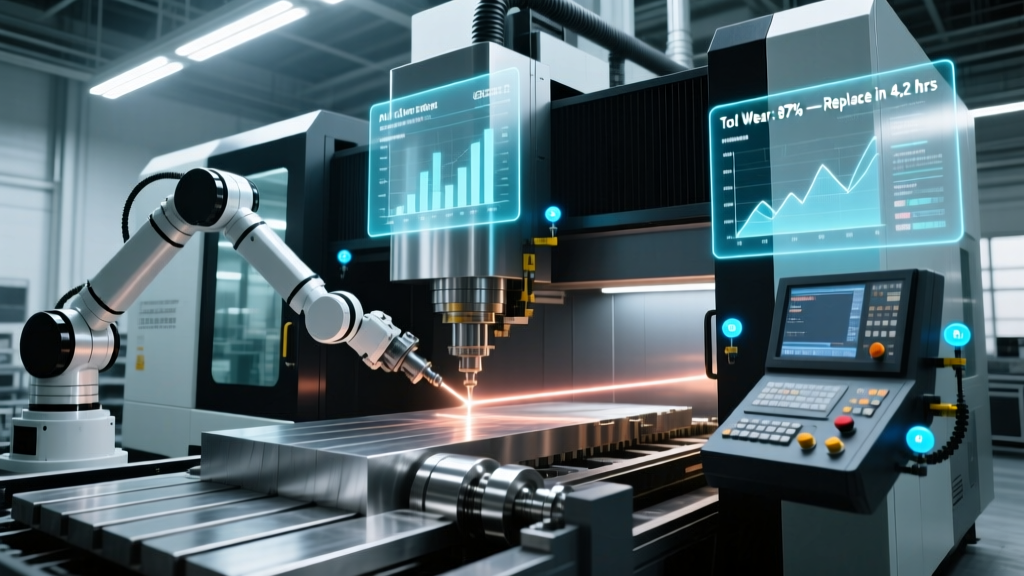
Observing a CNC machine at work in 2026 looks fundamentally different than it did a decade ago. The days of a machinist relying solely on the sound of the spindle or the color of the chips to gauge cutting efficiency are over. Today, a modern computer numerical control (CNC) machining center is a dense node of telemetry, generating gigabytes of operational data per shift. By integrating industrial Internet of Things (IIoT) sensors and edge-computing AI, shop floors are transforming raw mechanical action into predictive intelligence.
Understanding how a CNC machine at work processes this data is critical for manufacturing engineers and shop managers aiming to maximize Overall Equipment Effectiveness (OEE). This guide breaks down the exact sensor architectures, edge AI models, and retrofitting frameworks defining the 2026 smart machining landscape.
The Sensor Array: Capturing the Physics of Cutting
To understand a CNC machine at work, you must first measure the physical forces at the cutting edge. Modern setups rely on a multi-modal sensor approach, combining force, vibration, and acoustic data to build a complete picture of tool health and workpiece integrity.
Piezoelectric Dynamometers and Spindle Load
For high-precision aerospace and medical machining, measuring cutting force is non-negotiable. The Kistler Type 9257B piezoelectric dynamometer remains an industry benchmark, capable of measuring three orthogonal force components up to 30 kN with a sampling rate of 50 kHz. When mounted beneath a custom fixture, it detects micro-chatter and tool deflection milliseconds before a surface finish defect occurs.
Non-Contact Laser Tool Setting
Tool wear compensation is now handled dynamically. Systems like the Renishaw NC4 non-contact laser tool setter measure tool length and diameter to an accuracy of 0.5 µm. By integrating this data directly into the machine's macro variables, the CNC controller automatically adjusts Z-axis offsets mid-cycle, eliminating the need for manual probing between operations.
Acoustic Emission (AE) vs. Vibration Analysis
A common debate in 2026 condition monitoring is whether to prioritize vibration accelerometers or Acoustic Emission (AE) sensors. Both are critical, but they serve entirely different diagnostic purposes when monitoring a CNC machine at work.
| Feature | Tri-Axial Vibration Accelerometers | Acoustic Emission (AE) Sensors |
|---|---|---|
| Frequency Range | 10 Hz to 20 kHz | 100 kHz to 1 MHz |
| Primary Detection | Spindle bearing degradation, macro-chatter, imbalance | Micro-cracking in carbide inserts, initial tool breakage |
| Data Volume | Moderate (easily processed on standard PLCs) | Massive (requires dedicated edge AI processing) |
| Typical Cost (2026) | $350 - $800 per node | $2,500 - $4,200 per node |
| Best Application | High-volume roughing, long-duration spindle health | Finishing passes, brittle material machining (ceramics, glass) |
The Brain: Edge AI and Digital Twins
Collecting data is only the first step; interpreting it in real-time is where 2026 technology shines. Sending 50 kHz vibration data to a cloud server introduces unacceptable latency (often 150-300ms). If a carbide end mill fractures, the machine must halt in under 10 milliseconds to prevent catastrophic workpiece damage.
Local Inference at the Edge
Modern CNC architectures utilize edge computing gateways (such as the Siemens Industrial Edge or FANUC FIELD system) mounted directly inside the electrical cabinet. These units run lightweight neural networks—typically Long Short-Term Memory (LSTM) models optimized for time-series data—locally. The AI compares real-time spindle load and acoustic signatures against a 'digital twin' baseline of the perfect cut. When the deviation exceeds a 4% threshold, the gateway triggers an M-code (e.g., M00 or a custom macro) to pause the feed rate instantly.
⚠️ The Data Deluge Trap: A frequent mistake in 2026 smart manufacturing is purchasing high-frequency sensors without provisioning adequate edge storage. A single 3-axis AE sensor running at 1 MHz generates roughly 12 GB of raw data per hour. Ensure your IoT gateway includes at least a 2TB NVMe SSD for local buffering, and configure it to discard nominal data while retaining only anomaly-triggered event logs for cloud upload.Retrofitting Legacy Iron: A Step-by-Step Framework
You do not need a $250,000 5-axis DMG MORI to benefit from these trends. Retrofitting an older, reliable workhorse like a 2018 Haas VF-2SS to act as a smart, connected node is highly cost-effective. The MTConnect Institute provides the open-standard protocol necessary to extract data from legacy Fanuc, Haas, and Mazak controllers.
Step 1: Install the MTConnect Adapter
Purchase an MTConnect-compatible hardware adapter (typically $450 - $650). This device hardwires into the CNC's RS-232 or Ethernet port and translates proprietary controller variables (spindle speed, feed rate, alarm codes, axis positions) into standardized XML/JSON data streams.
Step 2: Deploy the IoT Gateway and Vibration Nodes
Mount a magnetic tri-axial vibration sensor (e.g., SKF Multilog IMx or a generic ICP accelerometer, ~$400) directly onto the spindle housing. Wire this into an MQTT-enabled IoT gateway ($600) sitting in the machine cabinet. Configure the gateway to sample at 5 kHz, which is sufficient for detecting spindle bearing defect frequencies (BPFO/BPFI) on standard 10,000 RPM spindles.
Step 3: Establish the Data Pipeline
Route the MQTT payload to a local on-premise server running an open-source time-series database like InfluxDB or TimescaleDB. Use Grafana to build operator dashboards that display real-time spindle load overlays and predictive tool-life countdowns.
Measuring the ROI: What the Data Actually Delivers
According to research on smart connected manufacturing by NIST (National Institute of Standards and Technology), the integration of IIoT and AI in subtractive manufacturing yields measurable, compounding returns. Shops implementing the sensor-to-edge framework described above typically report the following metrics within the first 12 months:
- Tool Life Extension (18-24%): By shifting from conservative time-based tool changes to actual condition-based changes, shops safely run inserts 20% longer without risking scrap.
- Unplanned Downtime Reduction (35-40%): Spindle bearing degradation is detected weeks before catastrophic failure, allowing maintenance to be scheduled during planned weekend changeovers.
- Scrap Rate Decrease (12-15%): Real-time thermal and force compensation eliminates out-of-tolerance parts caused by tool deflection during heavy roughing passes.
The 2026 Baseline: Actionable Next Steps
Watching a CNC machine at work is no longer a passive activity; it is an active data-science operation. To begin upgrading your shop floor, audit your current machine controllers for Ethernet connectivity and MTConnect compatibility. Start with a single critical machine—preferably one running high-value, tight-tolerance parts—and deploy a basic vibration and spindle-load monitoring stack. Once the local data pipeline is validated and the dashboard proves its value to your operators, scale the architecture horizontally across the rest of your VMC and HMC fleet. The shops that master the telemetry of the cut today will dictate the pricing and quality standards of the industry tomorrow.