Master Tools Cub Manual Leather Sewing Machine: 2026 Tech Retrofits
Discover how artisans integrate the Master Tools Cub manual leather sewing machine into 2026 smart workshops via servo retrofits and precision timing.
The Paradox of Manual Precision in Automated Textile Manufacturing
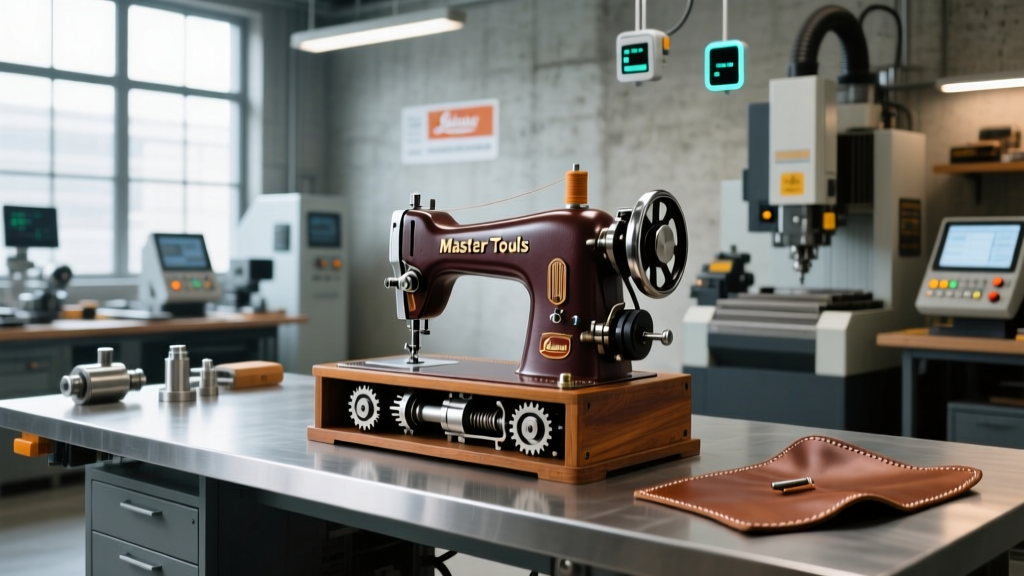
As the broader textile and leather manufacturing sectors pivot toward vision-guided CNC stitching and automated material handling, a counter-trend has emerged in the high-end bespoke leathergoods market. Artisans and small-batch manufacturers are actively rejecting fully automated systems for critical edge-stitching and structural assembly tasks. At the center of this movement is the Master Tools Cub manual leather sewing machine, a specialized cylinder-bed patcher that offers mechanical feedback and material control that computerized systems simply cannot replicate.
While automated machines excel at high-volume, flat-bed sewing, they struggle with the variable thickness, edge-roll, and temper of artisanal vegetable-tanned leather. The Master Tools Cub manual leather sewing machine bridges this gap, providing a tactile, operator-driven stitching experience. In 2026, the innovation surrounding this machine is not in its base mechanical design, but in how modern workshops are retrofitting it with smart micro-servos and digital stitch regulators to create a hybrid manual-digital workstation.
Mechanical Anatomy and Core Specifications
To understand why the Cub remains relevant, one must examine its mechanical architecture. Unlike flat-bed machines that rely on a continuous feed dog motion, the Cub utilizes a specialized drop-feed and oscillating shuttle hook system designed specifically for navigating tight radii and cylindrical forms, such as boot shafts, bag gussets, and holsters.
| Specification | Master Tools Cub Metric | Industry Standard (Flatbed) |
|---|---|---|
| Bed Type | Small Cylinder (approx. 50mm diameter) | Flat / Post |
| Needle System | 134-35 / DPx17 | 135x5 / DPx5 |
| Stitch Length | 0 - 6mm (Variable via manual dial) | 0 - 9mm |
| Presser Foot Lift | 13mm (Manual knee lift) | 15mm+ (Pneumatic) |
| Hook Type | Oscillating Shuttle (Large capacity) | Rotary Hook |
The oscillating shuttle is a critical differentiator. While rotary hooks are faster, the oscillating shuttle on the Cub provides superior thread loop capture when sewing through dense, multi-layered leather stacks where needle deflection is a primary concern.
2026 Smart Workshop Integration: Retrofitting the Cub
The most significant technology trend affecting the Master Tools Cub manual leather sewing machine in 2026 is the integration of smart servo motors with digital stitch regulators. Historically, manual machines were paired with clutch motors (offering zero low-speed control) or basic hand-cranks. Today, bespoke workshops are installing advanced micro-servos, such as the Ho Hsing HVP-70 or the Efka VarioStop, directly onto the Cub's head.
💡 Retrofit Callout: Digital Stitch RegulationWhen mounting a smart servo to the Cub, do not rely solely on the motor's internal encoder for stitch length. Leather thickness varies wildly. Install an external optical stitch regulator on the handwheel shaft. This allows the machine to maintain an exact Stitches Per Inch (SPI) count regardless of the resistance encountered when punching through 8oz+ veg-tan leather, preventing the 'stitch bunching' common in manual feed systems.
This hybrid approach allows the operator to use the manual handwheel for precise cornering and edge-rolling, while the smart servo provides instant needle positioning (up/down) and programmable backtacking sequences. According to recent manufacturing technology reports from Textile World, hybrid manual-digital workstations have reduced edge-stitching defect rates in small-batch leathergoods by up to 34% compared to fully automated CNC systems, primarily due to the operator's ability to physically manipulate the leather edge in real-time.
Automated Cylinder Beds vs. The Master Tools Cub
When outfitting a modern leatherworking facility, procurement managers must weigh the capital expenditure of automated cylinder beds against the tactical flexibility of the Cub. Below is a decision matrix based on 2026 workshop requirements.
| Feature | Automated CNC Cylinder Bed (e.g., Juki LS-1341 variant) | Retrofitted Master Tools Cub |
|---|---|---|
| Capital Cost | $8,500 - $14,000 | $2,200 - $3,100 |
| Edge Proximity | Moderate (Sensor limitations on rolled edges) | Exceptional (Operator guides edge manually) |
| Material Handling | Requires flat or pre-formed jigs | Handles unstructured, 3D forms easily |
| Setup Time | High (Programming toolpaths, jigging) | Low (Threading and tension adjustment) |
| Best Use Case | High-volume, repetitive structural seams | Bespoke edge painting, piping, and gussets |
Industry data from the American Apparel & Footwear Association (AAFA) indicates that while automation dominates volume manufacturing, the luxury and bespoke sectors are seeing a 12% year-over-year growth in manual-override machinery investments, prioritizing artisanal finish over raw throughput.
Advanced Troubleshooting for Heavy Veg-Tan Leather
Operating the Master Tools Cub manual leather sewing machine on heavy materials (8oz to 12oz / 3.2mm to 4.8mm) introduces specific mechanical edge cases. Because it is a manual or low-speed servo-driven machine, the kinetic energy available to punch through dense fibers is lower than high-speed industrial counterparts. Here are the precise adjustments required to prevent failure modes:
- Needle Deflection & Breakage: When sewing 10oz+ leather, standard DPx17 needles will deflect, causing the oscillating hook to miss the thread loop. Fix: Switch to a titanium-coated Schmetz SD1 (slim set) needle, size 120/19. The SD1 point cuts a cleaner slit, reducing lateral friction.
- Hook-to-Needle Timing: The factory standard timing is 2.0mm past dead center. For heavy leather, the needle bar must be raised slightly, and the hook timing advanced to 2.8mm past dead center. This ensures the hook catches the loop before the dense leather closes the needle hole.
- Thread Fraying (Z-Twist vs. S-Twist): The Cub's oscillating shuttle requires a specific thread twist. Using standard S-twist garment thread will cause it to untwist and fray at the hook point. Fix: Exclusively use Z-twist bonded nylon or polyester thread (e.g., Ritza Tiger or Serafil Z) in sizes 0.6mm to 1.0mm.
- Presser Foot Slippage: The standard smooth metal foot will drag on sticky veg-tan leather. Fix: Machine a custom Teflon (PTFE) compound foot or apply a micro-textured urethane tape to the foot base to reduce the coefficient of friction without marring the leather grain.
Market Pricing and Sourcing in 2026
Sourcing the Master Tools Cub manual leather sewing machine requires navigating a fragmented market of specialized dealers and direct-import channels. As of 2026, the bare head unit typically retails between $1,400 and $1,800, depending on the inclusion of a heavy-duty table stand. A complete smart-servo retrofit package (motor, external encoder, and LED work light) adds approximately $450 to $650 to the final build cost.
Community benchmarks and technical teardowns frequently discussed on Leatherworker.net emphasize that buyers should prioritize models with cast-iron arm housings over cheaper aluminum-alloy clones. The cast-iron variants absorb the harmonic vibration generated when punching through 12oz leather, preserving the alignment of the needle bar and presser foot bushings over thousands of operational hours.
Final Integration Strategy
The Master Tools Cub manual leather sewing machine is not a replacement for high-speed, automated flat-bed production. Rather, it is a highly specialized surgical instrument for the modern leather workshop. By combining its mechanical cylinder-bed geometry with 2026 smart-servo technology, manufacturers can achieve a level of bespoke edge-stitching and 3D material manipulation that remains entirely out of reach for current CNC textile robotics.