Applying Machinery Safety Standards: Auto vs Food Packaging
Discover how machinery safety standards apply differently in automotive welding vs. food packaging, featuring real-world case studies and specs.
The Core Divide: Kinetic Energy vs. Environmental Degradation
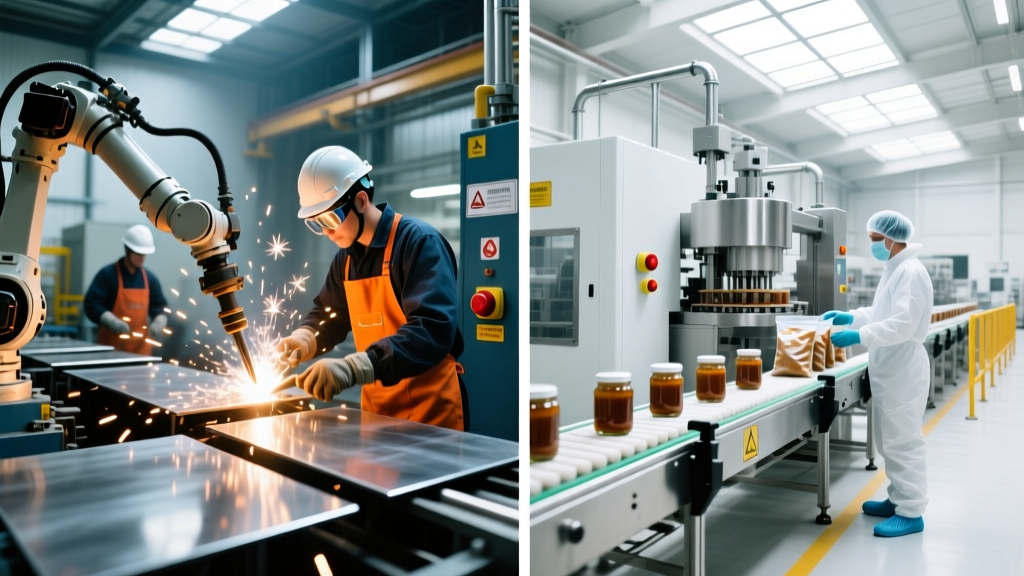
A 6-axis robotic welder and a 72-valve rotary beverage filler present fundamentally different hazard profiles. While both fall under the umbrella of OSHA machine guarding regulations and ISO 12100 risk assessment frameworks, the practical application of machinery safety standards diverges sharply based on the operating environment. In automotive manufacturing, the primary enemy is high-kinetic energy and optical interference. In food and beverage packaging, the enemy is high-pressure caustic washdowns and biological contamination. Applying a uniform safety architecture across both facilities is a costly engineering failure.
This analysis breaks down how modern machinery safety standards are interpreted and executed in these two distinct sectors, utilizing 2026 component pricing and real-world failure modes to guide safety engineers and plant managers.
Case Study A: Automotive Robotic Welding Cells
Automotive welding cells operate under ISO 10218-2 (Robots and robotic devices) and ISO 13849-1 (Safety-related parts of control systems). The dominant hazard is the crushing force of a 200kg payload robot moving at 2,000mm/s, combined with the secondary hazard of 1,500°C weld spatter.
The Guarding Material Trap
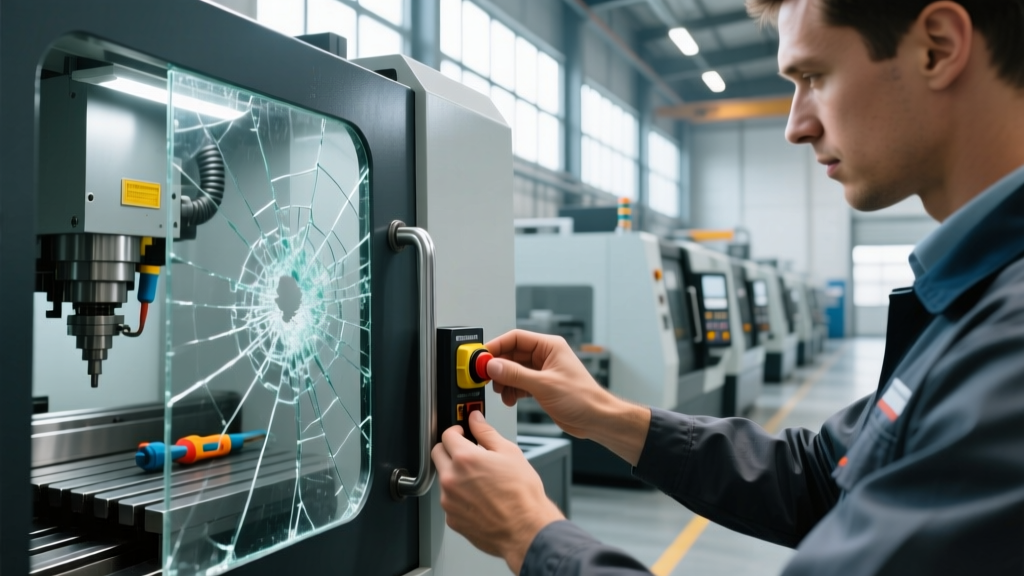
Under ISO 14120 (General requirements for the design and construction of guards), guards must withstand foreseeable impacts. Many integrators default to standard 3mm polycarbonate for sight glasses. However, standard polycarbonate degrades rapidly under UV light from arc welding and becomes brittle when coated in microscopic weld spatter. Within 14 months, a standard polycarbonate panel will fail a 50-joule impact test, violating ISO 14120 compliance.
Engineering Fix: Specify UV-stabilized, hard-coated polycarbonate (e.g., SABIC Lexan Margard) at a minimum 5mm thickness. While it costs roughly $45 per square foot compared to $12 for standard polycarbonate, it maintains structural integrity against spatter pitting for over five years, ensuring ongoing compliance with 1910.212 general machine guarding requirements.The Muting Blindspot
When pallets enter and exit the cell, safety light curtains (e.g., SICK C4000) must be muted. A common, low-cost method uses retro-reflective tape and optical sensors. In a welding environment, airborne metallic spatter coats the reflectors, causing the muting sequence to fail. This results in the robot dropping into a protective stop (Category 0 stop) mid-weld, scrapping the part and costing an average of $1,400 per incident in rework and downtime.
The 2026 Standard: Abandon optical muting in weld cells. Utilize active muting via a safety PLC (such as the Pilz PNOZ s30, approx. $3,200) reading dual, physically separated inductive proximity sensors (e.g., IFM IN5225, $185 each) embedded in the conveyor rails. This eliminates optical interference entirely.
Case Study B: High-Speed Beverage Rotary Fillers
Beverage fillers operate at speeds exceeding 60,000 bottles per hour. The kinetic energy is lower than a robotic welder, but the stored energy in pressurized pneumatics and the sheer speed of rotating carousels dictate a strict Performance Level (PL) d or e architecture. More critically, the environment demands daily Clean-in-Place (CIP) washdowns using 80°C water and 2% sodium hydroxide (NaOH) solutions.
The CIP Chemical Trap for Interlocks
ISO 14119 governs the design of interlocking devices. Standard safety switches with polymer housings (like basic tongue interlocks) will absorb moisture and degrade when exposed to daily caustic washdowns. The internal reed switches corrode, leading to 'safe' failures where the door appears locked to the PLC, but the mechanical locking tongue has actually sheared off due to chemical embrittlement. This is a severe violation of NIOSH machine guarding principles regarding positive locking mechanisms.
Specification Requirement: Mandate IP69K-rated, stainless steel (316L) RFID safety sensors. The Schmersal AZM40 IP69K solenoid interlock ($650 - $850 per unit) features an electropolished 316L housing that prevents caustic pooling and withstands 1,450 psi washdowns. Furthermore, RFID actuation eliminates the mechanical wear and tear of physical tongues, extending mean-time-between-failures (MTBF) from 100,000 cycles to over 1 million cycles in wet environments.Safe Distance vs. Sanitation
ISO 13857 dictates safe distances to prevent reaching over or through guards. For a filler rotating at high speeds, the safe distance from the hazard zone to the guard mesh is typically 850mm. However, expansive guarding creates 'shadow zones' where listeria and biofilms thrive, violating FDA sanitation standards. The solution is utilizing 316L stainless steel wedge-wire screens with exact 40mm x 40mm apertures. This specific aperture size satisfies the ISO 13857 finger-and-hand entrapment tables while providing an 82% open area for unobstructed CIP fluid flow, eliminating shadow zones.
Head-to-Head: Safety Architecture Comparison Matrix
| Parameter | Automotive Robotic Welding | Food & Beverage Rotary Filler |
|---|---|---|
| Primary ISO Standard | ISO 10218-2 / ISO 13849-1 | ISO 14119 / ISO 14120 |
| Control System PL | Category 3, PL d | Category 4, PL e |
| Guard Material | 5mm UV-Coated Polycarbonate / Welded Mesh | 316L Wedge-Wire / PETG |
| Interlock Tech | Coded Magnetic (e.g., Pilz PSENmag) | IP69K RFID Solenoid (e.g., Schmersal AZM40) |
| Muting Strategy | Dual Inductive Proximity Sensors | Not Applicable (Continuous Enclosure) |
| Environmental Threat | UV Degradation, Metallic Spatter | Caustic CIP Chemicals, High-Pressure Water |
| Avg. Safety PLC Cost | $2,800 - $3,500 | $4,500 - $6,200 (Requires IP67 enclosure) |
ISO 12100 Risk Assessment: Where the Math Diverges
When executing an ISO 12100 risk assessment, the Severity (S) and Probability (F) metrics yield entirely different required Performance Levels (PLr) for these two machines.
Automotive: High Severity, Low Frequency
A robot arm strike carries an S2 (Severe, potentially fatal) rating. However, because operators are strictly excluded from the cell during automatic mode via perimeter fencing, the Frequency/Exposure (F) is rated F1 (Seldom). This typically results in a required PLr of PL d.
Beverage: Moderate Severity, High Frequency
A filler carousel crush hazard is rated S2. But unlike robots, fillers require constant operator intervention to clear jammed bottles, adjust guides, and perform changeovers. The exposure is rated F2 (Frequent to continuous). Furthermore, the possibility of avoiding the hazard (P) is rated P1 (Possible but difficult due to machine speed). This combination pushes the required architecture to PL e, necessitating redundant, diverse safety channels and monitored safe-torque-off (STO) drives on every rotary servo.
Actionable Procurement Framework for Safety Components
To ensure your facility meets machinery safety standards without over-engineering or under-protecting, utilize this decision framework when specifying components to your integrator or OEM.
1. Interlock Selection Flowchart
- Is the environment subject to high-pressure washdowns (>1000 psi)?
→ YES: Specify IP69K, 316L RFID Solenoid (Budget: $750/door).
→ NO: Proceed to next question. - Is there high airborne particulate (weld spatter, sawdust, oil mist)?
→ YES: Specify Coded Magnetic or RFID (Non-contact). Avoid mechanical tongue interlocks which will jam with debris. (Budget: $250-$400/door).
→ NO: Standard electromechanical tongue interlocks are acceptable and cost-effective (Budget: $120/door).
2. Guard Material Decision Tree
- Requirement: Optical clarity for process monitoring.
- Welding/UV environment: 5mm UV-stabilized Polycarbonate (Lexan Margard).
- Caustic/Washdown environment: 6mm PETG (Polycarbonate will craze and crack under NaOH exposure).
- Requirement: Ventilation and debris ejection.
- Heavy impact (stamping/forging): 4mm woven steel wire mesh, mechanically fastened (welds can fatigue under harmonic vibration).
- Sanitary (Food/Pharma): 316L wedge-wire screen, continuously welded and electropolished.
By aligning your component specifications with the specific environmental and kinetic realities of your machinery, you ensure robust compliance with ISO and OSHA standards while minimizing lifecycle maintenance costs and unplanned downtime.