How AI Vision Systems Are Redefining Machinery Safety in 2026
Discover how AI computer vision, predictive analytics, and smart sensors are transforming machinery safety and ISO 12100 compliance in 2026.
The landscape of industrial hazard mitigation is undergoing a structural shift. For decades, OSHA machine guarding guidelines and ISO 14120 standards relied heavily on physical barriers, interlocked gates, and photoelectric light curtains. While these remain foundational, the 2026 manufacturing floor demands dynamic, adaptive protection. The integration of artificial intelligence, 3D volumetric sensing, and edge-computed safety logic is redefining machinery safety, moving the industry from reactive guarding to predictive, context-aware hazard avoidance.
2026 Trend Alert: The market for safety-rated AI vision systems has grown by 34% year-over-year. Manufacturers are no longer treating safety as a static compliance checklist, but as a dynamic data stream that integrates directly with Overall Equipment Effectiveness (OEE) and digital twin models.AI Computer Vision vs. Traditional Light Curtains
Traditional Type 4 light curtains (such as the SICK deTec4 or Keyence GL-R series) operate on a simple binary principle: if an infrared beam is broken, the machine halts. While highly reliable and easily validated under ISO 13849-1, they lack spatial awareness. A dropped tool, a splash of coolant, or a robotic arm extending into the field will trigger a nuisance stop, costing facilities thousands of dollars per hour in downtime.
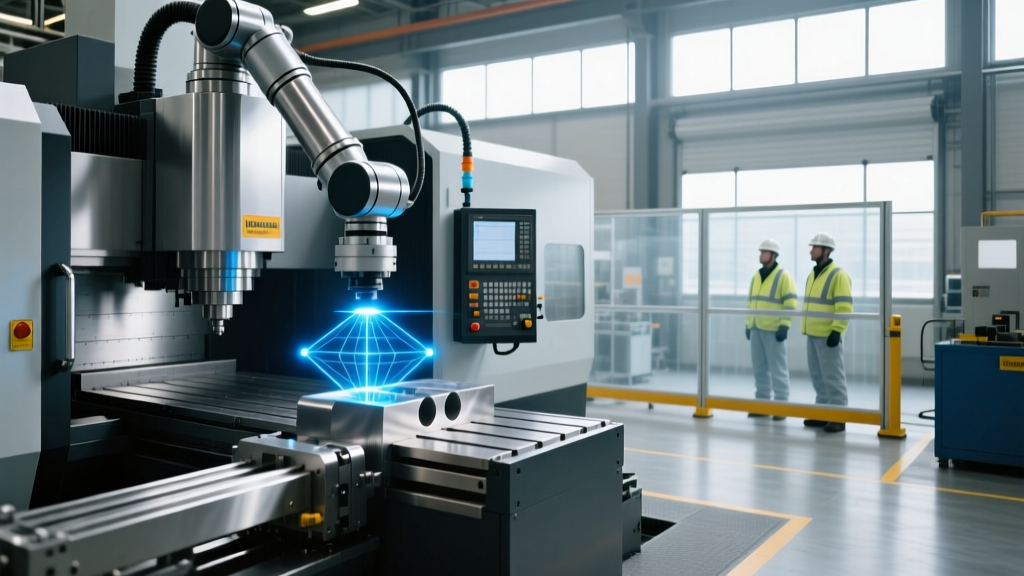
Modern AI vision systems utilize 3D Time-of-Flight (ToF) sensors and skeletal tracking algorithms to differentiate between an inanimate object, a machine component, and a human operator. By mapping the human skeleton in real-time, the system calculates the exact trajectory and velocity of the operator, triggering a localized slow-down or halt only when a true collision vector is detected.
| Feature | Type 4 Light Curtains | AI 3D Vision Safety (e.g., SICK Visionary-T) | Physical Interlocked Guards (ISO 14120) |
|---|---|---|---|
| Detection Logic | Binary beam break | Volumetric skeletal tracking & AI classification | Physical barrier with RFID/Reed switch |
| Nuisance Stop Rate | High (debris, coolant, off-axis parts) | Extremely Low (context-aware filtering) | Zero (unless door vibrates open) |
| Zone Flexibility | Fixed 2D plane | Dynamic 3D polygons, adjustable via software | Static physical footprint |
| Average Cell Cost (2026) | $1,800 - $3,500 | $14,500 - $22,000 | $2,500 - $6,000 (custom fabrication) |
Solving the ISO 13849 'Black Box' Problem
A critical engineering challenge in deploying AI for machinery safety is compliance with ISO 12100:2010 Safety of Machinery and ISO 13849-1, which mandate deterministic behavior for safety-related control systems. Neural networks are inherently non-deterministic; you cannot mathematically prove how an AI model will react to a novel, unseen pixel arrangement. Therefore, an AI camera cannot legally or safely wire directly into a machine's main safety relay.
The Deterministic Handoff Architecture
To achieve SIL 3 / PLe (Performance Level e) compliance in 2026, system integrators use a 'Deterministic Handoff' architecture:
- The AI Sensor Layer: The 3D vision camera (acting as an advanced, intelligent sensor) processes the environment. When a human breaches a predefined virtual warning zone, the camera outputs a safe, binary OSSD (Output Signal Switching Device) signal or a PROFIsafe telegram.
- The Safety PLC Layer: A deterministic safety controller, such as the Allen-Bradley GuardLogix 5580 or Pilz PNOZ Multi 2, receives this signal. The PLC does not 'think'—it executes hard-coded, mathematically verifiable logic to initiate a Safe Torque Off (STO) or Safe Stop 1 (SS1) command to the variable frequency drives (VFDs).
- The Actuation Layer: The drives cut power to the servos, engaging mechanical brakes within the calculated stopping time.
This synthesis allows manufacturers to leverage the flexibility of AI computer vision while satisfying the strict, auditable determinism required by international safety bodies and the Association for Advancing Automation (A3) Machine Vision Standards.
Predictive Safety Analytics and Digital Twins
Beyond guarding human operators, 2026 machinery safety encompasses protecting the facility from catastrophic mechanical failures. Predictive safety analytics utilize high-frequency vibration sensors (sampling at 50kHz+) and acoustic emission monitors to detect micro-fractures in high-speed spindles or hydraulic press rams before they result in kinetic energy releases.
Warning: Edge Case Failure ModesAI vision systems can experience 'snow blindness' in environments with high particulate matter (e.g., aluminum grinding or flour milling). In these scenarios, 3D ToF sensors must be equipped with IP69K-rated pressurized air-purge nozzles to keep the optical dome clear, adding roughly $1,200 to the per-unit hardware cost. Failing to spec air-purge systems in dirty environments is the leading cause of AI safety cell rejection during commissioning.
By feeding this telemetry into a digital twin, safety engineers can model the remaining useful life (RUL) of a guard interlock switch or a brake pad. If the digital twin predicts that a press brake's stopping time will exceed the 250ms safety threshold calculated in the original risk assessment within the next 48 hours, the system will automatically lock out the machine via the LOTO (Lockout/Tagout) digital protocol, preventing a potential crushing hazard.
Cost-Benefit Analysis Framework for Smart Safety Retrofits
When presenting capital expenditure requests for AI-driven safety upgrades, plant managers must look beyond the initial hardware cost. Use this framework to calculate true ROI:
- Nuisance Stop Reduction: Calculate the average cost of a line stoppage (e.g., $4,500/hour). If an AI vision system prevents just two false-trigger stops per shift that a light curtain would have caused, the system pays for itself in approximately 4.5 months.
- Throughput Optimization: AI systems allow operators to work closer to the hazard zone safely by dynamically scaling machine speed based on human proximity, often increasing cycle times by 8-12%.
- Insurance Premium Mitigation: Many industrial insurers in 2026 offer 5-15% reductions in workers' compensation premiums for facilities that implement PROFIsafe-rated predictive monitoring networks.
Frequently Asked Questions
Can AI completely replace physical machine guards?
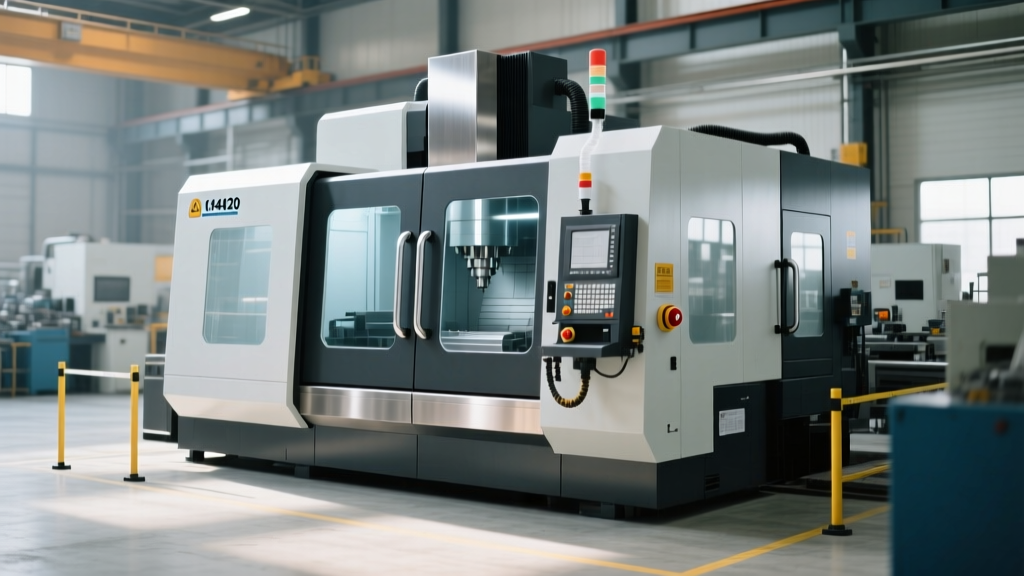
No. Under current OSHA and ISO 14120 regulations, physical guards are still required to contain flying debris, coolant, and catastrophic mechanical failures (like a shattered grinding wheel). AI vision and light curtains are classified as 'presence-sensing devices' and are used to protect operators from reaching into the point of operation during normal cycles, but they cannot replace the physical containment of hazards.
What network protocols are required for AI safety integration?
Standard Ethernet/IP or PROFINET are insufficient for safety-critical stops due to latency and packet loss risks. You must utilize safety-rated protocols such as CIP Safety or PROFIsafe, which embed safety checksums and sequential counters into the data packets to ensure the Safety PLC can detect network corruption or black-channel communication failures in under 10 milliseconds.
How do you validate an AI safety model before deployment?
Validation requires a rigorous 'edge-case injection' protocol. Engineers must physically test the system using standardized test pieces (e.g., the ISO 13855 test rods) alongside non-standard anomalies: operators wearing highly reflective PPE, partial occlusions by scaffolding, and extreme ambient lighting shifts (like a loading dock door opening to direct sunlight). The AI model must achieve a 99.99% detection confidence threshold across all injected variables before the Safety PLC is authorized to run in auto-mode.