AI-Driven Manufacturing Automation Equipment: 2026 Innovation Trends
Discover the latest 2026 innovations in manufacturing automation equipment, from AI-driven cobots to edge-computing PLCs, and calculate your ROI.
2026 Market Snapshot: The Cognitive Shift
The baseline for manufacturing automation equipment has permanently shifted from programmable repetition to cognitive adaptation. According to the World Economic Forum Global Lighthouse Network, facilities deploying AI-augmented automation in 2026 are seeing a 38% average increase in Overall Equipment Effectiveness (OEE) compared to traditional hard-automated lines. The capital expenditure (CapEx) premium for smart equipment has narrowed to just 12-18% over legacy systems, with payback periods compressing to under 14 months.
The era of buying isolated robotic arms and dumb conveyor systems is over. In 2026, modern manufacturing automation equipment operates as a decentralized network of edge-computing agents. Plant managers and systems integrators are no longer just programming kinematic paths; they are training localized neural networks to handle micro-variations in material tolerances, ambient temperature shifts, and tool wear in real-time. This guide dissects the specific hardware innovations defining the current landscape and provides a mathematical framework for upgrading your facility.
The Shift to Edge-AI PLCs and Cognitive Controllers
Traditional Programmable Logic Controllers (PLCs) relied on rigid ladder logic that required manual intervention when a process deviated from the norm. The 2026 standard integrates Edge AI directly into the controller chassis, allowing for sub-millisecond predictive adjustments without relying on cloud latency.
Hardware Spotlight: Siemens Simatic S7-1500T with Edge Computing
The Siemens S7-1500T Advanced Controller remains the benchmark for high-end motion control, but its 2026 iteration features native integration with Siemens Industrial Edge. Instead of sending vibration data from a spindle to a remote server for analysis, the controller processes the telemetry locally.
- Processing Latency: <2 milliseconds for closed-loop AI corrections.
- Hardware Cost: Base CPU module (1515T-2 PN) runs approximately $5,200, with Industrial Edge app licensing adding $1,500 to $3,000 annually depending on the analytics suite.
- Application: Real-time web tension control in high-speed converting lines, where the AI adjusts servo torque based on predictive material stretch models rather than reactive load-cell feedback.
2026 Equipment Matrix: Legacy vs. Cognitive Systems
When auditing your floor for upgrades, it is critical to understand the functional delta between legacy equipment and 2026 cognitive alternatives. The following matrix outlines the operational differences and current CapEx realities.
| Equipment Class | Legacy Standard (Pre-2023) | 2026 Cognitive Standard | CapEx Delta |
|---|---|---|---|
| Robotic Arms | Caged, fixed-path, blind to environment | Sensor-fused, dynamic pathing, human-aware | + 22% |
| Vision Systems | 2D rule-based pattern matching | 3D point-cloud AI defect classification | + 35% |
| Mobile Robotics | Magnetic tape or QR-code guided AGVs | LiDAR SLAM AMRs with semantic mapping | + 15% |
| PLC Controllers | Reactive ladder logic, isolated data | Edge-AI predictive, OPC-UA native | + 18% |
Next-Gen Cobots and 3D Vision Integration
The International Federation of Robotics (IFR) notes that collaborative robots (cobots) now account for over 18% of all industrial robot installations globally, driven heavily by advancements in payload capacity and integrated 3D vision. The days of cobots being limited to light assembly are over.
Heavy Payload Cobots: Universal Robots UR20
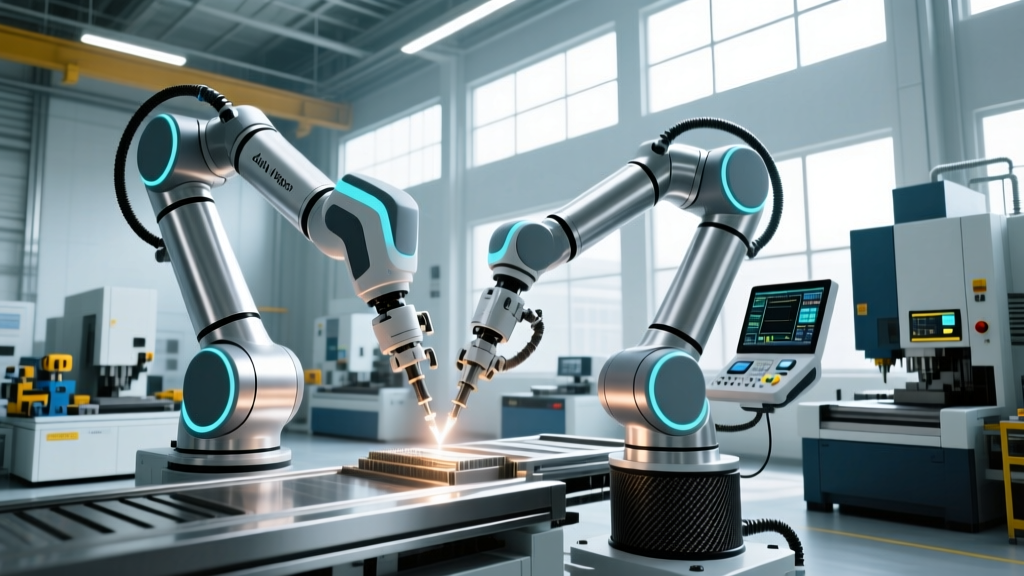
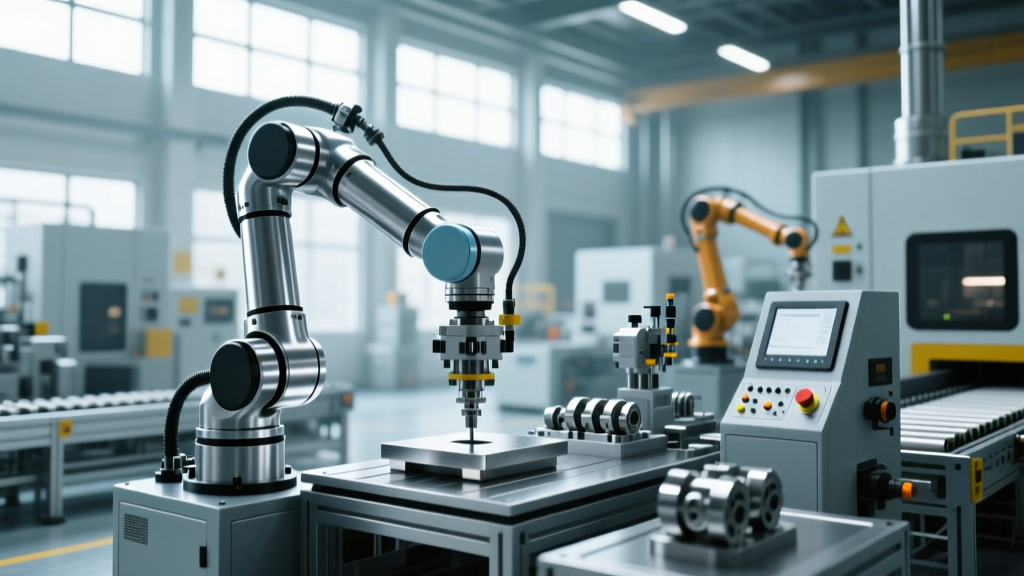
The Universal Robots UR20 has redefined the heavy-duty collaborative space. With a 20 kg (44 lbs) payload capacity and a 1,750 mm reach, it bridges the gap between traditional heavy industrial robots and safe, fenceless operation.
- Pricing: Base arm hardware is approximately $45,000 to $48,000. Fully integrated with a Schmalz vacuum gripper and UR+ certified vision system, expect a turnkey cell cost of $65,000 to $75,000.
- Innovation Factor: The UR20 utilizes a completely redesigned joint architecture that reduces the physical footprint by 30% while increasing speed by 25% compared to the UR16e, directly impacting cycle times in heavy machine tending applications.
Cognitive Vision: Cognex In-Sight 3D-L9000 Series
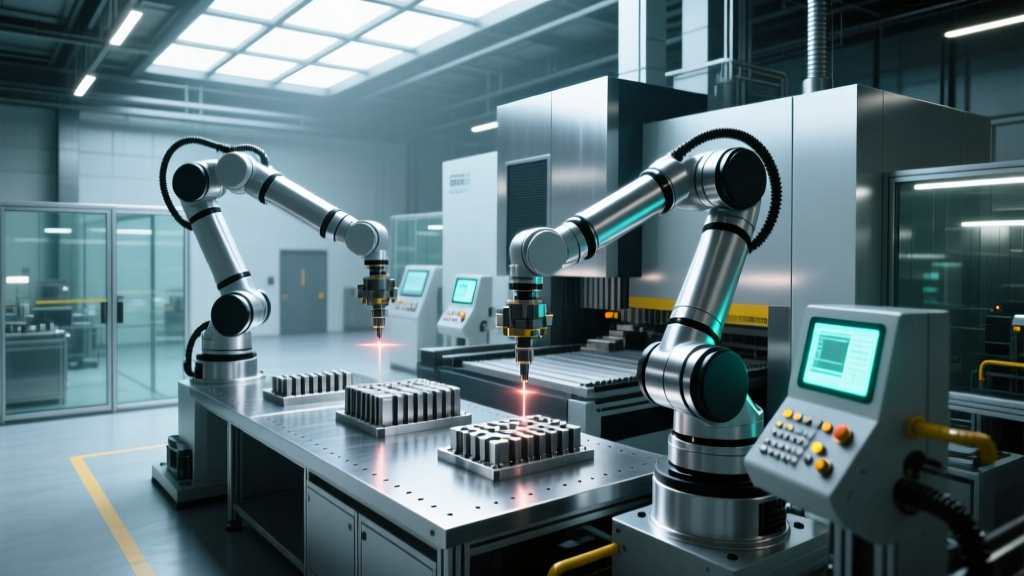
Pairing cobots with advanced vision is mandatory for unstructured environments. The Cognex In-Sight 3D-L9000 series utilizes a laser displacement sensor to generate high-resolution 3D point clouds (up to 2 million points per scan) at line speeds exceeding 2,000 mm/second. Unlike legacy 2D cameras that fail when ambient lighting shifts or part colors change, the 3D-L9000 relies on geometric topography and edge-AI deep learning models to identify bin-picking targets and micro-defects (down to 0.05mm anomalies) regardless of surface reflectivity.
⚠️ Integration Warning: The Data Latency Trap
When upgrading to 3D vision and edge-AI, do not bottleneck your system with legacy Ethernet switches. Real-time kinematic corrections require deterministic network protocols. Ensure your network architecture utilizes Time-Sensitive Networking (TSN) via PROFINET IRT or EtherCAT. Standard TCP/IP networks introduce jitter (10-50ms) that will cause micro-stutters in high-speed robotic pathing, leading to premature servo wear and scrapped parts.
Predictive Maintenance via Digital Twins
Manufacturing automation equipment in 2026 is expected to self-diagnose and order its own replacement parts before failure occurs. This is achieved through the convergence of IoT sensors and Digital Twin technology.
"Facilities that map their physical automation assets to dynamic digital twins are reducing unplanned downtime by up to 50%. The twin doesn't just mirror the machine; it simulates future degradation based on real-time torque and vibration telemetry." — National Institute of Standards and Technology (NIST) Advanced Manufacturing Series.
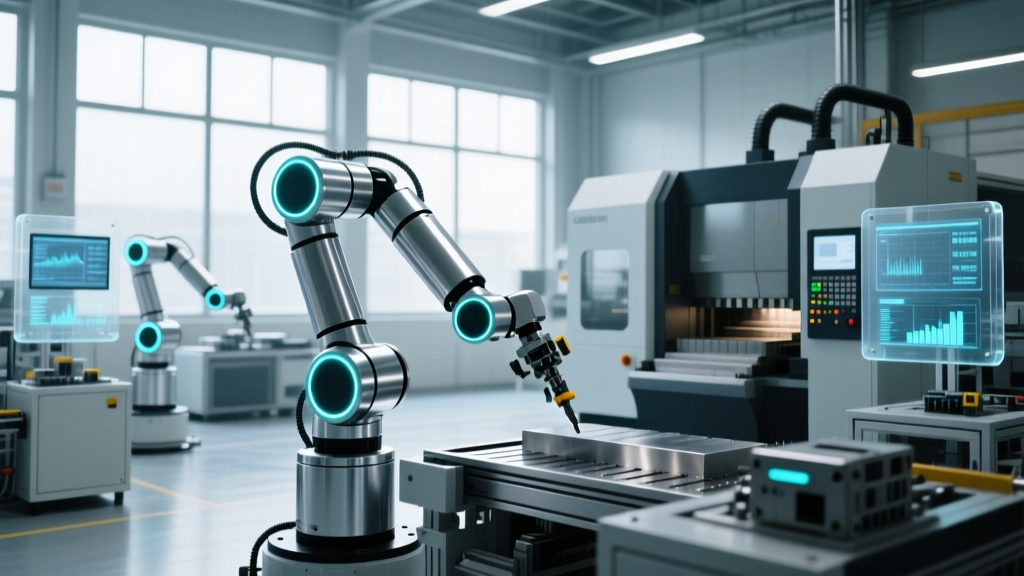
Platforms like Siemens Tecnomatix and Rockwell Automation's FactoryTalk InnovationSuite allow engineers to run physics-based simulations on the digital twin. If a spindle motor's vibration signature shifts by 2% in the Y-axis, the digital twin calculates the remaining useful life (RUL) based on the specific material hardness being machined, automatically triggering a work order in the CMMS (like Fiix or UpKeep) and adjusting the feed rate to prevent catastrophic failure until the maintenance window.
ROI Calculation Framework for Equipment Upgrades
Securing capital for advanced manufacturing automation equipment requires moving beyond simple "labor replacement" math. Use this 4-step framework to build an unassailable business case for 2026 cognitive equipment.
- Calculate the True Cost of Micro-Stoppages: Legacy equipment suffers from micro-stoppages (under 5 minutes) that operators rarely log. Install a temporary IoT gateway to track OEE availability. If a $120,000 AI-driven packaging cell reduces micro-stoppages by 45 minutes per shift, and your line generates $1,200 per minute, that is $54,000 in recovered revenue per shift.
- Factor in Energy Optimization: Modern servo drives with AI-regenerative braking (like the Bosch Rexroth IndraDrive Mi) can reduce axis energy consumption by 15-22%. For a 24/7 facility running 50 axes, this translates to roughly $18,000 to $25,000 in annual utility savings.
- Quantify Scrap Reduction via Vision: If your current end-of-line inspection misses 2% of defects, resulting in $80,000 in annual warranty claims and return shipping, a 3D cognitive vision system that catches 99.9% of defects eliminates this loss entirely.
- Compute the Adjusted Payback Period: Sum the recovered revenue, energy savings, and scrap reduction. Divide the total CapEx (including integration and edge-licensing) by the annualized savings. In 2026, a well-scoped cognitive automation project should yield a payback period of 9 to 16 months.
Actionable Next Steps for Plant Managers
Do not attempt a rip-and-replace of your entire floor. Identify the highest-bottleneck process with the most variable input conditions (e.g., unstructured bin picking, variable-tension web handling, or mixed-SKU palletizing). Deploy a single, fully integrated cognitive cell utilizing TSN networking and Edge-AI controllers. Measure the OEE delta over 90 days, validate the digital twin's predictive maintenance accuracy, and use that localized data to secure enterprise-wide funding for the remaining lines.