Automation Original Equipment Manufacturers: 2026 Case Studies
Explore how automation original equipment manufacturers are deploying modular robotics and standardized PLCs to cut commissioning times in 2026.
The Shifting Mandate for Automation OEMs in 2026
The role of automation original equipment manufacturers has fundamentally shifted from engineering rigid, hard-tooled machinery to delivering software-defined, flexible production cells. End-users now demand equipment that can handle high-mix, low-volume production runs without requiring weeks of mechanical changeover. According to market data tracked by the Association for Advancing Automation (A3), North American OEMs are increasingly standardizing around modular robotics and open-architecture PLCs to reduce factory acceptance testing (FAT) and site commissioning times.
This article examines two distinct 2026 case studies where automation original equipment manufacturers successfully integrated advanced robotics and standardized control stacks, alongside a technical breakdown of the architectures that made these deployments profitable.
Case Study 1: High-Mix Secondary Packaging OEM Adopts Modular Delta Robotics
The Engineering Challenge
A Midwest-based packaging OEM faced severe margin erosion due to excessive changeover times on their secondary cartoning lines. Their legacy mechanical cam-driven systems required up to 45 minutes of manual adjustment to switch between varying carton footprints. The OEM needed a flexible picking and placing solution capable of handling 120 cycles per minute (CPM) while maintaining a footprint small enough to fit inside existing facility constraints.
The Robotic Architecture
The OEM engineered a modular cell utilizing three FANUC M-3iA/12H Delta robots. Unlike traditional Deltas limited to 4-axis motion, the M-3iA/12H provides a 6-axis configuration with a compound wrist, allowing the end-of-arm tooling (EOAT) to tilt and rotate products into tight cartons. The base hardware cost per robot hovered around $48,500, excluding the custom vacuum EOAT.
System Specifications & ROI Matrix
- Robot Model: FANUC M-3iA/12H (6-axis, 12kg payload, 1350mm reach)
- Vision System: Cognex In-Sight 2900 (mounted on the ceiling, tracking via conveyor encoder)
- Control Platform: Beckhoff TwinCAT 3 running on an CX3000 Embedded PC
- Changeover Time: Reduced from 45 minutes to < 90 seconds via HMI recipe selection
- Cell Footprint: 14 sq. meters (22% smaller than the legacy mechanical equivalent)
Failure Mode Mitigation
During initial beta testing, the OEM identified a critical failure mode: harmonic drive degradation in the robot's wrist joints due to the high-frequency oscillation of the Delta picking motion. Backlash was exceeding 1.5 arc-minutes after 4,000 hours of continuous operation. The OEM solved this by implementing a custom grease-purging schedule in the PLC maintenance subroutine and switching to a higher-viscosity synthetic lubricant specified by FANUC for high-cycle applications, extending the mean time between failures (MTBF) to over 15,000 hours.
Case Study 2: Tier-2 Automotive Welding OEM Integrates Heavy-Payload Cobots
The Engineering Challenge
An automotive Tier-2 supplier building exhaust sub-assemblies needed to automate MIG welding cells. Traditional industrial robots required extensive safety caging, consuming up to 30% of the available floorspace and preventing operators from easily accessing the fixture for manual tack-welding during low-volume prototype runs. The automation OEM tasked with building the cells needed to eliminate the physical barriers without compromising cycle time or weld integrity.
The Robotic Architecture
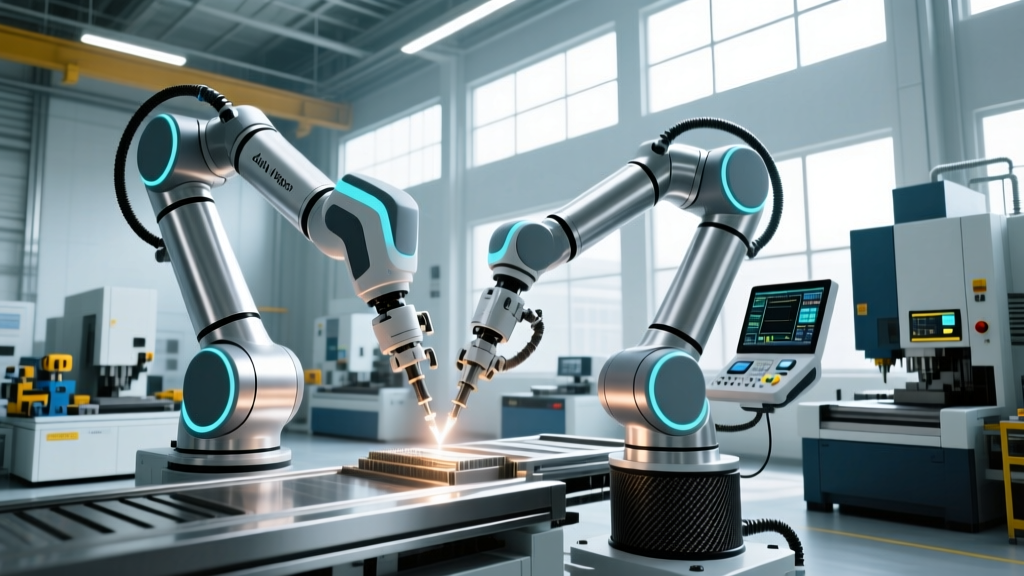
The OEM deployed the Universal Robots UR20, a heavy-payload collaborative robot capable of lifting 20kg with a 1750mm reach. Priced at approximately $52,000 for the base manipulator, the UR20 was paired with a Lincoln Electric Power Wave S500 welding power source and a Push-Pull MIG torch. To ensure safety without fencing, the OEM integrated Sick microScan3 Pro safety laser scanners configured with dynamic protective fields.
| Metric | Traditional Caged Cell | UR20 Cobot Cell (2026 Build) |
|---|---|---|
| Base Hardware Cost | $68,000 (6-axis industrial) | $52,000 (UR20) |
| Safety Infrastructure | $12,500 (Fencing, interlocks, light curtains) | $4,200 (Laser scanners, safety PLC) |
| Floorspace Required | 28 sq. meters | 11 sq. meters |
| Programming Time (New Part) | 14 hours (Teach pendant) | 3.5 hours (Hand-guiding + URCap) |
Navigating Safety Scanner Reflections
A major integration hurdle occurred when the polished stainless steel of the exhaust components caused specular reflections of the laser scanner beams, resulting in phantom safety stops. The OEM resolved this by angling the microScan3 scanners at a 4-degree downward tilt and applying a matte-black anodized finish to the interior of the welding fixture base. This non-obvious optical fix eliminated 98% of nuisance trips, a vital insight for any automation OEM working with reflective metal parts.
Technical Deep Dive: Standardizing the OEM Control Stack
According to the International Federation of Robotics (IFR), the most successful automation original equipment manufacturers are those that decouple their mechanical design from their control logic. By standardizing on open communication protocols, OEMs can swap out robot brands based on supply chain availability without rewriting the entire machine code.
Implementing PackML and OPC UA
Leading packaging OEMs are now strictly adhering to the ISA-TR88 (PackML) state model. By mapping every machine component—including the robot, conveyor VFDs, and vision systems—to a standardized state machine (e.g., Execute, Hold, Abort, Clear), OEMs drastically reduce the cognitive load on the end-user's maintenance team.
Furthermore, the transition to OPC UA over Time-Sensitive Networking (TSN) has become a baseline requirement in 2026. TSN guarantees deterministic data delivery on standard Ethernet networks, allowing the PLC to synchronize the robot's trajectory with a flying-shear cutter on a continuous web line with sub-millisecond jitter.
Standardized 2026 OEM Control Stack
- PLC / Motion Controller: Siemens S7-1500T (CPU 1516T-3 PN/DP) — ~$4,800
- Network Protocol: PROFINET IRT (Isochronous Real-Time) for drives; OPC UA for MES integration
- Robot Interface: Native PLCopen motion control blocks (eliminating the need for proprietary robot teach-pendant logic for primary path generation)
- HMI Framework: Standardized HTML5 web panels accessing the PLC's built-in web server, bypassing traditional SCADA licensing fees
Strategic Framework: Should Your OEM Build or Partner?
For machinery builders evaluating their robotics strategy, the decision to develop in-house integration capabilities versus partnering with a dedicated systems integrator hinges on production volume and IP sensitivity.
'The OEMs winning in 2026 are not the ones building the robots; they are the ones who have mastered the digital thread between the CAD model, the PLC simulation, and the physical machine commissioning.' — Industrial Automation Architect, Rockwell Automation Partner Network
Decision Matrix for OEM Robotics Integration
- High-Volume, Repeatable Machines (Build In-House): If your OEM ships more than 15 identical or highly similar machines per year, invest in an in-house robotics and PLC programming team. The upfront cost of standardizing your codebase (approx. $120,000 in engineering hours) will pay for itself by reducing on-site commissioning from 14 days to 3 days per machine.
- Low-Volume, Highly Custom Lines (Partner): If you build one-off, highly engineered production lines where the mechanical design changes by more than 40% per project, outsource the robot programming and safety validation to a certified integrator. This keeps your core engineering team focused on mechanical innovation and process chemistry.
- Hybrid Approach (The 2026 Standard): Develop a standardized 'Robotics Software Object Library' internally (e.g., pre-written function blocks for palletizing, pick-and-place, and conveyor tracking). Hand this library to your integration partners, ensuring that regardless of who programs the machine, the end-user receives a uniform diagnostic and operational interface.
Supply Chain Realities for Automation OEMs
While semiconductor shortages have largely stabilized, automation original equipment manufacturers must still navigate extended lead times for specialized mechanical components. Strain wave gears (harmonic drives) required for robotic joints and high-precision cycloidal reducers currently carry 16 to 22-week lead times from primary Asian suppliers. OEMs are responding by redesigning EOATs to utilize direct-drive torque motors where possible, bypassing the need for complex gearboxes in the end-effector and reducing both weight and procurement risk.