Palletizer Operator Training & Packaging Machinery Service Tips
Master end-of-line palletizer operator training and packaging machinery service best practices to reduce downtime and optimize automation throughput.
The Hidden Cost of End-of-Line Automation Bottlenecks
End-of-line palletizing is the final, and often most vulnerable, chokepoint in a high-speed packaging facility. When a FANUC M-410iC robotic arm or a Columbia Machine HL4000 conventional palletizer halts, the entire upstream production line—fillers, sealers, and labelers—must cascade to a stop. In fast-moving consumer goods (FMCG) and beverage manufacturing, unplanned downtime at the palletizer costs between $5,000 and $10,000 per hour in lost throughput and labor inefficiencies.
Critical Insight: Over 65% of end-of-line micro-stops (under 5 minutes) are resolved not by maintenance technicians, but by operators who possess advanced HMI fault-recovery training. Bridging the gap between basic machine operation and autonomous maintenance is the highest-ROI investment a plant manager can make.Effective operator training must transcend simple 'start and stop' button pushing. It requires a deep understanding of pneumatic tolerances, sensor calibration limits, and the precise threshold at which an issue must be escalated to professional packaging machinery service providers. This guide outlines the technical competencies required to maximize uptime on modern palletizing automation.
Core Operator Competencies for Robotic and Conventional Palletizers
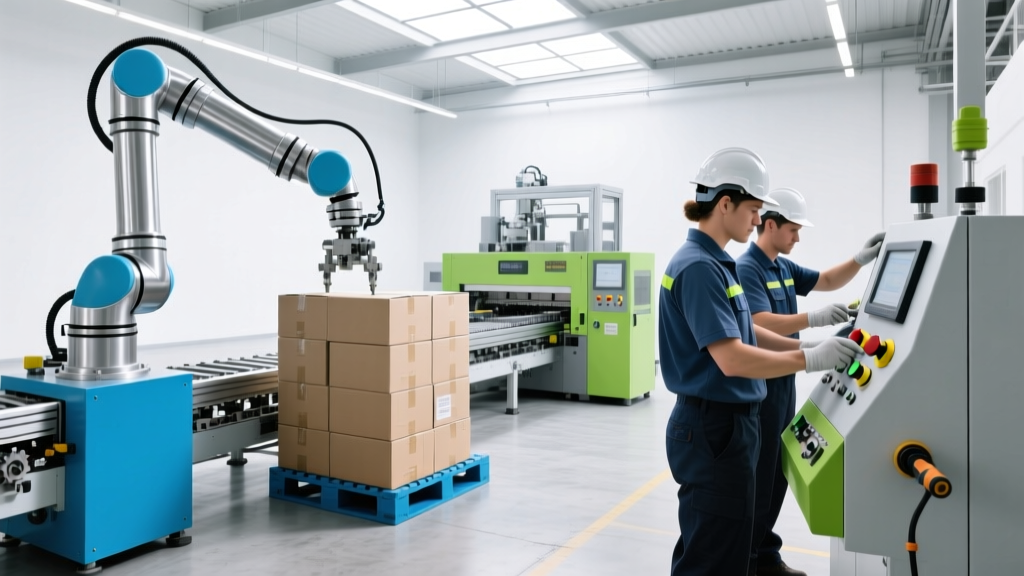
Modern palletizers rely on complex interplay between mechanical actuators, vacuum arrays, and PLC logic (typically Allen-Bradley ControlLogix or Siemens S7-1500 platforms). Operators must be trained on three primary mechanical subsystems.
1. Pneumatic and Vacuum System Monitoring
Layer-forming tables and robotic end-of-arm tooling (EOAT) rely on strict pneumatic parameters. For conventional palletizers like the Columbia HL series, operators must verify that main air pressure remains strictly between 85 and 95 PSI. A drop below 80 PSI will cause sluggish pneumatic cylinder actuation, leading to misaligned layer patterns and subsequent jamming.
For robotic palletizers utilizing vacuum EOAT, operators must monitor the vacuum generator gauges. Optimal gripping for corrugated cases requires a vacuum level between -0.4 and -0.6 bar. If operators notice increased dropped cases, they must be trained to inspect the Schmalz SPB1 or Piab piGRIP suction cups for corrugated dust buildup, which breaks the vacuum seal.
2. HMI Navigation and Fault Recovery
Operators must be proficient in navigating the Allen-Bradley PanelView or Siemens Comfort Panel HMI screens to identify the exact sequence step where a fault occurred. Training should focus on the 'Sequence Interlock' screen, which highlights the specific sensor blocking the machine cycle.
Shift-Level Autonomous Maintenance vs. Professional Packaging Machinery Service
A critical failure in many packaging plants is the conflation of operator duties with technician duties. To optimize equipment lifespan, facilities must implement Total Productive Maintenance (TPM) principles, clearly delineating daily autonomous maintenance (AM) from scheduled packaging machinery service.
| Maintenance Task | Frequency | Owner | Technical Specification |
|---|---|---|---|
| Vacuum Cup Cleaning | Every Shift | Operator | Wipe with isopropyl alcohol; check for tearing. |
| Photoeye Sensor Alignment | Every Shift | Operator | Verify SICK/Balluff sensor indicator lights are solid green. |
| Chain and Belt Tensioning | Monthly | Service Tech | Deflection must not exceed 1/2 inch under moderate pressure. |
| Servo Motor Greasing | Bi-Annually | OEM Service | Use OEM-specified lithium-complex grease; do not overpack. |
Troubleshooting Common Layer-Formation Failures
When a palletizer faults during the layer-formation or deposition phase, operators should follow a structured diagnostic tree before calling for external packaging machinery service.
- Slip Sheet Misalignment: If the slip sheet dispenser drops the cardboard layer off-center, operators must check the magazine guides. The guides should be set exactly 2mm wider than the slip sheet width. Additionally, inspect the Festo vacuum generators for clogged inline filters.
- Layer Table Height Sensor Faults: Conventional palletizers use proximity sensors to determine when the lowering table has reached the discharge conveyor height. If the table over-travels or stops too high, the SICK IM18 proximity sensor is likely coated in dust or has vibrated out of its mounting bracket. Operators should clean the sensor face and verify the sensing distance is set to 4mm-6mm from the metal target flag.
- Case Crushing During Squaring: If corrugated cases are crushing during the side-squaring phase, the pneumatic pressure on the squaring cylinders is too high. Operators must adjust the localized flow control valves to reduce the cylinder extension speed, ensuring a gentle but firm tamp.
Safety Protocols: Light Curtains and Zone Management
End-of-line palletizers operate with high kinetic energy. Robotic arms moving at 2,500mm/s and conventional layer tables dropping 400 lbs of product pose severe crushing hazards. Safety systems must never be bypassed, and operators must be trained on the specific reset protocols for safety devices.
According to OSHA's robotics safety guidelines and NIOSH robotics safety research, the majority of palletizer-related injuries occur not during normal operation, but during fault recovery when operators enter the guarded workspace without executing proper Lockout/Tagout (LOTO) or utilizing the teach pendant's reduced-speed enabling devices.
Managing SICK deTec4 Light Curtains
Most modern cells utilize SICK deTec4 Core safety light curtains at the operator entry points. Operators must understand the difference between a 'Muting' state and a 'Tripped' state. Muting allows full pallets to exit the cell via conveyor without breaking the light beam, utilizing secondary muting sensors. If a light curtain faults without an obstruction, operators should check for reflective interference from nearby stainless steel surfaces or accumulation of stretch wrap debris on the emitter/receiver lenses.
Escalation Triggers for OEM Support
Operators must know exactly when a problem exceeds shift-level troubleshooting and requires specialized packaging machinery service. Escalate immediately to OEM-certified technicians if you observe:
- Servo Drive Alarms: Any fault code indicating a 'Following Error' or 'Encoder Loss' on the main hoist or robotic axes. This indicates internal feedback loop failures requiring proprietary diagnostic software.
- PLC Communication Drops: Intermittent loss of connection between the main PLC and remote I/O blocks (e.g., Allen-Bradley POINT I/O), which usually signifies a failing EtherNet/IP switch or corrupted firmware.
- Structural Deflection: Visible bowing or hairline fractures on the main mast or robotic base plate, often caused by repeated emergency stops under full load.
Frequently Asked Questions
How often should robotic palletizer EOAT suction cups be replaced?
In high-speed environments processing standard RSC (Regular Slotted Container) corrugated cases, Piab or Schmalz silicone suction cups should be replaced every 6 to 9 months. If processing shrink-wrapped bundles, the abrasive nature of the plastic film reduces cup lifespan to 3 to 4 months. Operators should log cup wear rates to optimize spare parts inventory.
Can operators modify layer patterns on the HMI without engineering support?
Yes, provided the HMI is equipped with a pattern editor wizard (common on modern FANUC PalletTool software and Columbia Machine HMIs). However, operators must be trained to calculate the maximum layer weight and ensure the new pattern maintains a 2-inch interlocking overlap to prevent load shifting during stretch wrapping. Modifying patterns that alter the center of gravity requires a review by the packaging engineering team.
What is the most common cause of stretch wrap integration faults at the palletizer discharge?
The most frequent failure is a misaligned pallet transfer. If the palletizer discharges the load 1-2 inches off-center on the conveyor, the downstream rotary stretch wrapper's photoeyes will miscalculate the load dimensions, causing the film carriage to strike the corners of the cases. Operators must ensure the pallet centering stops at the discharge conveyor are properly adjusted and that the pneumatic pop-up stops are fully extending.