End-of-Line Palletizing for Doypack Packaging Machinery
Master end-of-line palletizing for doypack packaging machinery. Learn robotic gripper calibration, case packing, and layer pad best practices.
The Doypack Palletizing Paradox: Why Flexible Pouches Break End-of-Line Automation
Integrating end-of-line automation with upstream doypack packaging machinery presents a unique mechanical challenge. While modern horizontal form-fill-seal (HFFS) machines can reliably produce stand-up pouches at speeds exceeding 140 ppm, the transition to secondary case packing and tertiary palletizing is where Overall Equipment Effectiveness (OEE) frequently collapses. Unlike rigid PET bottles or corrugated boxes, doypacks possess a variable geometric profile. The crown of a 1kg spouted pouch can sit 30mm to 45mm higher than the shoulders, and the flexible multi-layer film structure is highly susceptible to crushing, static cling, and shifting during robotic acceleration and deceleration.
For plant managers and packaging line operators, mastering the end-of-line transition requires moving beyond standard rigid-container programming. This guide details the precise End-of-Arm Tooling (EOAT) configurations, vacuum calibration protocols, and pattern-layering strategies required to palletize flexible pouches reliably in 2026's high-speed manufacturing environments.
⚠️ Operator Warning: Static Charge in Mono-Material PE FilmsWith the industry's aggressive shift toward recyclable mono-material polyethylene (PE) doypacks, operators must account for severe static buildup. PE laminates generate high triboelectric charges on accumulation conveyors, causing pouches to cling to guide rails or stick together in the case packer drop zone. Best Practice: Install active ionizing air bars (e.g., Fraser 3024) exactly 150mm upstream of the robotic pick-point, and ensure conveyor belts are grounded via copper slip rings to dissipate surface charges below 2kV.
EOAT Selection Matrix: Matching Grippers to Doypack Formats
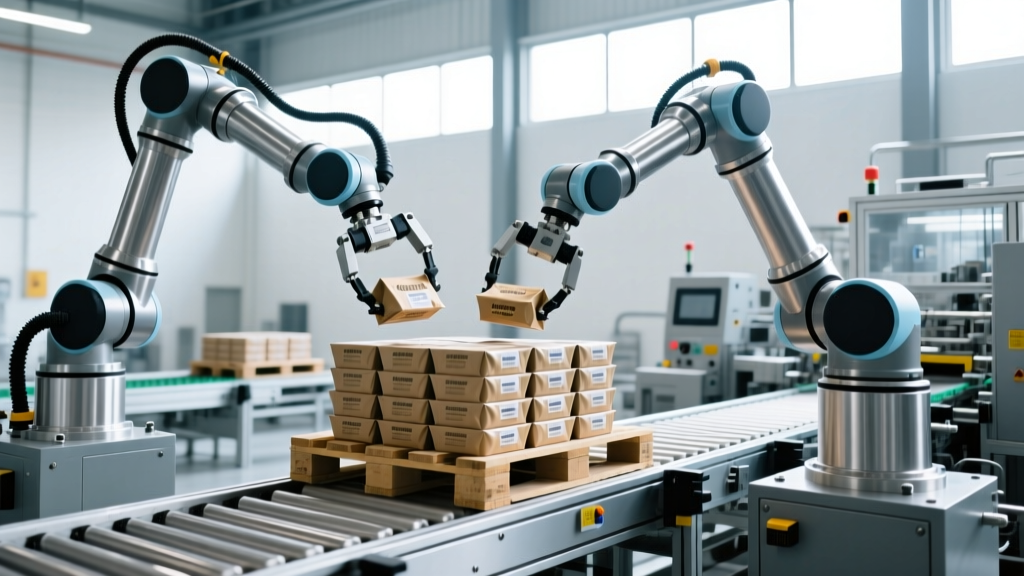
Selecting the wrong gripper for a specific doypack format is the leading cause of dropped loads and micro-tears in the film seal. Operators must configure the robotic palletizer—such as a FANUC M-410iC or KUKA KR QUANTEC PA—with an EOAT that matches the pouch's structural integrity.
| Doypack Format | Recommended EOAT Type | Critical Operator Adjustment |
|---|---|---|
| Standard Flat-Bottom (Powder/Granule) | High-Flow Vacuum Array with Foam Lip | Set vacuum to -55 kPa; use 60mm diameter bellows cups to absorb crown height variance. |
| Spouted Pouch (Liquids/Viscous) | Hybrid (Vacuum + Mechanical Side-Clamp) | Clamp pressure must not exceed 15 PSI to avoid forcing liquid past the spout seal. |
| Zipper-Top Retort Pouch | Fork/Scoop Style with Bottom Support | Retort films are slippery; vacuum cups fail. Use pneumatic forks to slide entirely beneath the pouch base. |
Step-by-Step Calibration for Vacuum Cup Arrays
When running standard flat-bottom doypacks, vacuum generators must be tuned to handle the micro-porosity of modern sustainable films. Follow this calibration sequence during line changeovers:
- Inspect the Sealing Lip: Ensure the polyurethane foam sealing lip on the suction cups is free of film dust and ink residue. Wipe with isopropyl alcohol (IPA) every 4 hours.
- Set the Ejector Pulse: Program the vacuum generator (e.g., Schmalz X-Pump) to emit a 0.2-second compressed air blow-off pulse upon release. Flexible films tend to stick to the cups; without a blow-off, the robot will lift the pouch, drop it, and pull it back, tearing the top seal.
- Calibrate the Deceleration Ramp: In the robot controller, reduce the maximum deceleration rate by 15% compared to rigid box settings. Sudden stops cause the liquid or powder inside the doypack to surge forward, breaking the vacuum seal.
Upstream Case Packing: Controlling the 'Bulge' Before the Palletizer
A robotic palletizer cannot fix a poorly formed case. Doypacks inherently bulge at the base when filled. If operators use standard drop-packers, the pouches will tumble and create an uneven, un-palletizable surface.
The Solution: Utilize wrap-around case packers or side-load cartoners with active compression belts. Operators must adjust the side-squish belts on the accumulation table to apply exactly 2-3 mm of lateral compression. This forces the doypacks into a uniform, rectangular block before the corrugated blank is wrapped around them. If the compression is too tight (>5mm), the zipper profiles will engage prematurely, or the spouts will be pushed out of alignment, causing jams in the case sealer.
Pallet Patterns and the 'Zipper Lean' Phenomenon
One of the most insidious issues in doypack palletizing is cumulative lean. Zipper doypacks are not perfectly uniform; the zipper track adds approximately 3mm to 4mm of thickness to the top of the pouch compared to the sealed bottom edge.
📐 The Math of Zipper Lean:If you stack a column of 5 zipper doypacks, the top of the stack will lean by up to 20mm (5 x 4mm). By the time a pallet reaches 5 layers high, the lean compounds to 100mm, resulting in a collapsed pallet during forklift transport.
Operator Fix: Never use a pure column-stack pattern for zipper pouches. Program the palletizer to alternate the orientation of the pouches 180-degrees on every layer (zipper-left on layer 1, zipper-right on layer 2). Furthermore, mandate the insertion of a 3mm corrugated layer pad every 3 layers to reset the vertical plumb line.
Safety and Ergonomics in Manual Intervention Zones
While end-of-line automation reduces heavy lifting, operators frequently enter the palletizer cell to clear jammed layer pads or reset misaligned cases. According to OSHA's ergonomic guidelines, repetitive twisting while clearing jams at floor level is a primary cause of musculoskeletal disorders in packaging plants.
To comply with modern safety standards outlined by the Association for Advancing Automation (A3), facilities must integrate Safety PLCs that differentiate between a full E-stop and a Safe Speed Reduction. When an operator opens the access gate, the FANUC or KUKA robot should not drop power; instead, it should enter a collaborative monitoring state, reducing its speed to 250mm/s. This allows the operator to safely extract a jammed doypack from the EOAT without requiring a full 5-minute system reboot and homing sequence, saving massive amounts of downtime.
Troubleshooting Decision Tree: Dropped Loads and Shifted Patterns
When the palletizer faults due to a dropped load or a shifted layer, operators should follow this diagnostic sequence rather than simply clearing the fault and restarting:
- Symptom: Pouch drops during the vertical lift phase.
- Cause A: Vacuum leak due to film crease. Fix: Adjust upstream shingling conveyor to prevent pouch overlap.
- Cause B: Clogged vacuum filter. Fix: Replace the 5-micron sintered bronze filter in the EOAT manifold (required weekly for powder products).
- Symptom: Pallet pattern shifts outward on the 4th layer.
- Cause A: Layer pad friction too low. Fix: Switch from glossy chipboard pads to unbleached kraft corrugated pads (higher coefficient of friction).
- Cause B: Robot placement Z-axis offset. Fix: Recalibrate the drop-height. The EOAT must release the layer exactly 5mm above the previous layer to prevent the robot tool from dragging across the pouches during retraction.
Final Calibration Checklist for Shift Supervisors
Before signing off on a doypack palletizing changeover, verify the following parameters:
1. Ionizing bar output is >5kV and air nozzles are clear.
2. Accumulation belt side-guides are spaced exactly 2mm wider than the pouch width.
3. Layer pad magazine vacuum separators are pulling single sheets without double-feeds.
4. Pallet pattern alternation is active to neutralize zipper/crown lean.
By treating the flexible nature of doypacks as a core mechanical variable rather than an anomaly, packaging facilities can push their end-of-line OEE above 92%, matching the high speeds of their upstream filling equipment.