Food Packaging Machinery Manufacturers for Eco-Friendly Materials
Compare top food packaging machinery manufacturers for eco-friendly materials. Analyze Syntegon, Multivac, and Ishida for mono-PE and PLA films.
The Shift to Sustainable Substrates: Why Legacy Machines Fail
As global CPG brands accelerate their 2026 sustainability mandates, operations teams face a severe mechanical bottleneck. Transitioning from multi-layer PET/PE laminates to mono-materials (like all-PE structures) or compostable biopolymers (PLA, PBAT) fundamentally alters the physics of the packaging line. When evaluating food packaging machinery manufacturers for eco-friendly materials, plant managers quickly discover that legacy equipment tuned for traditional laminates fails catastrophically on sustainable films.
⚠️ Critical Failure Modes on Legacy Equipment:- Thermal Burn-Through: PLA has a dangerously narrow heat-seal window (often just 12°C to 15°C). Standard cam-driven thermal jaws overshoot this, melting the film and causing chain-jams.
- Film Tracking & Stretch: Mono-PE lacks the tensile strength of PET. Standard friction-pull belts stretch the film, resulting in misregistered prints and skewed cross-seals.
- Static Buildup: Paper-based barrier films generate high static charges, causing web-breaks at the forming collar and inconsistent tension control.
According to the Ellen MacArthur Foundation, achieving true circularity requires packaging to be designed for recycling from the substrate up, but the machinery must be equally capable of processing these novel structures at commercial speeds (80+ bags per minute). This necessitates a strategic pivot toward OEMs that engineer specifically for low-temperature sealing and high-friction web handling.
Comparing Top Food Packaging Machinery Manufacturers for Eco-Lines
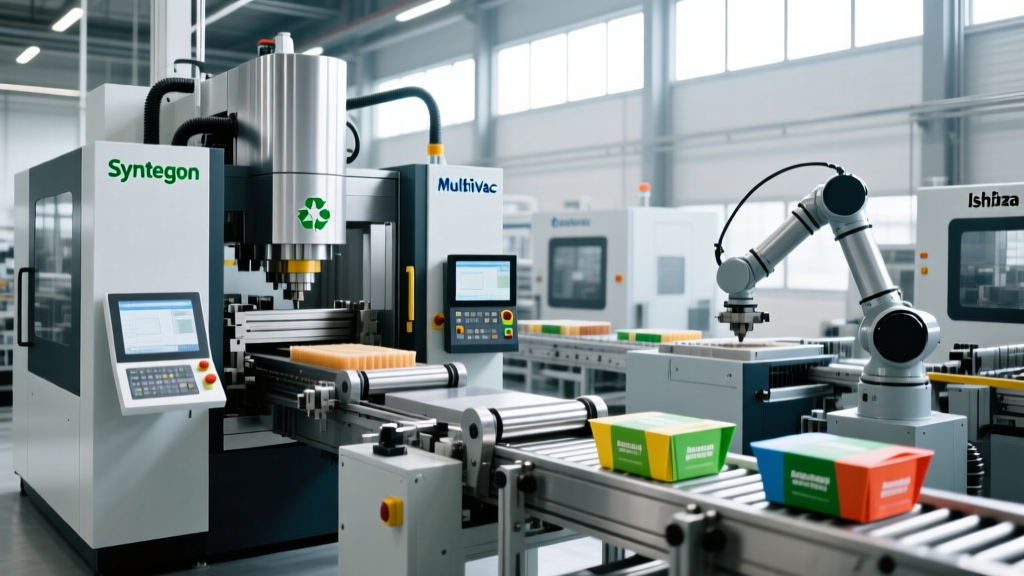
Not all OEMs approach sustainable packaging with the same engineering philosophy. Below is a direct comparison of three dominant food packaging machinery manufacturers and their flagship platforms for eco-friendly substrates.
| Manufacturer & Model | Primary Eco-Substrate | Sealing Technology | Est. Capital Cost (2026) |
|---|---|---|---|
| Syntegon SVE 4220 (VFFS) | Mono-PE, High-Friction Paper | Servo-driven cross seal with ultrasonic option | $185,000 - $240,000 |
| Multivac R 535 (Thermoformer) | Fiber-trays, rPET, Thin-gauge PP | Induction heating & precise dwell control | $450,000 - $620,000 |
| Ishida Inspira (Flow Wrapper) | Compostable PBAT/PLA blends | Low-temp thermal & cold-seal compatible | $140,000 - $195,000 |
Syntegon: The Mono-Material VFFS Specialist
Syntegon (formerly Bosch Packaging) dominates the vertical form-fill-seal (VFFS) space for dry foods and powders. The SVE 4220 platform addresses the primary failure point of mono-PE: film stretching. By utilizing independent servo-driven pull-belts rather than mechanical friction bands, the SVE 4220 dynamically adjusts tension based on the film's coefficient of friction (COF). For powdery products like protein isolate or flour, Syntegon offers an ultrasonic sealing upgrade. Ultrasonic welding (typically at 20 kHz or 35 kHz) creates hermetic seals through product contamination in the seal area, a common issue that causes leakers in traditional thermal jaws when running recyclable PE structures.
Multivac: Thermoforming for Fiber and rPET
For fresh proteins, cheeses, and ready meals, the shift is toward fiber-based trays with thin PE/EVOH barrier liners, or ultra-thin recycled PET (rPET). Multivac’s R 535 thermoformer is engineered with a highly adaptable forming station that prevents the micro-tearing common in brittle rPET and rigid paper-board composites. Their proprietary induction heating systems allow for rapid, localized heating of the sealing flange without warping the underlying fiber tray. While the capital expenditure is high, the material savings from downgauging top-webs by up to 30% typically yields an ROI within 22 months on high-volume lines.
Ishida: Precision Flow Wrapping for Compostables
Compostable films like PBAT and PLA blends are notoriously difficult to run on horizontal flow wrappers due to their low melting points and high susceptibility to heat distortion. Ishida’s Inspira series utilizes advanced motion-control algorithms that dynamically adjust the dwell time of the cross-seal jaws on a per-bag basis. If the line slows down, the thermal mass of the jaws is instantly compensated via PID controllers to prevent burn-through. Ishida is the preferred alternative for bakeries and confectioners transitioning to certified home-compostable wrappers.
Retrofit vs. Replace: A Decision Framework for Plant Managers
Capital expenditure committees frequently debate whether to retrofit existing packaging lines or purchase new eco-ready machinery. Use the following decision matrix to determine the most viable path for your facility.
✅ When to RETROFIT (Estimated Cost: $35,000 - $65,000)
- Machine Age: Less than 7 years old with existing servo-driven architecture.
- Target Substrate: Mono-PE or recyclable PP (materials that require better tension control but standard thermal sealing).
- Required Upgrades: Swap standard friction belts for servo pull-belts; upgrade forming collars to low-friction anodized aluminum or Teflon-coated steel; install static elimination bars (ionizers) at the film unwind.
❌ When to REPLACE (New Machine Required)
- Machine Age: Over 10 years old, relying on mechanical cam-drives and chain-linkages.
- Target Substrate: Compostable biopolymers (PLA, PBAT, PHA) or ultra-thin paper barriers.
- The 'Why': Cam-driven machines cannot dynamically alter jaw dwell times or temperatures on the fly. Biopolymers require micro-second adjustments to thermal profiles that legacy PLCs and mechanical linkages physically cannot execute.
Critical Tooling Upgrades for Sustainable Films
Beyond the base machine, the tooling interface dictates the success of an eco-friendly packaging run. Standard OEM tooling is optimized for multi-layer laminates. When sourcing from food packaging machinery manufacturers, specify the following tooling modifications for sustainable materials:
- Jaw Face Geometry: Transition from standard serrated jaws to flat-faced or micro-serrated jaws. Deep serrations cut through thin mono-material films, causing micro-leaks that compromise shelf life.
- Thermal Insulation Blocks: Install high-grade ceramic or mica insulation blocks between the heating element and the machine chassis. This stabilizes jaw temperature, reducing fluctuations from ±5°C down to ±1°C, which is critical for the narrow seal windows of PLA.
- Forming Collar Shoulders: Request 'zero-drag' forming shoulders with integrated air-cushions or specialized UHMW (Ultra-High-Molecular-Weight) polyethylene coatings. This prevents the scuffing and delamination of delicate paper-based barrier films as they are pulled over the collar.
Industry Standards and Sourcing Verification
When vetting machinery for sustainable packaging, ensure the OEM's equipment complies with the latest safety and hygiene standards for novel materials. The Packaging Machinery Manufacturers Institute (PMMI) provides extensive guidelines on machine safety and material handling updates, particularly regarding the dust explosion risks associated with certain biodegradable starch-based films.
Furthermore, verify that the machine's sealing parameters can be validated against ASTM F2029 (Standard Guide for Making Heat Seals) and ASTM F88 (Seal Strength Testing). A reputable manufacturer will conduct a 72-hour Factory Acceptance Test (FAT) using your exact sustainable film gauge and product, providing a documented seal-strength matrix before the equipment is shipped. Do not accept generic 'eco-film' guarantees; demand empirical data on burst pressure and creep resistance for the specific mono-material or compostable structure your brand has selected.