Aseptic Egg Packaging Machinery: Troubleshooting Guide
Diagnose and fix common failures in aseptic egg packaging machinery. Expert troubleshooting for liquid egg filling, sterilization, and sealing systems.
The Thermal-Protein Paradox in Liquid Egg Aseptic Lines
Operating aseptic egg packaging machinery requires balancing two conflicting thermal requirements. The packaging material (typically HDPE bottles or multilayer cartons) must be sterilized using hydrogen peroxide (H2O2) vaporized at 280°C to 300°C. Simultaneously, the liquid egg product (LEP)—whether whole egg, albumen, or yolk—must be maintained below 60°C during the filling phase. Egg whites (albumen) begin to denature and coagulate at 62°C, while yolks coagulate at 65°C. When aseptic fillers like the Tetra Pak A3/Flex, Syntegon ALF, or GEA Aseptic Fillers experience thermal bleed-over, the result is not just a mechanical jam; it is a critical biological hazard.
CRITICAL STERILITY WARNING: Never bypass the H2O2 concentration sensors or thermal interlocks on aseptic fillers. A drop below 30% H2O2 concentration or a vaporization temperature below 275°C compromises the 6-log reduction of Salmonella Enteritidis, directly violating FDA aseptic packaging regulations. Downtime in high-volume LEP facilities costs between $15,000 and $25,000 per hour, but a sterility breach costs millions in recalls.Diagnosing Filling Valve Coagulation (The 'Cooked Egg' Fault)
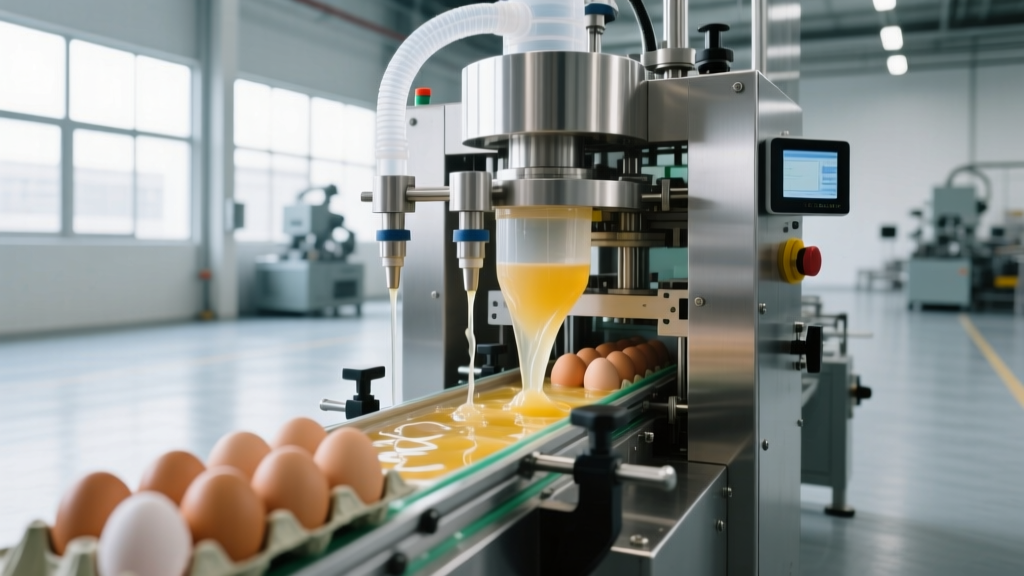
The most frequent cause of micro-leakers and uneven fill volumes in liquid egg packaging machinery is protein coagulation inside the filling valve. Modern aseptic fillers use magnetic flowmeter-controlled membrane valves. If the cooling jacket surrounding the valve fails, radiant heat from the adjacent sterilization tunnel migrates into the product contact zone.
Symptom Identification
- Visual: White, rubbery strings or particles visible in the filled product or caught in the inline strainer.
- Operational: Filling valve exhibits 'drip' or 'stringing' post-dosing, leading to contaminated bottle threads.
- Telemetry: PLC registers intermittent flowmeter deviations due to increased product viscosity near the valve seat.
Corrective Actions
- Verify Coolant Flow: Check the propylene glycol cooling jacket. The flow rate must be strictly maintained at 12 to 15 L/min with an inlet temperature of 4°C. If flow is adequate but valve temp exceeds 55°C, the internal thermal barrier is compromised.
- Inspect PTFE Seats: Degraded PTFE (Teflon) valve seats lose their insulating properties. Replace membrane seals every 1,500 operating hours or immediately if thermal scoring is visible.
- Recalibrate Dosing: Coagulated product alters fluid dynamics. Flush the system with a 60°C enzymatic detergent before recalibrating the Endress+Hauser Promag flowmeters to prevent under-filling.
H2O2 Vaporization and Packaging Sterilization Faults
Packaging sterilization relies on 35% food-grade H2O2 vaporized by quartz heaters. If the vapor condenses before contacting the inner surface of the bottle or carton, sterility is lost, and residual peroxide levels will exceed the FDA-mandated limit of 0.5 ppm.
| Symptom | Root Cause | Corrective Action |
|---|---|---|
| Wet spots on inner foil seal | H2O2 condensation due to low tunnel temp or poor exhaust | Recalibrate quartz heaters to 285°C; clean exhaust fan impellers to restore 400 CFM draw |
| High residual H2O2 (>0.5 ppm) | Insufficient sterile hot air drying phase post-dosing | Increase sterile air knife pressure to 1.2 bar; verify HEPA filter integrity (DOP test) |
| Brittle or warped HDPE bottle necks | Radiant heater overshoot or slow line speed | Adjust PID controller deadband; ensure line speed does not drop below 8,000 BPH during sterilization |
CIP/SIP Residue and Biofilm Edge Cases
Liquid egg products are notoriously difficult to clean. Yolks contain high lipid (fat) content, while whites are almost pure protein. Standard alkaline Clean-In-Place (CIP) protocols used for water or juice will fail to remove egg residue, leading to biofilm formation that shields pathogens during the Sterilize-In-Place (SIP) phase. According to the CDC's guidelines on Salmonella and eggs, environmental persistence in processing equipment is a primary vector for contamination.
Process Engineering Maxim: The most catastrophic failures in liquid egg aseptic lines are thermal, not mechanical. A mere 3°C deviation in the filling zone cooks the albumen, creating a protein matrix that shields pathogens from standard CIP caustics, directly violating USDA FSIS egg safety mandates.
Optimized CIP Chemistry for Egg Packaging Machinery
To prevent biofilm-induced SIP failures, maintenance teams must implement a dual-phase chemical wash:
- Phase 1 (Alkaline Wash): 1.5% to 2.0% Sodium Hydroxide (NaOH) at 75°C for 20 minutes. This saponifies the yolk fats and breaks down initial protein bonds.
- Phase 2 (Acid Wash): 0.8% to 1.0% Nitric Acid at 65°C for 15 minutes. This is non-negotiable for egg lines; it dissolves the calcium-protein complexes and mineral scales that alkaline washes leave behind.
- SIP Validation: Steam injection must hold all product contact surfaces at 143°C for a minimum of 30 minutes. Use calibrated thermocouples at the furthest dead-legs (e.g., sampling valves) to verify thermal penetration.
Induction Sealing and Cap Torque Deviations
Aseptic LEP bottles rely on foil induction seals to maintain the sterile barrier post-capping. A common failure mode is micro-leaking detected at the 14-day shelf-life mark. This is rarely a foil defect; it is almost always a cap torque anomaly caused by thermal expansion.
As HDPE bottles exit the 280°C sterilization tunnel, the bottle neck is thermally expanded. If the capping head applies torque while the plastic is still expanded, the plastic will contract as it cools on the conveyor, reducing the effective top-load pressure on the foil seal.
Troubleshooting the Capping Station
- Implement a Cooling Delay: Ensure the bottle travels through a forced sterile-air cooling tunnel for at least 4 seconds before reaching the capping turret.
- Adjust Magnetic Clutches: Set the capping head magnetic clutches to 1.8 Nm to 2.0 Nm. Torque below 1.6 Nm will result in seal creep; torque above 2.2 Nm will stress-crack the HDPE threads.
- Verify Induction Generator: For standard 38mm caps with a 0.05mm aluminum foil liner, the induction generator (e.g., Enercon Super Seal) should be tuned to 2.5 kW with a conveyor line speed matching the filler (typically 15 to 25 meters per minute).
Preventative Maintenance & Calibration Intervals
Reactive maintenance in aseptic egg packaging machinery guarantees eventual biological failure. Implement the following strict calibration schedule to maintain E-E-A-T compliance and operational uptime:
- Every 72 Hours: Calibrate the H2O2 concentration refractometer using certified 30% and 35% reference solutions. Sensor drift is common due to crystallization on the optical prism.
- Weekly: Perform a DOP (Dioctyl Phthalate) or PAO integrity test on the sterile air HEPA filters supplying the filling chamber and drying tunnel.
- Monthly: Ultrasonically inspect the filling valve cooling jackets for internal scaling. Glycol scaling reduces heat transfer efficiency by up to 15%, leading to the 'cooked egg' fault.
- Annually: Replace all elastomeric seals (EPDM or Viton) in the product zone, regardless of visual condition, as egg lipids cause microscopic swelling that compromises aseptic boundaries over time.