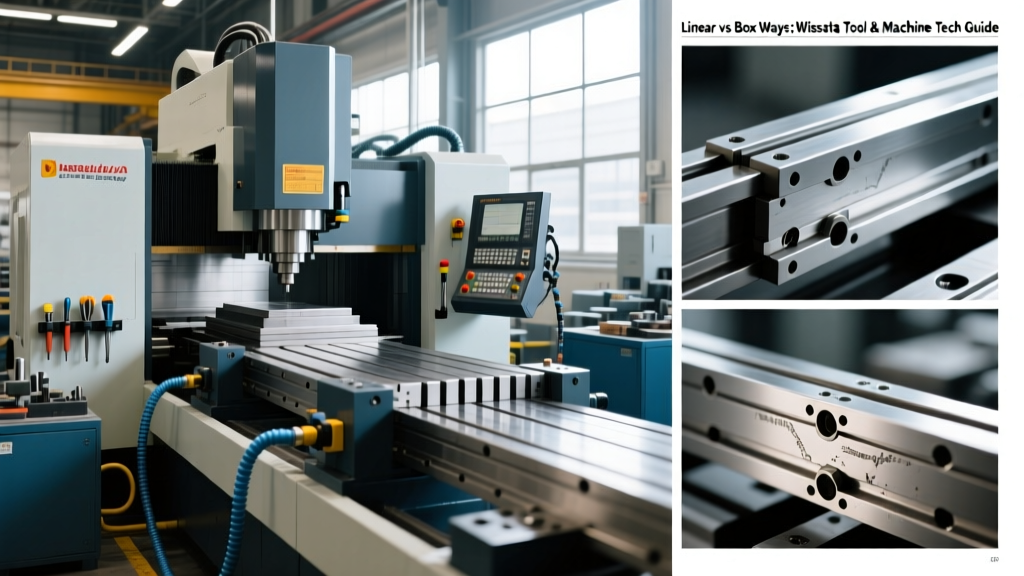
Linear vs Box Ways: Wissota Tool & Machine Tech Guide
Explore the technical specs of linear vs box ways in CNC machines, featuring tooling and fixturing insights from Wissota Tool & Machine.
The Kinematics of Machine Tool Way Systems
The structural interface between the moving carriage and the stationary bed of a CNC machine tool is defined by its way system. This interface dictates the machine's dynamic stiffness, positioning accuracy, and maximum feed rates. For precision tooling and custom fixture manufacturers like Wissota Tool & Machine, the way system of the machining centers they operate directly influences the geometric tolerances and surface finishes achievable on complex workholding components. Understanding the tribology and kinematics of linear guideways versus traditional box ways is essential for optimizing machining parameters and selecting the right equipment for specific manufacturing tasks.
Core Distinction: Linear guideways utilize recirculating rolling elements (balls or rollers) for near-frictionless motion, prioritizing speed and precision. Box ways rely on sliding surface contact, prioritizing structural rigidity, heavy load capacity, and vibration damping.Linear Guideways: Technical Specifications & Dynamics
Linear guideways achieve motion through recirculating ball or cylindrical roller bearings trapped between a hardened steel rail and a carriage block. The rolling elements reduce the coefficient of friction ($\mu$) to approximately 0.002 to 0.005, allowing for rapid traverse rates exceeding 100 m/min in high-speed machining centers.
Recirculating Element Geometry and Contact Angles
The load capacity and rigidity of a linear guide are governed by the contact angle of the rolling elements. A standard 45-degree contact angle provides equal load ratings in all four primary directions (radial, reverse radial, and lateral). However, for heavy-duty milling applications where downward cutting forces dominate, manufacturers utilize a 30-degree contact angle, which increases the radial load capacity by approximately 15% while sacrificing lateral rigidity.
According to technical data from THK's linear motion engineering specifications, the choice between ball and roller elements is critical. Roller-type linear guides offer a line contact rather than a point contact, yielding up to 30% higher rigidity and a 200% increase in basic dynamic load rating compared to ball-type guides of the same physical dimensions.
Preload Classes and System Rigidity
To eliminate internal clearance and increase system stiffness, linear guides are manufactured with specific preload classes. Preload is applied by using oversized rolling elements. Applying excessive preload, however, increases friction, generates heat, and reduces the operational lifespan of the guide.
| Preload Class | Preload Force (% of C) | Primary Application | Friction Impact |
|---|---|---|---|
| C0 (Light / Clearance) | 0% - 2% | General automation, low-load transfer | Minimal |
| C1 (Medium) | 2% - 4% | Standard CNC milling, moderate cutting forces | Moderate |
| C2 (Heavy) | 4% - 8% | Heavy roughing, high-rigidity boring | High (Requires forced cooling) |
Box Ways: Sliding Friction and Damping Dynamics
Box ways consist of a sliding interface, traditionally cast iron moving against cast iron, enclosed in a box-like structural configuration. While their coefficient of friction is significantly higher ($\mu \approx 0.05$ to $0.10$), their primary advantage lies in their massive surface area contact and superior vibration damping characteristics.
The Stick-Slip Phenomenon and Turcite Integration
The inherent challenge of metal-on-metal sliding surfaces is the 'stick-slip' phenomenon, where the static coefficient of friction is noticeably higher than the kinetic coefficient. This causes the carriage to 'jump' microscopically at low feed rates, destroying surface finish and positioning accuracy.
To mitigate this, modern box-way machines utilize engineered polymer composites like Turcite-B or Rulon applied to the moving way surface. These materials reduce the static friction coefficient to approximately 0.06, nearly matching the kinetic friction and eliminating stick-slip. Furthermore, Turcite acts as a sacrificial wear surface, protecting the expensive cast-iron bed from scoring in the event of lubrication failure.
"The damping capacity of a box-way system is typically 5 to 10 times greater than that of a linear guideway system. This high damping ratio ($\zeta \approx 0.15$) absorbs the high-frequency chatter generated during heavy interrupted cuts, which is critical when machining hard metals or large, asymmetrical weldments."
Hand Scraping and Oil Retention Specifications
Unlike linear rails which are ground and assembled, box ways require meticulous hand scraping to achieve geometric alignment and oil retention. The standard specification for a precision box way is 12 to 20 points per square inch (PPI). These microscopic high points support the load, while the scraped valleys act as micro-reservoirs to maintain a hydrodynamic oil film. If the PPI is too low, the way will wear rapidly; if it is too high (over-scraped), the oil reservoirs are eliminated, leading to metal-to-metal contact and galling.
Wissota Tool & Machine: Fixturing and Way System Synergy
For custom tooling and fixture manufacturers like Wissota Tool & Machine, the physical realities of way systems dictate how workholding solutions are designed and machined. When producing large, custom weldments for heavy-duty workholding, the machining process involves severe interrupted cuts on uneven surfaces. If performed on a linear-way machine, the lack of damping can induce regenerative chatter, resulting in poor surface finishes on the fixture bases and accelerated tool wear.
By utilizing box-way machining centers for heavy fixture roughing, manufacturers leverage the high damping ratio to maintain stable cutting forces. Conversely, when Wissota Tool & Machine produces high-volume, tight-tolerance aerospace tooling from aluminum or pre-hardened steels, linear-way machines are deployed to utilize high-speed machining (HSM) toolpaths. The low friction of linear guides allows for the rapid acceleration and deceleration required by HSM, reducing cycle times on complex 3D contouring operations.
Decision Matrix: Selecting the Way System for Tooling Production
Selecting the correct machine tool based on its way system requires analyzing the specific material removal rates (MRR), part geometry, and tolerance requirements of the tooling being manufactured.
| Parameter | Linear Guideways (Roller Type) | Box Ways (with Turcite-B) |
|---|---|---|
| Max Traverse Speed | 60 - 120 m/min | 15 - 24 m/min |
| Damping Ratio ($\zeta$) | 0.01 - 0.03 (Low) | 0.10 - 0.20 (High) |
| Static Rigidity | High (Dependent on Preload) | Very High (Massive Surface Area) |
| Lubrication Requirement | NLGI Grade 2 Grease or ISO VG 32 Oil | ISO VG 68 to VG 220 Way Oil |
| Ideal Tooling Application | Aluminum aerospace fixtures, high-speed die molds | Heavy steel weldments, large casting fixture bases |
Lubrication Tribology and Maintenance Protocols
The operational lifespan of both way systems is entirely dependent on precise lubrication management. The Society of Manufacturing Engineers (SME) frequently highlights that improper way lubrication is a leading cause of premature CNC machine failure and geometric drift.
- Linear Ways: Require clean, low-viscosity lubricants. Grease lubrication (NLGI 2 with lithium complex thickener) is preferred for sealed environments, offering maintenance intervals of 3 to 6 months. If oil is used, ISO VG 32 is standard, delivered via automated metered injectors at intervals of 2 to 4 hours of active runtime.
- Box Ways: Demand high-viscosity, tacky way oils (ISO VG 68 for horizontal ways, ISO VG 220 for vertical ways) formulated with anti-wear and friction-modifier additives. The oil must possess high 'stickiness' to prevent being wiped off the way surface by the wipers during movement. Continuous flow or high-volume metered systems are mandatory; gravity feed systems are insufficient for modern CNC cycle times.
Summary of System Selection
The choice between linear guideways and box ways is not a matter of one being universally superior, but rather a strict alignment of machine kinematics with manufacturing requirements. Linear ways provide the velocity and precision necessary for modern high-speed machining of non-ferrous and pre-hardened materials. Box ways deliver the structural mass and damping required for heavy, interrupted cuts on large-scale tooling and weldments. Manufacturers like Wissota Tool & Machine leverage both technologies, matching the machine's way system to the specific dynamic forces generated by the workholding components they engineer, ensuring optimal tool life, surface integrity, and geometric accuracy.