Blender Machine Tools: Troubleshooting Flood vs Mist Coolant Systems
Expert troubleshooting guide for flood and mist coolant systems on blender machine tools. Fix pressure drops, MQL clogs, and sump foaming.
Diagnosing Coolant Failures in Blender Component Machining
Machining industrial blender components—such as high-shear impellers, 316L stainless steel mixing vats, and 4140 alloy steel drive shafts—imposes severe thermal and mechanical loads on blender machine tools. The choice between flood coolant and Minimum Quantity Lubrication (MQL or mist) directly dictates tool life, surface finish, and cycle times. However, when these delivery systems degrade, the resulting work hardening of stainless steel or built-up edge (BUE) on aluminum lids can destroy tooling in minutes.
This guide provides actionable troubleshooting frameworks for flood and MQL systems specifically configured for the demanding tolerances of blender manufacturing.
Rapid Diagnostic Matrix: Symptom to Solution
| Symptom on Blender Tooling | Probable Root Cause | System Type | Immediate Corrective Action |
|---|---|---|---|
| Severe foaming in sump; poor surface finish on 316L vat walls | Tramp oil contamination > 2% or water hardness < 50 ppm | Flood | Run belt skimmer for 4 hours; add calcium-based coolant conditioner to raise hardness to 150 ppm. |
| MQL nozzle dripping fluid instead of atomizing; tool chipping on aluminum lids | Air-to-fluid pressure mismatch or worn needle valve seat | Mist/MQL | Verify air pressure at 60-90 PSI and fluid pressure at 10-30 PSI. Replace Unist/Biel needle valve if dripping persists. |
| Chatter marks on 4140 blender shafts during deep hole drilling | High-Pressure Coolant (HPC) flow starvation at the cutting edge | Flood (HPC) | Check centrifugal pump impeller for swarf scoring. Ensure delivery pressure maintains 1,000+ PSI at the spindle union. |
| White smoke accumulation; operator respiratory irritation | MQL fluid viscosity too high for ambient shop temperature, causing incomplete atomization | Mist/MQL | Switch to a lower viscosity ester-based MQL fluid (e.g., 20-30 cSt at 40°C) or install a fluid heater to maintain 75°F. |
Flood Coolant System Troubleshooting
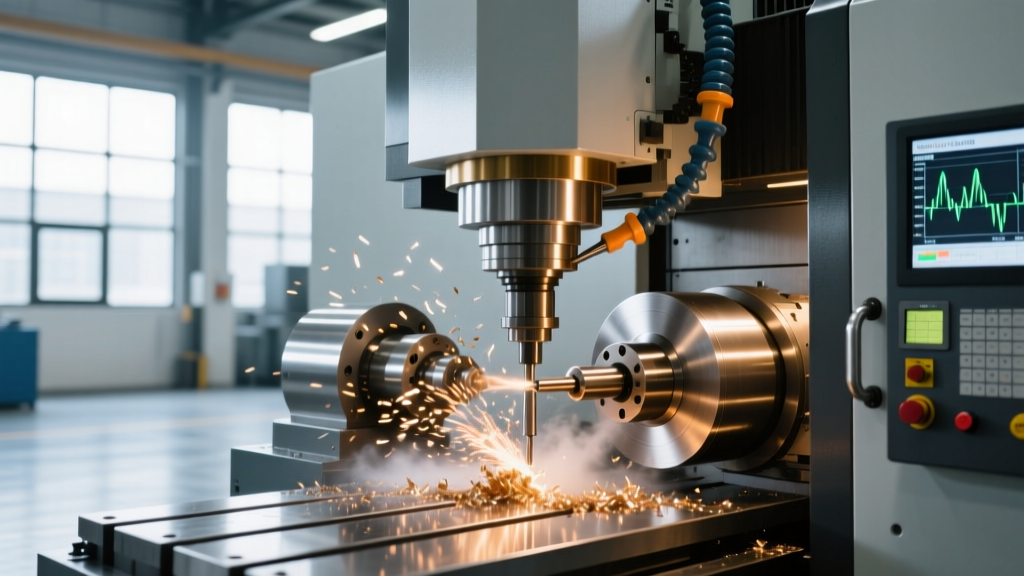
Flood coolant remains the standard for heavy roughing operations on blender machine tools, particularly when milling thick 316L stainless steel plates for mixer housings. The primary failure modes involve concentration drift, pressure loss, and biological degradation.
Concentration and Refractometer Calibration
A common mistake in machine shops is relying on visual inspection of the coolant sump. For machining tough blender alloys, maintain a strict 8% to 10% concentration. If you are using a semi-synthetic fluid like Master Chemical TRIM MicroSol 585XT, you must account for the refractometer multiplier (typically 5.5). A refractometer reading of 1.5 Brix actually indicates an 8.25% concentration (1.5 x 5.5).
Technical Warning: Never top off a flood sump with straight water. As coolant evaporates, only the water leaves, concentrating the minerals and chemical additives. Always top off with a pre-mixed solution at 2% to 3% concentration to maintain the sump's chemical balance and prevent rust on the machine tool's cast iron ways.Resolving High-Pressure Coolant (HPC) Drops
When gun-drilling or deep-hole boring the main drive shafts of industrial ribbon blenders, standard 40-60 PSI flood coolant cannot penetrate the cutting zone. Shops utilize HPC systems delivering 1,000 to 1,500 PSI. If pressure drops at the tool tip despite the pump running at capacity:
- Inspect the Spindle Union: High-pressure rotary unions degrade rapidly if subjected to lateral runout. Check the union seals for micro-leaks. Replacement seals (often PTFE-based) cost around $150-$300 but prevent catastrophic pressure loss.
- Clear the Tool Nozzles: Carbide drills with internal coolant channels (e.g., 0.8mm diameter holes) easily clog with fine 316L swarf. Use a specialized high-pressure blowout gun rated for 2,000 PSI to clear the channels from the shank end.
- Check the Pump Impeller: If the shop's coolant filtration is only 50 microns, fine abrasive particles will score the tungsten carbide or hardened steel impellers inside the HPC pump, dropping volumetric efficiency by up to 30%.
Mist and MQL System Repair
Minimum Quantity Lubrication (MQL) is highly effective for finishing operations on blender machine tools, such as face-milling aluminum alloy top covers or tapping mild steel access panels. MQL systems typically consume only 5 to 15 mL of fluid per hour, eliminating the $800-$1,500 cost of sump disposal and reducing operator exposure to hazardous metalworking fluid aerosols.
Fixing Atomization Failures
The most frequent MQL failure is fluid dripping from the nozzle rather than forming a dry, micron-sized aerosol. This ruins the surface finish on aluminum blender lids by causing hydraulic shock at the cutting edge. Atomization requires a precise balance of air volume and fluid metering.
- Air Pressure: Must be strictly regulated between 60 and 90 PSI (4-6 bar) at the mixing chamber.
- Fluid Pressure: Should be maintained between 10 and 30 PSI to push the ester-based lubricant into the air stream.
- Hose Routing: MQL delivery hoses must not have dips or U-bends. Because the fluid volume is so low, gravity will pool the lubricant in the low points of the hose, causing intermittent 'slugs' of fluid to hit the tool. Route all MQL lines with a continuous downward slope from the generator to the nozzle.
Needle Valve and Generator Maintenance
If adjusting the pressures does not resolve dripping, the internal needle valve in the aerosol generator (such as those found in Unist or Biel systems) is likely worn. The brass or stainless steel needle seat degrades after roughly 4,000 hours of operation. Rebuilding the MQL mixing chamber requires a $250-$400 seal and needle kit. When reassembling, apply a light coat of the MQL fluid itself to the O-rings; never use petroleum-based greases, which will react with the ester lubricants and clog the micro-orifices.
Decision Framework: Flood vs. Mist for Blender Tooling
Selecting the correct coolant delivery method depends entirely on the specific blender component being machined and the material's thermal conductivity. Refer to Sandvik Coromant's cutting fluid application data for baseline material requirements, but use this shop-floor matrix for final decisions:
| Blender Component | Material | Operation | Recommended System | Rationale |
|---|---|---|---|---|
| Mixing Vat / Tank | 316L Stainless Steel | Heavy Roughing & Profile Milling | Flood (High Volume) | 316L has low thermal conductivity. Flood coolant is mandatory to pull heat away from the cut and prevent severe work hardening. |
| Top Cover / Lid | 6061-T6 Aluminum | Finishing & Face Milling | MQL / Mist | Aluminum dissipates heat rapidly. MQL provides sufficient lubrication to prevent BUE while keeping chips dry for easy vacuum extraction. |
| Main Drive Shaft | 4140 Alloy Steel | Deep Hole Drilling / Boring | Flood (HPC > 1000 PSI) | Requires high-velocity fluid to evacuate chips from deep cavities. MQL cannot provide the mechanical force needed for chip evacuation. |
| Shear Impeller Blades | 17-4 PH Stainless | Precision Turning | Flood (Through-Tool) | Hardened precipitation stainless requires intense, targeted cooling directly at the shear zone to maintain dimensional tolerances. |
Preventative Maintenance Schedule
To prevent unplanned downtime on blender machine tools, implement this strict maintenance cadence for your coolant infrastructure:
Daily (Operator Level)
- Check flood coolant concentration with a calibrated refractometer. Log the Brix reading and pH (target 8.8 - 9.2).
- Inspect MQL fluid reservoir levels. Top up only with the exact manufacturer-specified ester fluid; never mix brands.
- Verify HPC pressure gauge readings at the spindle union during the first tool change of the shift.
Weekly (Maintenance Technician)
- Empty the tramp oil skimmer collection tank. If the skimmer is pulling more than 2 gallons of tramp oil per week, investigate the machine tool's way lube system for internal leaks.
- Purge MQL delivery lines by running the air-only cycle for 60 seconds to blow out any pooled fluid or micro-condensation.
- Check flood coolant nozzle alignment. Vibrations from heavy milling can shift flexible Loc-Line hoses, directing coolant away from the cutting edge.
Quarterly (Facility Level)
- Perform a full sump clean-out on flood systems. Use a tramp oil splitter or hire a professional coolant recycling service to centrifuge the fluid, removing sub-10 micron fines that cause abrasive wear on the machine tool's linear guideways.
- Replace the desiccant in the MQL air preparation unit. Moisture in the compressed air line will emulsify the ester fluid inside the generator, causing erratic atomization and internal corrosion.