Beyond the Machine Tools Definition: 2026 Brand Cost & Value Analysis
Move past the basic machine tools definition. Compare 2026 TCO, hidden costs, and resale value for Haas, DN Solutions, and Mazak VMCs to optimize your budget.
While the academic machine tools definition categorizes equipment simply as power-driven machines used to shape, cut, or deform solid materials, modern CNC buyers know this textbook description fails to capture the financial complexity of capital equipment acquisition. In 2026, purchasing a Vertical Machining Center (VMC) is less about the cast-iron weight and more about the Total Cost of Ownership (TCO). A machine's true cost includes initial capital outlay, control licensing, spindle lifecycle expenses, energy consumption, and eventual resale depreciation.
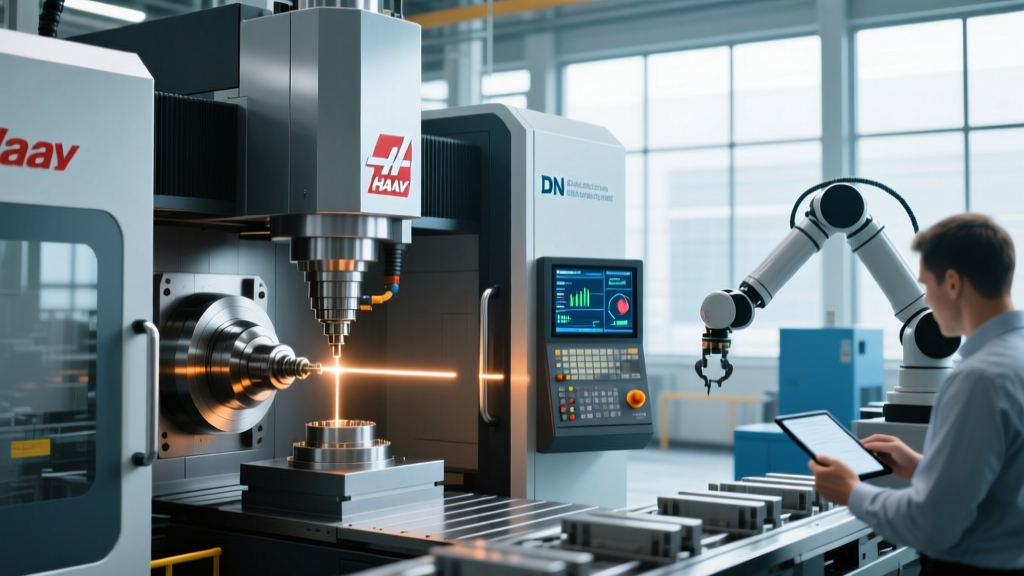
For job shops and production facilities planning their 2026 capital expenditures, understanding the financial nuances between Tier 1 and Tier 2 brands is critical. This analysis dissects the real-world costs of three dominant VMC platforms: the Haas VF-2SS, the DN Solutions (formerly Doosan) DNM 4500, and the Mazak VCN-530C.
The 2026 VMC Total Cost Matrix
Base MSRP is a misleading metric. The 'Out-The-Door' (OTD) price includes mandatory options like chip conveyors, high-pressure coolant (HPC), and basic probing, which are rarely included in the brochure price. Below is a realistic 2026 TCO snapshot for a standard 40-taper VMC configured for production.
| Brand & Model | Base MSRP | Typical OTD Cost | 5-Yr Spindle Replacement | Control Licensing |
|---|---|---|---|---|
| Haas VF-2SS | $74,500 | $98,200 | $8,500 (Direct Drive) | Free (Lifetime) |
| DN Solutions DNM 4500 | $92,000 | $118,500 | $12,000 (Belt/Gear) | FANUC: ~$1,200/yr |
| Mazak VCN-530C | $115,000 | $148,000 | $18,500 (Integral Motor) | SmoothAi: Included base |
Budget Planning Callout: The OTD Multiplier
When forecasting capital requirements, apply a 1.35x multiplier to the base MSRP for Tier 2 brands (Haas, DN Solutions) and a 1.28x multiplier for Tier 1 brands (Mazak). Tier 1 machines typically include more standard productivity features (like standard Renishaw probing and HPC) in their base configuration, narrowing the gap between brochure price and final invoice.
Brand-Specific Hidden Costs & Value Traps
Every manufacturer structures their pricing and options differently. Failing to anticipate brand-specific 'gotchas' can blow a Q3 equipment budget by 15% or more.
Haas Automation: The Option Creep
Haas is famous for its accessible entry price, but the Next Generation Control (NGC) ecosystem relies heavily on a la carte option codes. If your 2026 production schedule requires a 4th-axis rotary table, you must purchase the physical Haas HRT210 ($6,200) and the software option code for 4-axis simultaneous machining. Furthermore, while Haas provides lifetime control software updates, hardware failures on the NGC mainboard outside of the standard 1-year warranty require full board replacements costing upwards of $3,500. Haas offers the best value for 3-axis prismatic parts, but complex multi-axis add-ons erode the initial price advantage rapidly.
DN Solutions: The Third-Party Markup
The DNM 4500 is a rigid, heavy-duty workhorse favored for aggressive steel milling. However, DN Solutions relies on FANUC controls and third-party accessories. When equipping the machine with a Renishaw OMP60 probe and a Toolsetter, you are often buying these through the dealer network rather than direct from the accessory manufacturer. This introduces a 15% to 25% dealer markup on the probing package. Additionally, FANUC's strict licensing model means that unlocking advanced features like High-Speed A.I. Contour Control (AI APC) requires purchasing parameter unlocks that can add $4,000 to $7,000 to the final build sheet.
Mazak: The Premium Productivity Tax
Mazak's VCN-530C commands a premium, justified by the MAZATROL SmoothAi control and superior thermal stability. The hidden cost here is not in hardware, but in training and integration. SmoothAi is incredibly powerful for conversational programming, but it requires a distinct skill set. If your shop floor is staffed entirely by G-code/M-code veterans accustomed to FANUC or Haas, expect a 3-to-6-month productivity dip and $2,500 per programmer in specialized Mazak training courses. Furthermore, while the base control includes many features, advanced 5-axis TCP (Tool Center Point) calibration software and specific robotic integration packages require annual subscription licenses.
Energy Consumption and Facility Requirements
According to research from NIST's Advanced Manufacturing Programs, energy efficiency in machine tools is becoming a critical factor in facility-level cost modeling. The power draw of a VMC extends beyond the spindle motor.
- Haas VF-2SS: Peak draw is approximately 35 kVA. Haas machines are relatively lightweight and utilize standard servo motors. They are cost-effective to run on standard shop drop power but lack advanced regenerative braking systems.
- DN Solutions DNM 4500: Requires a robust 45 kVA supply due to its high-torque gear/belt spindle configuration and heavy-duty coolant pumps. Facility electrical upgrades to support multiple DNM units can add $10,000+ to the installation budget.
- DMG MORI / Mazak Tier 1: While initial draw is high (40+ kVA), premium brands increasingly utilize regenerative drive systems that feed kinetic energy from spindle deceleration back into the machine's power supply, reducing net consumption by up to 12% during high-cycle start/stop operations.
Depreciation Curves and Resale Realities
Capital expenditure tracking by The Association For Manufacturing Technology (AMT) consistently shows that machine tool residual values fluctuate based on brand perception, control obsolescence, and local dealer support. When modeling a 5-year TCO, you must subtract the projected resale value.
'A machine tool is a depreciating asset, but the rate of decay is dictated by the brand's secondary market liquidity. Premium iron holds its geometric accuracy longer, making it more desirable to secondary buyers machining tight-tolerance aerospace or medical components.'
— Secondary Equipment Market Analysis, 2025/2026
5-Year Resale Value Estimates (Assuming 2,000 hours/year utilization):
- Mazak VCN-530C: Retains ~60-65% of OTD value. The MAZATROL ecosystem and Mazak's certified pre-owned program create a highly liquid secondary market.
- DN Solutions DNM 4500: Retains ~45-50% of OTD value. The FANUC control is universally understood, making it an easy sell to general job shops, though the initial premium depreciates faster than Mazak.
- Haas VF-2SS: Retains ~35-40% of OTD value. Because Haas produces such a high volume of VF-series machines, the secondary market is saturated. Buyers expect steep discounts on used Haas equipment.
The 2026 Capital Allocation Decision Tree
Do not default to the cheapest brochure price. Use this framework to align your machine tool purchase with your shop's specific operational profile:
Scenario A: High-Mix, Low-Volume Job Shop
Priority: Fast setup, conversational programming, probe integration.
Optimal Choice: Mazak VCN-530C. The higher initial OTD cost is offset by drastically reduced setup times via MAZATROL Quick Mazak and superior out-of-the-box probing. The 5-year TCO is lower due to higher resale value and reduced scrap rates during first-article runs.
Scenario B: High-Volume, Commodity Prismatic Parts
Priority: Low initial capital, fast chip-to-chip times, standard G-code.
Optimal Choice: Haas VF-2SS. If you are running 10,000-part batches of aluminum brackets where cycle time and initial ROI trump 5-axis flexibility, the Haas platform offers the fastest path to break-even. Keep the configuration simple to avoid option creep.
Scenario C: Heavy Steel & Titanium Roughing
Priority: Rigidity, high torque at low RPM, vibration damping.
Optimal Choice: DN Solutions DNM 4500. The heavier casting and gear-driven spindle options provide the necessary mass and torque for hard metals. Budget for the FANUC AI APC parameter unlock to ensure surface finish quality during heavy roughing passes.
Understanding the true financial footprint of these platforms requires looking far beyond the standard machine tools definition. By modeling the out-the-door costs, anticipating brand-specific licensing traps, and accurately forecasting residual values, manufacturing leaders can allocate 2026 capital budgets with precision, ensuring new equipment drives profitability rather than hidden overhead.