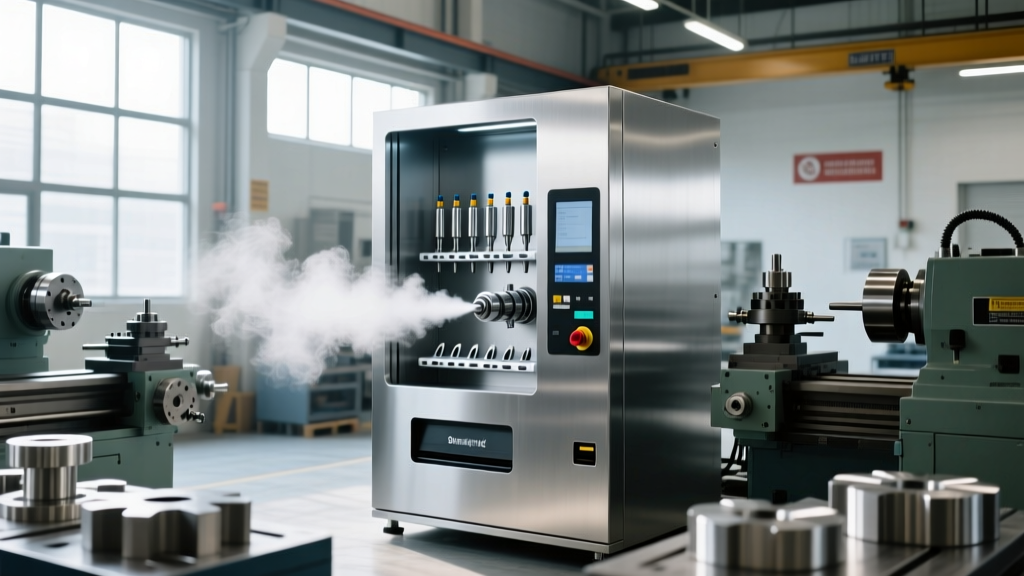
Smart Vending Machine for Tools: Flood vs Mist Cooling Inventory
Transitioning from flood to mist cooling? Learn how to reconfigure your vending machine for tools to manage MQL nozzles, coolant-through drills, and fluid.
The Shift from Flood to MQL: Why Tool Cribs Must Adapt
The manufacturing sector's pivot toward Minimum Quantity Lubrication (MQL)—commonly known as mist cooling—is accelerating rapidly in 2026. Driven by stringent environmental regulations on metalworking fluid disposal and the push for near-dry machining, shops are retiring traditional flood coolant systems. However, the bottleneck in this transition rarely lies in the CNC spindle or the machine enclosure; it lies in the tool crib. If your vending machine for tools is still stocked, tracked, and configured for flood-cooling consumables, your MQL transition will suffer from hidden inefficiencies and tooling failures.
Flood cooling and mist cooling require fundamentally different tooling architectures, fluid chemistries, and maintenance schedules. A modern smart vending machine for tools must act as the central nervous system for this transition, tracking precise MQL nozzle orifices, coolant-through carbide assemblies, and ester-based fluid consumption. This guide details exactly how to reconfigure your tool inventory management system to support advanced coolant technologies.
2026 MQL Adoption & Fluid Cost Reality Check
- Flood Coolant Disposal: Hazardous waste hauling for spent semi-synthetic emulsions now averages $1.20 to $1.80 per gallon in major industrial hubs, up from $0.85 in 2023.
- MQL Ester Oil Costs: High-performance biostable MQL fluids cost $45 to $65 per gallon, but consumption drops to 10-20 mL per hour.
- Tool Life Variance: Coolant-through drills operating on MQL show a 15% increase in tool life in aluminum, but a 20% decrease in heavy interrupted steel cuts if nozzle calibration is incorrect.
Flood vs. Mist Cooling: A Technical & Inventory Comparison
Understanding the physical differences between these systems is critical for setting minimum and maximum par levels in your vending software. Flood cooling relies on high-volume (10-20 GPM) water-soluble emulsions to cool the workpiece and evacuate chips. The fluid chemistry requires constant pH monitoring (maintaining 8.5-9.5) and biocide additives to prevent bacterial growth. Mist cooling (MQL) uses aerosolized fatty alcohols or synthetic esters delivered directly to the cutting edge via compressed air (4-6 bar). MQL fluids are biostable, eliminating the need for tramp oil skimmers and pH balancers in your crib inventory.
| Parameter | Flood Cooling Systems | Mist (MQL) Cooling Systems | Vending Machine Tracking Metric |
|---|---|---|---|
| Fluid Delivery | External hoses, manifold nozzles | Internal tool channels, precision air/oil mixers | Track internal vs. external holder tapers (HSK/Capto) |
| Nozzle Wear | Low (plastic/rubber hoses) | High (brass/steel orifices clog with fines) | Set strict 40-hour lifecycle limits on MQL nozzles |
| Chip Evacuation | High-pressure fluid flushing | Compressed air blast + specialized chip breakers | Link MQL dispensing to specific polished-flute endmills |
| Fluid Storage | 55-gallon drums, central sumps | 1-liter cartridges, integrated machine reservoirs | Integrate liquid dispensing module with load cells |
Reconfiguring Your Vending Machine for Tools
Upgrading to a smart vending machine for tools—such as the AutoCrib SV1000, Seco Point, or Zoller smartLabel systems—requires both hardware retrofits and software logic updates to handle MQL consumables. The physical dimensions and dispensing mechanisms for MQL tooling differ vastly from standard flood-cooling accessories.
Step 1: Matrix Drawer Calibration for MQL Nozzles
MQL applicator nozzles are highly sensitive to orifice diameter, typically ranging from 0.3mm to 2.5mm. A 0.8mm nozzle might provide perfect lubrication for aluminum face milling, but attempting to slot 316 stainless steel with that same nozzle will result in oil starvation, built-up edge (BUE), and catastrophic tool failure. Your vending machine matrix drawers must be recalibrated to separate these nozzles into distinct coils.
Actionable Setup: Configure the vending software to require the operator to input the workpiece material and operation type before dispensing an MQL nozzle. The system should then automatically recommend and dispense the correct orifice size (e.g., 1.5mm for steel slotting, 0.5mm for aluminum finishing).
Step 2: RFID Tracking for Coolant-Through Assemblies
Tools like the Sandvik CoroDrill 860 or Kennametal Beyond Blast rely on internal coolant channels. In an MQL environment, these micro-channels must be perfectly clean; even a microscopic accumulation of aerosolized oil and fine chips will restrict airflow and cause thermal cracking at the cutting edge.
Actionable Setup: Utilize the RFID chips embedded in modern tool holders (like HSK-A63 with dual-channel air/oil ports). Program the vending machine to track cumulative cutting time. After 45 minutes of active machining, the machine should lock out the tool and mandate a return to the crib for ultrasonic cleaning before it can be checked out again.
'The most common cause of MQL failure in 2026 is not the machine tool, but the operator grabbing a standard external coolant holder because the internal MQL holder was buried in the bottom of the vending matrix. Spatial organization in the tool crib directly dictates near-dry machining success.' — Advanced Machining Fluids Report, 2025
Troubleshooting MQL Failures via Tool Crib Data
When mist cooling fails, the vending machine for tools holds the diagnostic data required to fix the issue. By analyzing checkout logs, shop floor managers can identify operational bottlenecks.
- Symptom: Chips welding to the flutes of a carbide endmill during aluminum pocketing.
- Crib Data Check: Vending logs show the operator checked out a standard 3-flute endmill and a 0.5mm MQL nozzle.
- The Fix: The operator needs a polished-flute, 2-flute endmill designed specifically for MQL chip evacuation, paired with a 1.2mm nozzle. Update the vending software to bundle these items together in a single 'MQL Aluminum Pocketing' virtual kit.
- Symptom: Thermal shock and micro-chipping on CBN inserts during hardened steel turning.
- Crib Data Check: MQL fluid dispensing logs show a 40% drop in fluid draw for that specific CNC asset.
- The Fix: The machine's internal MQL mixer is clogged. Dispatch maintenance to clean the Venturi tube, and temporarily dispense a high-pressure external flood nozzle from the crib to keep the spindle running.
The Dual-Inventory Reality: When Flood Still Wins
Despite the massive push toward sustainability and near-dry machining, MQL is not a universal panacea. As outlined by the EPA Pollution Prevention guidelines, while reducing fluid waste is a priority, shops must maintain a dual-inventory for edge cases where flood cooling remains mandatory.
Your vending machine for tools must maintain a 20/80 split in inventory to support these high-demand operations:
- Deep-Hole Drilling (>10xD): MQL air pressure cannot reliably evacuate chips from deep cavities in materials like Inconel 718. High-pressure flood coolant (1,000+ PSI) is required to prevent chip packing and drill breakage.
- Heavy Interrupted Cuts: The thermal shock of interrupted milling on titanium alloys (Ti-6Al-4V) requires the massive heat-absorption capacity of water-based flood emulsions. MQL esters will simply flash off, leading to rapid flank wear.
- Creep-Feed Grinding: The sheer volume of heat generated in deep-profile grinding demands high-flow flood nozzles to prevent workpiece metallurgical damage (burn).
For these operations, the vending machine must stock heavy-duty chip breakers, high-pressure external coolant manifolds, and tramp oil skimmer replacement belts. According to OSHA Metalworking Fluids Standards, managing the mist and aerosol exposure from these high-pressure flood systems requires strict maintenance of machine enclosures and mist collectors, which should also be tracked as consumable assets within your vending system.
ERP Integration and Automated Procurement
The ultimate innovation in 2026 tool crib management is the integration of the vending machine for tools with the shop's ERP system (such as Epicor or JobBOSS). Modern vending units can be equipped with liquid dispensing modules featuring integrated load cells. When an operator scans their badge to refill an MQL cartridge, the machine dispenses exactly 1.2 liters of ester oil and deducts it from the digital inventory.
When the central MQL reservoir scale drops below 15%, the vending software automatically triggers a purchase order to the fluid supplier, factoring in current lead times and upcoming production schedules. This closed-loop system eliminates the hidden costs of emergency fluid shipments and ensures that the transition from flood to mist cooling remains seamless, profitable, and environmentally compliant.