Linear vs Box Ways in a Screw Machine Tool: Technical Guide
Compare linear guideways and box ways in screw machine tools. Explore technical specs, damping ratios, friction coefficients, and CNC Swiss applications.
The Kinematic Foundation of Screw Machine Tools
The way system dictates the fundamental limits of geometric accuracy, chatter resistance, and rapid traverse speeds in any precision manufacturing equipment. When engineering or specifying a modern screw machine tool—whether a multi-spindle automatic or a CNC Swiss-type lathe—the selection between traditional box ways and linear guideways is the most critical structural decision. This choice determines whether the machine will excel at high-speed micro-machining of medical implants or heavy-duty interrupted cutting of aerospace fasteners.
While modern CNC Swiss screw machine tools predominantly utilize linear motion systems for their speed and precision, heavy-duty multi-spindle screw machines often retain box way architectures to manage extreme vibrational loads. Understanding the exact technical specifications, tribology, and damping characteristics of both systems is essential for process engineers and machine buyers.
Technical Highlight: The primary differentiator between way systems is the friction coefficient ($\mu$). Box ways operate on sliding friction ($\mu \approx 0.05$ to $0.15$ depending on lubrication and liners), while linear guideways utilize rolling friction ($\mu \approx 0.002$ to $0.005$). This two-order-of-magnitude difference dictates the machine's dynamic response and power consumption.Box Ways: Sliding Friction and Superior Damping
Box ways rely on large surface areas of sliding metal-to-metal (or metal-to-polymer) contact. In high-end screw machine tools, the base and saddle are typically cast from Meehanite or high-grade gray cast iron. The mating surfaces are precision scraped by hand or CNC-guided scraping machines to achieve 10 to 16 bearing points per square inch, creating microscopic oil pockets that maintain hydrodynamic lubrication even at low velocities.
Vibration Absorption and Interrupted Cuts
The defining advantage of box ways in a screw machine tool is their inherent damping capacity. Cast iron and the sliding oil film absorb vibrational energy significantly better than rolling elements. According to structural dynamics testing in machine tool design, a box way system can dampen vibrations up to 10 times more effectively than an equivalent linear guide system. This is why multi-spindle screw machines, such as the Tornos MultiAlpha series, utilize box ways or hydrostatic way systems. When performing heavy cross-drilling, broaching, or polygon milling on 316L stainless steel or Inconel, the interrupted cuts generate severe harmonic chatter. The mass and friction of box ways dissipate this energy, protecting the spindle bearings and ensuring surface finish integrity.
Overcoming Stick-Slip with Polymer Liners
Historically, box ways suffered from the "stick-slip" phenomenon, where the static friction coefficient is higher than the dynamic friction coefficient. This causes jerky motion during micro-positioning (e.g., a 0.002 mm depth-of-cut adjustment). Modern screw machine tools eliminate this by bonding PTFE-based composite way liners, such as Turcite-B or Moglice, to the sliding surfaces. These materials reduce the friction coefficient to approximately 0.06 and equalize static and dynamic friction, enabling smooth, sub-micron positioning while retaining the massive load-bearing footprint of the box way.
Linear Guideways: Rolling Friction and High-Speed Dynamics
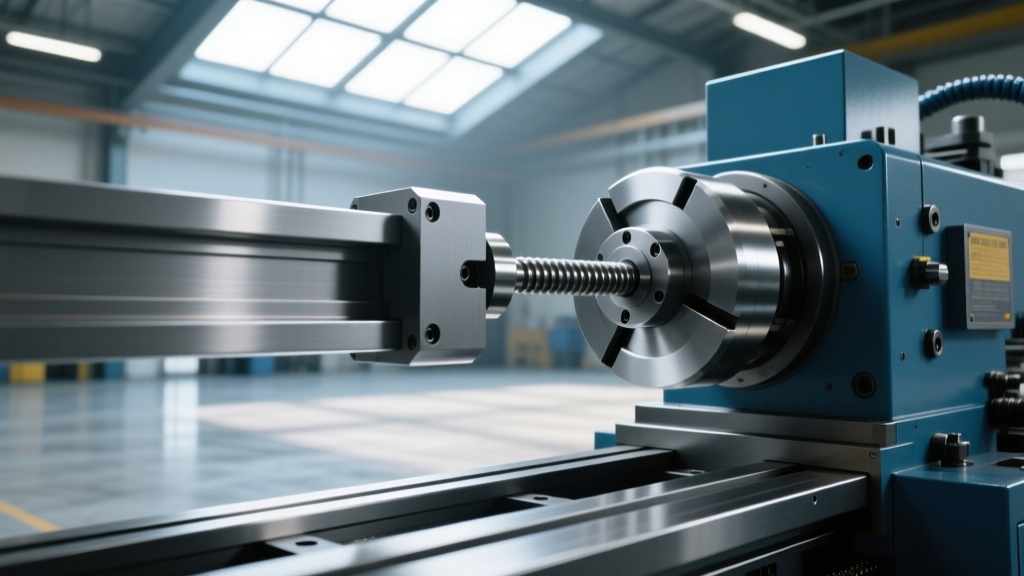
Linear guideways replace sliding contact with recirculating ball or cylindrical roller bearings housed in precision-machined carriages. For CNC Swiss-type screw machine tools—like those manufactured by Star Micronics, Citizen, and Tsugami—linear guides are the undisputed standard. The guide bushing and tool slides must accelerate and decelerate rapidly to machine complex, micro-diameter parts in cycle times measured in seconds.
Preload Classes and Static Rigidity
Unlike box ways, which rely on mass and geometry for rigidity, linear guides achieve rigidity through internal preload. Preload is the intentional introduction of oversized rolling elements to eliminate internal clearance. According to technical specifications from leading manufacturers like THK Linear Motion Systems and Bosch Rexroth, linear guides are categorized into distinct preload classes:
- Light Preload (e.g., THK Radial Clearance 0): Used for non-critical slides where smooth motion is prioritized over rigidity.
- Medium Preload (approx. 2% of dynamic load rating): Standard for most CNC Swiss screw machine tool cross-slides, balancing rigidity with carriage lifespan.
- Heavy Preload (approx. 8-10% of dynamic load rating): Utilized on the main Z-axis slides of heavy-duty Swiss lathes to resist the massive axial thrust generated during deep hole drilling and peck turning.
While roller-type linear guides offer higher static rigidity than ball-type guides, they are more sensitive to misalignment and contamination from the high-pressure coolant and stringy chips inherent in screw machine operations.
Comparison Matrix: Box Ways vs. Linear Guideways
The following matrix outlines the critical engineering parameters when evaluating way systems for screw machine tool applications.
| Technical Parameter | Box Ways (with PTFE Liners) | Linear Guideways (Ball/Roller) |
|---|---|---|
| Friction Coefficient ($\mu$) | 0.05 - 0.08 | 0.002 - 0.005 |
| Damping Capacity | Exceptional (High mass + oil film) | Low (Relies on structural mass) |
| Rapid Traverse Limits | 10 - 18 m/min | 40 - 120 m/min |
| Static Load Capacity | Extremely High (Distributed area) | High (Concentrated on Hertzian contacts) |
| Contamination Resistance | Excellent (Wipers seal large flats) | Poor/Moderate (Chips can jam carriages) |
| Primary Screw Machine Use | Multi-spindle, heavy interrupted cuts | CNC Swiss-type, high-speed micro-machining |
Tribology and Lubrication Requirements
The longevity of a screw machine tool's way system is entirely dependent on proper tribological management. The lubrication regimes for box ways and linear guides are fundamentally incompatible, requiring distinct fluid specifications.
Box Way Lubrication: ISO VG 68 and Tackifiers
Box ways require a dedicated way oil, typically ISO VG 68. The critical additive in way oil is a tackifier, usually polyisobutylene. Because screw machine tools often feature vertical or inclined slides, standard hydraulic oil would immediately drain away from the way surface, leading to boundary lubrication and catastrophic galling. Tackifiers increase the oil's adhesiveness, allowing it to cling to the vertical cast iron surfaces and maintain the hydrodynamic wedge necessary to prevent metal-to-metal contact during heavy axial thrusts.
Linear Guide Lubrication: Grease vs. Oil-Air
Linear carriages in Swiss screw machines are typically pre-packed with NLGI Grade 2 lithium-complex or urea-based grease. However, in high-production environments running 24/7, automated oil-air or oil-mist lubrication systems are preferred. These systems inject microscopic droplets of ISO VG 22 or ISO VG 32 spindle oil directly into the carriage raceways at timed intervals, flushing out micro-chips and preventing thermal expansion of the bearing blocks without the rolling resistance associated with thick grease.
Warning: Coolant Washout in Swiss MachinesIn CNC Swiss screw machine tools, high-pressure coolant (often 1000+ PSI) is directed near the guide bushing and main slides. If the way covers (bellows) are compromised, water-soluble coolant will wash out the linear guide grease, leading to Hertzian fatigue and spalling on the rail raceways within weeks. Specify machines with labyrinth seals and positive-pressure air purges on the linear carriages when machining with aggressive emulsions.
Decision Framework: Specifying the Right Way System
When procuring or retrofitting a screw machine tool, apply the following decision matrix based on your specific production requirements:
- Specify Box Ways (or Hydrostatic Ways) When:
- Your primary materials are difficult-to-machine superalloys (e.g., Titanium Ti-6Al-4V, Waspaloy) or high-carbon stainless steels.
- The process involves heavy interrupted cuts, such as polygon milling or deep cross-drilling, where chatter will destroy carbide tooling.
- You are utilizing a multi-spindle automatic screw machine (e.g., 5-spindle or 8-spindle configurations) where the cumulative cutting forces are massive and continuous.
- Specify Linear Guideways When:
- You are operating a CNC Swiss-type lathe producing high-volume, micro-diameter components (e.g., medical bone screws, watch components, electronic connectors).
- Cycle time is the primary economic driver, requiring rapid traverse rates exceeding 30 m/min and ultra-fast acceleration/deceleration of the tool slides.
- The machining process involves continuous, light-to-medium chip loads where harmonic vibration is minimal.
The Hybrid Approach in Modern Manufacturing
It is worth noting that advanced machine tool builders are increasingly adopting hybrid architectures. Some modern heavy-duty turning centers and specialized screw machines utilize box ways for the primary X and Z axes to maintain damping and heavy-load capacity, while employing linear guides on secondary slides (such as the Y-axis or rotary B-axis) to reduce friction and improve contouring accuracy. Furthermore, as outlined in precision testing standards like ISO 230-2 for machine tool accuracy, the ultimate geometric performance relies not just on the way type, but on the thermal stability of the surrounding casting and the resolution of the linear encoders compensating for minute thermal growths.
Selecting the correct way system ensures that the screw machine tool operates within its optimal kinematic envelope, maximizing tool life, holding tight geometric tolerances (often within $\pm$0.005 mm on Swiss parts), and minimizing unplanned downtime due to premature carriage failure.