What Are Machining Tools? DRO and Control System Maintenance
Master machine tool control and DRO readout maintenance schedules. Learn preventative care for linear scales, encoders, and CNC panels to avoid downtime.
Redefining What Are Machining Tools: The Electronic Brains
When apprentices and procurement managers ask what are machining tools, they typically point toward physical assets: carbide end mills, hydraulic chucks, ball screws, and cast-iron beds. However, in modern manufacturing environments, the physical tool is only half the equation. The true precision, repeatability, and productivity of a mill or lathe are dictated by its machine tool control systems and Digital Read Out (DRO) readouts. Without rigorous maintenance of these electronic and electromechanical components, a $250,000 CNC machining center performs no better than a worn manual mill.
Maintaining DRO readouts and CNC control systems requires a shift from reactive repairs to predictive, schedule-based servicing. This guide details the exact maintenance intervals, cleaning protocols, and component replacement schedules required to keep linear encoders, servo drives, and control panels operating at peak accuracy in 2026.
Anatomy of DRO and CNC Feedback Systems
Before establishing a service schedule, it is critical to understand the hardware generating your positional data. Modern feedback systems generally fall into two categories, each requiring distinct maintenance approaches:
Optical Glass Scales (e.g., Magnescale GB-ER Series)
Glass scales use a photoelectric sensor to read microscopic graduations on a glass substrate. They offer exceptional resolution (down to 0.1 microns) but are highly vulnerable to coolant ingress, oil films, and physical shock. According to Magnescale's technical documentation, optical contamination is the leading cause of readhead failure in harsh machining environments.
Magnetic and Inductive Encoders (e.g., Newall Sphero)
Magnetic scales utilize a magnetoresistive sensor reading a magnetic tape or spherical encoder. They are virtually immune to coolant and oil but are highly susceptible to ferrous swarf (cast iron or steel chips) clinging to the scale surface, which distorts the magnetic field and causes axis drift.
DRO Readout & Linear Scale Maintenance Schedule
DRO systems on manual machines and linear encoders on CNC axes require strict adherence to cleaning and inspection intervals. Ignoring these schedules leads to 'following errors' and scrapped parts.
| Frequency | Component | Action Required | Tools & Materials |
|---|---|---|---|
| Daily | Scale Wipers / Seals | Inspect rubber wiper lips for tears or embedded chips. Ensure no coolant is pooling at the scale ends. | Visual inspection, compressed air (low PSI). |
| Weekly | Magnetic Scales | Wipe down exposed scale surfaces to remove ferrous dust and micro-chips. | Lint-free shop towels, non-magnetic plastic scraper. |
| Monthly | Optical Glass Scales | Clean exposed glass surfaces. Check for oil film buildup that scatters the photoelectric light beam. | 99% Isopropyl Alcohol (IPA), optical-grade microfiber. |
| Bi-Annually | Readhead Alignment | Verify mounting bracket torque. Vibration can cause the readhead to drift out of the optimal focal plane (typically 0.1mm to 0.5mm gap). | Torque wrench, feeler gauges, dial indicator. |
| Annually | Cable Flex Loops | Inspect encoder cables at the bending radius. Look for micro-fractures in the shielding or intermittent signal drops during rapid traverses. | Ohmmeter, cable drag chain inspection. |
CRITICAL WARNING: Never use standard shop solvents, acetone, or brake cleaner on optical glass scales. These chemicals will degrade the epoxy bonding the glass to the aluminum extrusion and destroy the anti-reflective coatings. Always use 99% IPA and lint-free wipes.
CNC Control Panel & Cabinet Service Intervals
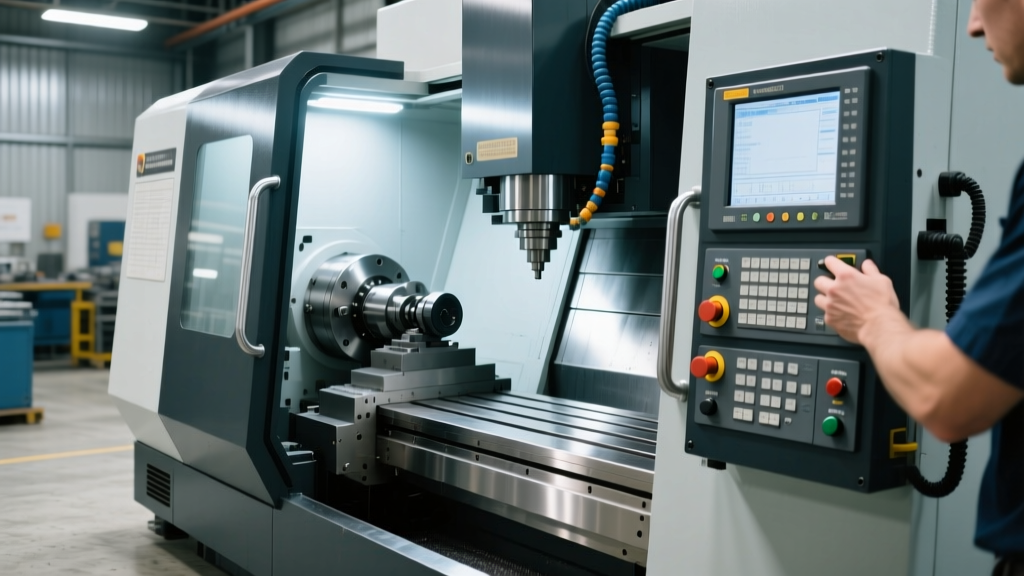
While DRO readouts handle positional feedback, the CNC control cabinet (housing the PLC, servo drives, and power supply) is the central nervous system. Modern controls like the Heidenhain TNC 7 or Siemens Sinumerik ONE generate significant heat and rely on pristine electrical connections.
1. Absolute Encoder Battery Replacement (Every 12 Months)
Most modern CNC machines utilize absolute encoders, meaning the machine remembers its position even when powered off. This data is maintained by lithium batteries located either in the servo motor casing or the main control cabinet.
- Battery Type: Typically 3V Lithium (e.g., Panasonic BR2/3AGCT4A or Fanuc A98L-0031-0012).
- Procedure: Batteries must be replaced while the machine control is powered ON. If the machine is powered off during replacement, the absolute position data is instantly lost, requiring a $300–$600 service call to re-home the axes and recalibrate the tool changers.
- Cost of Neglect: A dead battery results in a 'Servo Alarm: Absolute Position Lost' error, halting production entirely.
2. Cabinet Cooling and Fan Maintenance (Every 3 Months)
Control cabinets are sealed to prevent conductive metal dust from shorting out the servo drives. However, the heat exchangers and AC units require maintenance.
- Filter Mats: Replace cabinet fan filter mats every 90 days. Clogged filters cause internal temperatures to exceed the 55°C (131°F) threshold, triggering thermal shutdowns in the spindle drive.
- AC Unit Condensers: Clean the external condenser fins with compressed air monthly. In high-ambient-temperature shops (common in summer), a dirty condenser will fail to cool the cabinet, leading to premature failure of the $4,000+ main spindle amplifier.
3. Membrane and Touchscreen Care (Weekly)
Operator panels are subjected to cutting fluids, way oils, and abrasive dust. For touchscreen interfaces, clean daily with a specialized screen cleaner and a microfiber cloth. For physical membrane keypads, inspect the tactile domes for 'stuck' keys, which can cause unintended cycle starts or feedrate overrides.
Troubleshooting Matrix: Symptoms, Causes, and Fixes
When control systems or DROs fail, the symptoms are often misdiagnosed as mechanical issues. Use this matrix to isolate electronic feedback failures.
| Symptom | Probable Cause | Diagnostic Step & Fix |
|---|---|---|
| DRO display jumps erratically during axis movement. | Readhead gap is too wide, or glass scale has micro-scratches scattering the light beam. | Check readhead mounting torque. Inspect glass with a magnifying loupe. Replace scale if scratched ($400–$1,200 part cost). |
| CNC 'Following Error' or 'Servo Lag' alarm during rapid traverse. | Encoder cable micro-fracture inside the cable drag chain, causing intermittent signal loss. | Perform a continuity test on the encoder cable while physically flexing the drag chain. Replace cable if resistance fluctuates. |
| Axis drifts by 0.005" after sitting idle overnight. | Thermal expansion of the machine casting outpacing the scale, or magnetic scale contaminated with fine ferrous dust. | Clean magnetic scale thoroughly. Ensure machine is running a warm-up cycle to stabilize thermal growth before precision cuts. |
| Control panel reboots randomly during heavy cutting. | Voltage sag from the shop's main power line, or failing 24V DC power supply inside the control cabinet. | Monitor 24V DC rail with an oscilloscope during spindle load spikes. Replace the cabinet power supply unit if voltage drops below 22V. |
The Financial Impact: Preventative Maintenance vs. Unplanned Downtime
Industry data consistently shows that the cost of preventative maintenance (PM) on machine tool electronics is a fraction of the cost of reactive repairs. According to manufacturing efficiency reports tracked by the Association for Manufacturing Technology (AMT), unplanned downtime in a mid-sized machine shop costs an average of $1,500 to $3,000 per hour in lost production, scrapped material, and expedited shipping fees.
| Maintenance Scenario | Estimated Cost | Machine Downtime |
|---|---|---|
| Proactive: Annual PM (Battery replacement, scale cleaning, fan filter swap) | $150 - $300 (Parts + Labor) | 2 Hours (Scheduled) |
| Reactive: Dead absolute encoder battery (Parameters lost) | $450 - $800 (Service tech + lost time) | 4 - 8 Hours (Unplanned) |
| Reactive: Coolant-flooded glass scale (Shorted readhead) | $1,200 - $2,500 (Scale + Readhead + Calibration) | 24 - 72 Hours (Parts lead time) |
'The moment you understand that the DRO and CNC control are not just accessories, but the actual measuring instruments dictating your part tolerances, your maintenance paradigm shifts. You stop treating them like consumer electronics and start treating them like metrology lab equipment.'
— Senior Metrology Engineer, Aerospace Tier 1 Supplier
Final Calibration and Verification
Maintaining machine tool control systems and DRO readouts is an exercise in contamination control, thermal management, and electrical integrity. By implementing strict 90-day cabinet filter rotations, 12-month battery replacement protocols, and utilizing the correct optical cleaning solvents, shops can eliminate the vast majority of electronic feedback failures. When evaluating what are machining tools in the context of modern precision, the physical cutter removes the metal, but the control system and DRO dictate the profit margin.