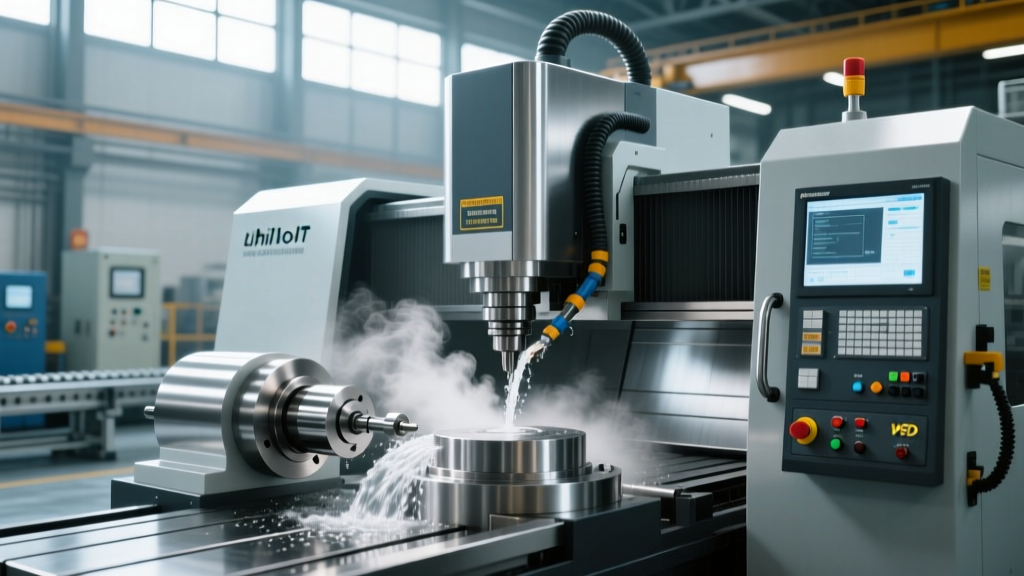
Machine Tool Chiller Tech: Flood vs Mist Cooling Trends
Explore how modern machine tool chiller systems adapt to flood vs mist cooling, featuring VSD sizing matrices, IIoT integration, and thermal ROI data.
The Thermal Reality: Flood vs. Minimum Quantity Lubrication (MQL)
Thermal growth remains the primary adversary in precision CNC machining. For carbon steel, a mere 1°C temperature increase results in an expansion of approximately 11.7 microns per meter. In a 5-axis machining center with a 600mm Z-axis column, a 2°C thermal spike translates to nearly 14 microns of vertical drift—enough to scrap aerospace turbine blades holding ±10-micron tolerances. Managing this heat requires a highly calibrated machine tool chiller, but the thermal dynamics shift radically depending on whether your shop utilizes traditional flood coolant or Minimum Quantity Lubrication (mist cooling).
Flood cooling (typically a 5-8% concentration of semi-synthetic fluids like Castrol Alusol SL 51 XBB) acts as a massive convective heat sink. It evacuates up to 85% of the heat generated at the cutting zone, carrying it away to the coolant tank where the machine tool chiller extracts it. Conversely, MQL systems (using ester-based fluids like Unist Coolube applied at 10-30 mL/hr) provide lubrication but almost zero convective cooling. With mist cooling, less than 5% of the cutting heat is carried away by the fluid. The remaining thermal energy transfers directly into the cutting tool, the workpiece, and critically, back up into the spindle bearings and drive motors.
This fundamental physics divergence means that transitioning from flood to MQL does not eliminate the need for a machine tool chiller; it entirely changes its required architecture, capacity, and precision.
How Machine Tool Chillers Are Adapting to MQL
Because MQL fails to cool the workpiece and tool, the spindle absorbs significantly more thermal load. A 25,000 RPM HSK-63 spindle running heavy roughing cycles in titanium can generate 15-20 kW of heat. In a flood setup, the coolant jacket catches some of this. In an MQL setup, the spindle's internal cooling jacket becomes the sole defense against bearing seizure and thermal deflection.
Modern 2026 machine tool chiller systems address this by utilizing dual-circuit, variable speed drive (VSD) compressors. Units like the Rittal Blue e+ or Parker Hyperchill Plus series employ hybrid VSD technology, combining a variable-speed scroll compressor with a fixed-speed baseline. This allows the chiller to modulate cooling output from 20% to 100% capacity in real-time, maintaining spindle jacket temperatures to an exacting ±0.1°C, compared to the ±1.0°C hysteresis of older fixed-speed on/off compressors.
Chiller Sizing Matrix: Flood vs. MQL Setups
Sizing a machine tool chiller requires different calculations based on the cooling methodology. The table below outlines the critical parameters for a standard 3-axis VMC and a 5-axis aerospace cell.
| Parameter | Flood Coolant Setup | MQL (Mist) Setup |
|---|---|---|
| Primary Heat Sink Target | Coolant Reservoir Tank | Spindle Jacket, Drive Motors, Hydraulics |
| Required Temp Precision | ±1.0°C | ±0.1°C (Critical for Z-axis stability) |
| Typical Capacity (5-Axis) | 15 - 25 Tons | 8 - 12 Tons (Multi-circuit) |
| Pump Architecture | High-flow centrifugal (50+ GPM) | Low-flow, high-pressure positive displacement |
| Edge Case: Inconel 718 | Standard sizing sufficient | Oversize spindle circuit by 20-30% |
Smart Chillers and IIoT Integration in 2026
The integration of Industrial Internet of Things (IIoT) protocols into machine tool chillers has shifted thermal management from a passive utility to an active predictive diagnostic tool. Modern chillers now natively support MTConnect and OPC-UA, broadcasting granular telemetry directly to the CNC controller or shop-floor ERP.
By monitoring the FluidTempOut, CompressorLoad, and FlowRate variables via MTConnect, shop managers can detect mechanical degradation before it impacts part quality. For example, if the chiller's compressor load spikes by 15% to maintain the same spindle jacket temperature during a standard cutting cycle, it indicates increased friction in the spindle bearings or a blockage in the spindle's internal cooling channels. According to guidelines from the U.S. Department of Energy Advanced Manufacturing Office, integrating VSD chillers with smart factory monitoring can reduce overall thermal management energy consumption by up to 45% while providing early-warning maintenance signals.
Warning: The Condensation Trap in MQL Setups
When running MQL, operators often drop the machine tool chiller setpoint to 15°C to aggressively cool the spindle. If the ambient shop humidity is high, this causes condensation to form on the spindle housing and linear scales, leading to rust and scale reader failures. Always set the chiller's PID controller to track the shop's ambient dew point, maintaining the coolant at least 2°C above the dew point threshold.
Actionable Framework: Upgrading Your Coolant Thermal Loop
If you are retrofitting a shop or transitioning to MQL for environmental and fluid-cost savings, follow this decision framework to specify your machine tool chiller correctly:
- Audit the Thermal Load: Calculate the spindle's maximum continuous kW rating. For MQL, size the spindle-specific chiller circuit at 1.2x the spindle's max kW to account for heat transferred from the cutting tool shank.
- Specify Multi-Circuit Architecture: Do not use a single-loop chiller. Specify a dual-circuit machine tool chiller: Circuit 1 (set to 20°C ±0.1°C) dedicated exclusively to the spindle and torque motor jackets; Circuit 2 (set to 30°C ±1.0°C) for the hydraulic power unit and gearbox cooling.
- Mandate VSD Compressors: Fixed-speed chillers cycle on and off, causing micro-fluctuations in fluid temperature that translate to Z-axis waving in finished parts. Require inverter-driven scroll compressors in your RFQ.
- Optimize the Glycol Mix: Use a 30% propylene glycol to water ratio. Ethylene glycol is toxic and poses severe environmental hazards if a leak occurs in the MQL air-blast environment, where atomization could aerosolize the glycol.
Real-World Cost & ROI Breakdown
Upgrading to a smart, VSD-enabled machine tool chiller requires capital expenditure that must be justified by operational savings. For a standard 10-ton cooling requirement:
- Fixed-Speed Chiller (Legacy): ~$12,000 initial cost. Consumes ~45,000 kWh annually at full load.
- VSD Hybrid Chiller (2026 Tech): ~$21,500 initial cost. Consumes ~24,000 kWh annually due to partial-load optimization.
- Financial Impact: At an industrial rate of $0.14/kWh, the VSD chiller saves $2,940 annually in electricity. Factoring in the elimination of scrapped parts due to thermal drift (averaging $4,500/year in aerospace job shops), the ROI payback period is exactly 13.8 months.
For advanced manufacturing facilities, the choice between flood and mist cooling is no longer just about fluid management or chip evacuation; it is fundamentally a thermal engineering challenge. Aligning your machine tool chiller specifications with the specific heat-transfer realities of your chosen lubrication method is mandatory for holding tight tolerances in 2026 and beyond. For further benchmarking on machining thermal stability and precision standards, consult the resources provided by the NIST Manufacturing Extension Partnership.