Machine Tools Application Engineering Services: Linear vs Box Ways
Compare linear guideways and box ways for CNC machining. Expert insights on damping, speed, and MRR from machine tools application engineering services.
The Core Kinematic Dilemma in CNC Architecture
When manufacturing facilities engage machine tools application engineering services to specify new CNC machining centers, the selection of the way system—linear guideways versus traditional box ways—dictates the machine’s ultimate performance envelope. This decision is not merely a matter of preference; it is a fundamental tribological and kinematic choice that determines material removal rates (MRR), surface finish capabilities, and long-term geometric accuracy.
Linear guideways rely on recirculating ball or roller bearings, offering near-frictionless motion and high rapid traverse rates. Box ways, utilizing sliding friction interfaces (often coated with PTFE-based composites like Turcite-B) or hydrostatic oil films, prioritize dynamic stiffness and vibration damping. Understanding the exact failure modes, maintenance lifecycles, and cutting dynamics of each system is critical for optimizing production cells.
Quick-Glide Decision Matrix
- Choose Linear Guideways if: Your primary materials are aluminum, plastics, or cast iron; cycle times are bottlenecked by rapid traverses; and you require high-velocity contouring (e.g., 3D aerospace molds).
- Choose Box Ways if: You are performing heavy roughing in titanium (Ti-6Al-4V) or Inconel 718; chatter and tool deflection are limiting your depth of cut (DOC); and machine longevity under shock loads is paramount.
Linear Guideways: Speed, Precision, and the Bearing Standard
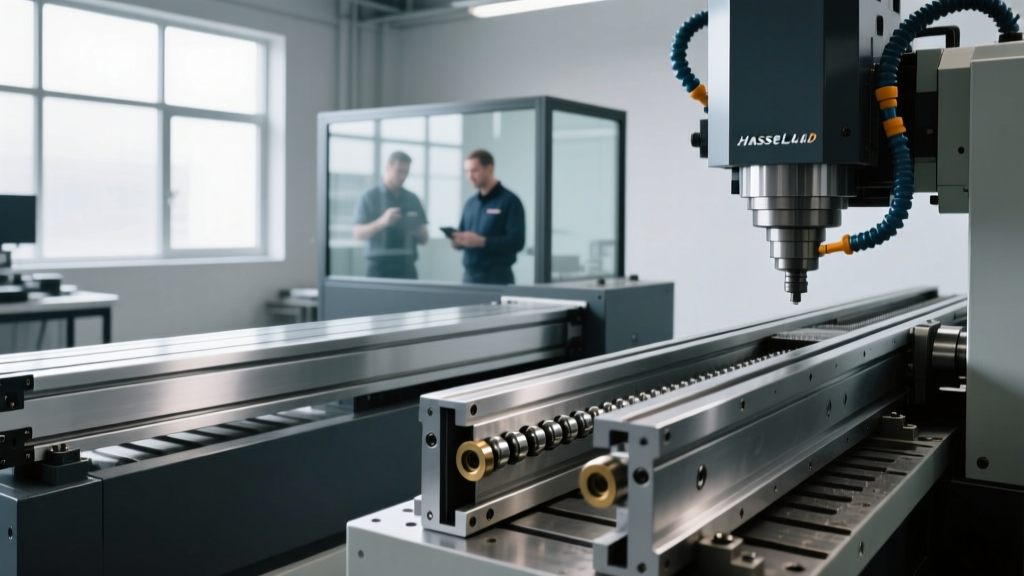
Modern linear motion systems, dominated by manufacturers like THK, NSK, and Rexroth, utilize recirculating ball or cylindrical roller elements. The primary advantage is the coefficient of friction, which hovers between 0.002 and 0.003. This allows CNC servomotors to achieve rapid traverse rates exceeding 60 m/min with minimal breakaway torque, effectively eliminating the "stick-slip" phenomenon that plagues poorly lubricated sliding surfaces.
Preload Dynamics and Thermal Growth
To achieve rigidity, linear guides are preloaded by inserting oversize balls or rollers into the bearing block. A medium preload (typically 2% of the dynamic load rating) provides excellent rigidity for light-to-medium milling. However, this preload generates internal friction. When a machine like a Haas VF-2SS operates at 50 m/min rapids continuously, the linear blocks generate significant heat. If the machine casting is not thermally stabilized, this localized heat transfers to the saddle, causing microns of thermal growth that compromise tight-tolerance boring operations.
Where Linear Ways Fail: Shock Loads and Chatter
The critical vulnerability of recirculating ball bearings is point contact stress. During interrupted cuts or heavy roughing in hardened steels, the shock loads transmit directly through the balls to the raceway. Over time, this causes Brinelling (permanent indentation of the raceway), leading to catastrophic block failure. Furthermore, linear ways lack inherent damping. When machining thin-walled aerospace components, the lack of vibrational absorption often forces programmers to reduce spindle speeds and DOC to avoid harmonic chatter, severely limiting MRR.
Box Ways: The Heavy-Duty Damping Advantage
Box ways consist of precision-machined, hand-scraped cast iron or steel surfaces sliding against one another. To manage friction and wear, the moving saddle is typically coated with a low-friction polymer composite such as Turcite-B, Rulon, or Moglice. This sliding interface creates a massive surface area contact patch, fundamentally altering the machine's dynamic response.
The Physics of Vibration Damping
The sliding friction coefficient of Turcite-coated box ways is approximately 0.05 to 0.08—roughly 20 times higher than linear guides. While this limits rapid traverse speeds (usually capping at 20–30 m/min), the energy dissipation is extraordinary. Box way machines can exhibit 10 to 50 times the damping capacity of linear guide machines. According to foundational machining dynamics outlined by Sandvik Coromant, high damping is essential for maintaining tool life and surface integrity during aggressive milling of superalloys. The box way interface absorbs the vibrational energy of the cutting edge, preventing the regenerative chatter that destroys carbide end mills.
Hydrostatic Box Ways: The Ultimate Hybrid
For high-end horizontal boring mills and jig grinders (e.g., Waldrich Siegen or Kitamura), hydrostatic box ways represent the pinnacle of way system engineering. A pressurized oil film (typically 10 to 50 microns thick) completely separates the sliding surfaces. This drops the friction coefficient to 0.001 (lower than ball bearings) while retaining the massive footprint and damping characteristics of a box way. The tradeoff is extreme complexity: hydrostatic systems require dedicated, temperature-controlled hydraulic power units and precise pressure zoning to prevent saddle pitch and yaw.
Technical Specification Comparison
The table below contrasts the empirical data across the four primary way system configurations utilized in modern CNC vertical and horizontal machining centers.
| Way System Type | Friction Coefficient (µ) | Damping Capacity | Max Practical Rapid Traverse | Primary Failure Mode |
|---|---|---|---|---|
| Linear Ball Guide | 0.002 - 0.003 | Very Low | 60 - 120 m/min | Raceway Brinelling, Seal Wear |
| Linear Roller Guide | 0.003 - 0.005 | Low-Medium | 40 - 80 m/min | Roller Skewing, Edge Spalling |
| Box Way (Turcite/PTFE) | 0.050 - 0.080 | Very High | 20 - 30 m/min | Way Liner Wear, Stick-Slip |
| Hydrostatic Box Way | ~0.001 (Fluid Film) | Extreme | 30 - 50 m/min | Hydraulic Pump Failure, Oil Contamination |
Application Engineering Framework: Matching the Way System to the Part
Leveraging machine tools application engineering services ensures that the kinematic selection aligns with the specific metallurgical and geometric demands of the production run. Below is a practical framework for process engineers:
- High-Volume Automotive Aluminum (e.g., 380 Die Cast, 6061-T6): Linear roller guides are mandatory. The low mass of the cutting forces requires high acceleration and deceleration to minimize non-cutting time. Box ways cannot accelerate fast enough to keep pace with modern 15,000+ RPM spindles in soft materials.
- Aerospace Titanium Forgings (e.g., Ti-6Al-4V, Ti-5553): Box ways are heavily favored. Titanium requires low surface speeds (40-90 m/min) but massive torque and rigid setups to prevent tool deflection. The damping of box ways allows for stable trochoidal milling and heavy plunge roughing without shattering the carbide substrate.
- Hardened Tool Steels & Mold Making (e.g., P20, H13 at 45+ HRC): Linear roller guides (specifically preloaded cylindrical rollers, not balls) offer the best compromise. They provide the necessary rigidity for hard milling while allowing the high feed rates required by modern CBN or coated carbide tooling.
Total Cost of Ownership and Maintenance Realities
The financial implications of way system maintenance are frequently overlooked during the initial capital expenditure (CapEx) phase. A 40-taper VMC equipped with heavy-duty box ways (such as a Mazak VCN-530C or Okuma GENOS series) may carry a 10% to 15% price premium over a linear-guide equivalent. However, the operational expenditure (OpEx) profiles diverge drastically after year seven.
⚠️ Maintenance Warning: The Rebuild DiscrepancyWhen a linear guide system reaches the end of its lifecycle, a technician can unbolt and replace the bearing blocks and rails in a single shift. The cost is typically $1,500 to $4,000 per axis in parts. Conversely, rebuilding worn box ways requires a master scraper to hand-scrape the cast iron base, apply new Turcite liner material, and precision-grind the mating surfaces. This process can take weeks and cost upwards of $25,000, requiring the machine to be moved to a specialized rebuild facility.
Ultimately, the choice between linear and box ways is a calculation of cutting forces versus cycle time. While linear guideways continue to dominate the general-purpose market due to their speed and lower manufacturing costs, box ways remain irreplaceable in heavy-duty, high-precision applications where vibrational stability dictates the success or failure of the machining process.