Troubleshooting Hankook Machine Tools Co Ltd Lathes Post-Auction
Expert guide to troubleshooting and repairing Hankook Machine Tools Co Ltd CNC lathes purchased at auction. Learn liquidation inspection and fix strategies.
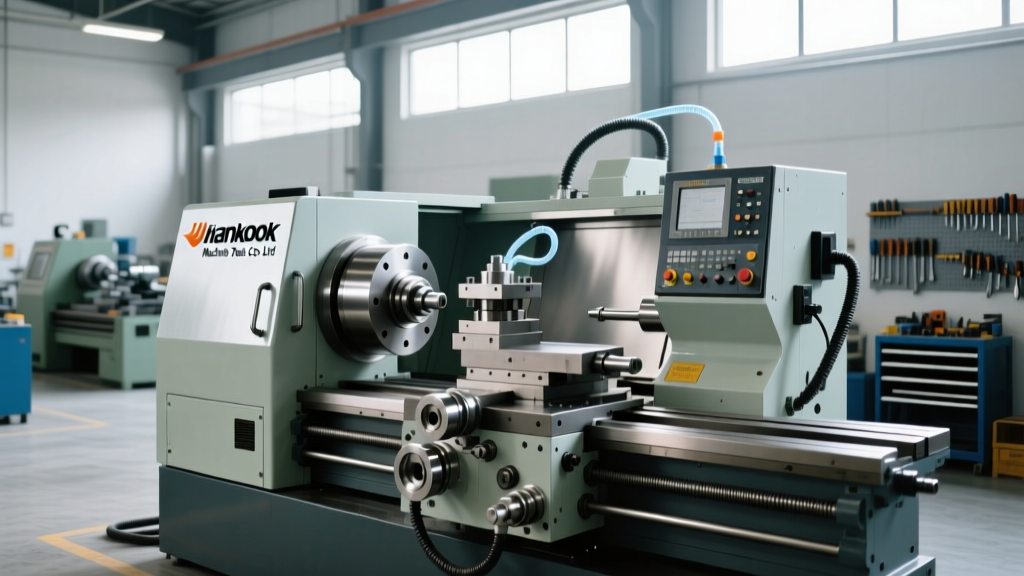
Acquiring heavy-duty CNC equipment through industrial liquidation auctions presents a high-reward, high-risk scenario for machine shops. When targeting premium Asian-manufactured iron, buyers frequently encounter robust Korean engineering. Specifically, assets from Hankook Machine Tools Co Ltd—such as the HIT-series CNC lathes and HBM horizontal boring mills—are highly sought after in the secondary market for their heavily ribbed Meehanite castings, high-torque gearboxes, and exceptional dampening characteristics.
However, machines sitting dormant in unclimate-controlled auction yards for 12 to 24 months develop latent mechanical and electrical faults. The 2026 liquidation market is flooded with closed-down heavy manufacturing plants, meaning buyers are often taking on machines that have not been properly decommissioned. This guide provides a master-level troubleshooting and repair framework for reviving Hankook Machine Tools Co Ltd equipment immediately after the gavel falls.
⚠️ CRITICAL LIQUIDATION WARNING: Never power on a liquidated Hankook CNC lathe directly from the main disconnect without verifying the FANUC absolute encoder battery voltage and checking the way lube reservoir. Instant power application with dead SRAM batteries will wipe machine parameters, and dry ways will score the cast iron within minutes of movement.Pre-Bid Inspection: The Hankook-Specific Checklist
Before bidding on auction platforms, a physical or video inspection is mandatory. Hankook machines are built with specific proprietary components that dictate your post-purchase repair budget. Use this matrix to evaluate the asset's true condition.
| Component | Hankook-Specific Vulnerability | Inspection Method | Pass / Fail Criteria |
|---|---|---|---|
| Spindle Gearbox | Hydraulic clutch slippage in 2-speed/3-speed configurations | Listen for engagement clunk; check hydraulic pressure gauge | Pass: Pressure holds >45 bar. Fail: Whining noise or pressure <35 bar. |
| Way Lubrication | Showa/Bijur volumetric metering units clog with congealed oil | Manually trigger pump; check Z-axis way cover flow | Pass: Oil weeps from all meter units. Fail: Dry ways or pump overload alarm. |
| Control Cabinet | FANUC 0i/31i SRAM battery decay and coolant intrusion | Visual inspection of cabinet floor; check battery date code | Pass: Clean floor, battery <1 yr old. Fail: Rust on floor, battery >2 yrs. |
| Turret / Tool Post | Curvic coupling misalignment from crash damage prior to liquidation | Cycle through all 8/12 stations; check locking pressure | Pass: Locks with solid thud. Fail: Hissing air or turret fails to clamp. |
Post-Auction Troubleshooting Matrix: Symptom, Cause, and Fix
Once the Hankook Machine Tools Co Ltd asset is rigged, shipped, and dropped onto your foundation, the revival process begins. Below are the three most common failure modes encountered in liquidated Korean heavy lathes, complete with exact repair protocols.
1. Spindle Vibration and Gearbox Chatter (HIT-Series Lathes)
The Symptom: When commanding speeds above 1,200 RPM, the spindle vibrates heavily, and the gearbox emits a high-pitched whine. Surface finish on turned parts shows harmonic chatter marks.
The Root Cause: Hankook heavy lathes utilize a hydraulic actuation system to shift gears and engage the high-speed spindle clutch. During long-term auction storage, the hydraulic fluid degrades, and the accumulator bladder loses its nitrogen pre-charge. If the hydraulic pressure drops below the required 45 bar threshold, the high-speed clutch does not fully engage, causing it to slip and vibrate under load.
The Fix:
- Drain the hydraulic tank and flush with ISO 32 hydraulic fluid. Replace the 10-micron return filter (typically a SKF or Hydac element).
- Check the nitrogen pre-charge on the hydraulic accumulator. It should be set to 70% of the minimum working pressure (approx. 30 bar).
- Adjust the main relief valve to achieve a stable 50 bar operating pressure.
- Verify clutch engagement by monitoring the PLC diagnostic page for the "High Gear Clamped" proximity switch signal.
2. FANUC SRAM Parameter Loss and Absolute Encoder Alarms
The Symptom: Upon initial power-up, the FANUC control (commonly the 0i-TF or 31i-B series paired with Hankook machines) boots to a black screen or displays AP300-series absolute encoder alarms. The machine has "forgotten" its axis zero positions and machine parameters.
The Root Cause: Liquidation auctions rarely feature machines that were properly decommissioned. The FANUC control relies on a lithium battery to maintain SRAM memory and absolute encoder positions when main power is off. After 18 months in a warehouse, the battery voltage drops below 2.5V, resulting in total memory corruption.
The Fix:
- Replace the main PCB battery (FANUC A02B-0207-K102) and the absolute encoder batteries on the servo motors.
- Access the FANUC Boot Monitor screen: Power on the control while simultaneously pressing the two rightmost soft keys (located just below the screen).
- Select SRAM DATA RESTORE from the boot menu. You will need the original parameter backup file (usually a .BIN or .TXT file on a CF/PCMCIA card). Note: If the previous owner did not leave a backup, you must contact Hankook Machine Tools Co Ltd or a certified FANUC America integrator to rebuild the parameter set from scratch, which costs between $1,500 and $3,000.
- Once parameters are restored, perform a manual absolute encoder reset: Set parameter 1815#4 and 1815#5 to 0, jog the axes to the physical machine zero marks, and reset the bits to 1.
3. Way Lube Starvation and Axis Stiction
The Symptom: The Z-axis carriage exhibits "stick-slip" movement during slow-feed facing operations. The control may eventually trigger a low-pressure way lube alarm.
The Root Cause: Hankook machines use precision ground, hardened box ways coated with Turcite-B. These require a constant film of ISO 68 way oil. In cold auction warehouses, residual oil in the metering units congeals into a sludge, blocking the flow to the Z-axis way covers.
The Fix: Do not simply force the pump. Disconnect the main distribution line at the pump and flush the lines with a light solvent (like mineral spirits) followed by fresh ISO 68 way oil. Inspect the Showa volumetric metering units located under the way covers. If the internal springs are seized, replace the meter units (approx. $45 to $85 per unit). According to industry maintenance standards outlined by organizations like the Association for Manufacturing Technology (AMT), verifying way lube flow is the single most critical step in preventing catastrophic casting damage on used heavy machinery.
"The biggest mistake shops make with liquidated Korean CNCs is assuming the heavy cast iron means the machine is indestructible. The iron is world-class, but the peripheral systems—hydraulics, lube, and pneumatics—are the first to fail when neglected. Budget 15% of your auction purchase price specifically for fluid system revival and sensor recalibration."
Cost-Benefit Analysis: Reviving Liquidated Hankook Assets
Is it worth buying a liquidated Hankook HIT-400 lathe for $45,000 when a new equivalent costs $220,000? The answer depends entirely on your repair capabilities. Below is a realistic 2026 cost breakdown for bringing a neglected, auction-purchased Hankook lathe back to OEM tolerances.
| Repair / Revival Task | In-House Cost (Parts Only) | Third-Party Rebuilder Cost | Time to Complete |
|---|---|---|---|
| Fluid Flush & Filter Replacement (Hydraulic/Coolant/Lube) | $450 - $800 | $1,200 - $1,800 | 1 - 2 Days |
| FANUC Battery Replacement & Parameter Recovery | $150 (Batteries) | $2,500 (If parameters lost) | 2 Hours - 3 Days |
| Spindle Gearbox Clutch Rebuild | $800 - $1,500 | $4,500 - $7,000 | 3 - 5 Days |
| Turret Curvic Coupling Cleaning & Recalibration | $50 (Seals/Grease) | $2,200 - $3,500 | 1 - 2 Days |
| TOTAL ESTIMATED REVIVAL COST | $1,450 - $2,500 | $10,400 - $15,800 | 1 - 2 Weeks |
Sourcing OEM and Aftermarket Parts
One of the primary challenges of operating liquidated equipment from Hankook Machine Tools Co Ltd is the parts supply chain. While the castings and structural components are virtually indestructible, wear items like turret proximity switches, hydraulic clutch seals, and specific Showa lube meters can be difficult to source directly from the OEM if you lack an established corporate account.
Strategic Sourcing Tips:
- Hydraulics & Pneumatics: Hankook heavily utilizes Yuken hydraulic valves and SMC pneumatic components. These are globally available standard industrial parts. Cross-reference the part numbers on the valve bodies rather than ordering through the machine tool builder.
- Spindle Bearings: The spindle assemblies typically rely on high-precision angular contact bearings. Identify the bearing manufacturer (usually NSK, SKF, or FAG) stamped on the outer race and order directly from an authorized industrial bearing distributor to avoid the 300% OEM markup.
- Electrical & Sensors: Proximity switches and limit switches are almost exclusively Omron or Panasonic. Take clear photos of the sensor labels before tearing down the machine to ensure exact replacement matching.
Buying at auction requires a shift in mindset from simple procurement to mechanical archaeology. By understanding the specific architecture of Hankook Machine Tools Co Ltd equipment and executing a methodical, parameter-driven revival protocol, machine shops can secure world-class heavy turning capacity at a fraction of the capital expenditure, ensuring the machine produces tight-tolerance parts for another two decades.