Cincinnati Machine Tools USA: Lubrication Systems & Schedules Compared
Compare lubrication systems and maintenance schedules for Cincinnati Machine Tools USA. Analyze Bijur vs. SKF Lincoln retrofits and way oil specs.
Evaluating Tribology Management for Cincinnati VMCs and Manual Mills
Maintaining the geometric accuracy of legacy and modern Cincinnati machine tools requires strict adherence to precise tribology protocols. Whether you are operating a legacy Cincinnati Milacron Cintimatic 10VC, a high-production Sabre 1250 VMC, or an Arrow 500, the lubrication system is the primary defense against way scoring, spindle thermal growth, and ball screw backlash. In the secondary market, many 'Cincinnati Machine Tools USA' branded assets arrive with compromised or heavily modified lubrication circuits. This analysis compares the original equipment manufacturer (OEM) Bijur metering systems against modern progressive alternatives, outlines exact fluid specifications, and provides a rigorous maintenance schedule to maintain micron-level tolerances.
CRITICAL WARNING: Never substitute standard anti-wear (AW) hydraulic fluid for way lubricant. AW fluids lack the tackiness additives (like molybdenum disulfide or specialized polymers) required to cling to vertical ways. Using AW 46 in a Cincinnati Sabre's way lube system will result in severe stick-slip phenomenon during slow contouring feeds, ruining surface finishes and accelerating way liner wear.Lubrication System Architectures: OEM vs. Retrofit Alternatives
Most Cincinnati CNC machines deployed between 1990 and 2010 utilized single-line parallel metering systems. When these fail, shops face a decision: rebuild the OEM system or retrofit a series progressive architecture. Below is a technical comparison of the three primary configurations found on Cincinnati Machine Tools USA equipment today.
| System Architecture | OEM / Brand Example | Operating Principle | Retrofit / Rebuild Cost (2026 Est.) | Best Application |
|---|---|---|---|---|
| Single-Line Parallel | Bijur FJM / One-Shot | Pressure builds to inject a fixed volume at each metering unit; system must vent to reset. | $850 – $1,400 (Pump & Injectors) | Standard 3-axis VMCs (Arrow series) with short lube lines. |
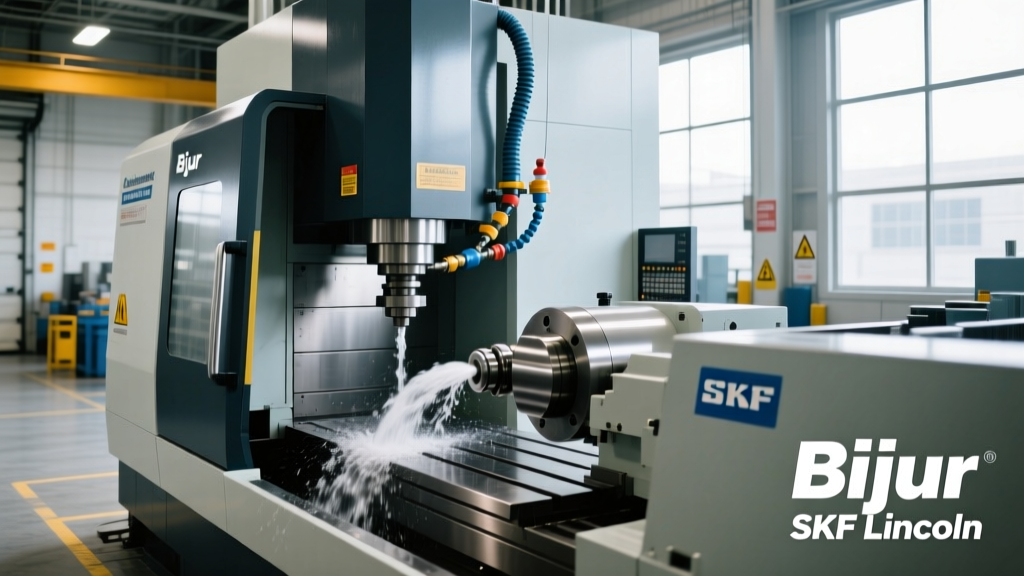
| Series Progressive | SKF Lincoln Centro-Matic | Flow is divided sequentially; a single blocked line stops the entire cycle and triggers an alarm. | $3,800 – $5,200 (Full Retrofit Kit) | Heavy-duty 5-axis machines, large Sabre gantries, and multi-pallet HMCs. |
| Manual / Air-Over-Oil | Generic Shop Air Pumps | Operator manually triggers pneumatic pump; oil is distributed via simple restrictors. | $200 – $450 | Legacy manual mills (Cintimatic) or low-cycle training machines. |
The Case for Series Progressive Retrofits
While rebuilding a Bijur single-line system is cost-effective in the short term, it suffers from a critical blind spot: if a single metering unit clogs with varnish, the system pressure still reaches the threshold switch, satisfying the Fanuc or Acramatic CNC control. The machine continues to run, but the specific way zone starves. According to SKF's industrial lubrication guidelines, series progressive systems physically lock up if a single outlet is blocked, forcing a low-pressure alarm on the CNC and preventing catastrophic dry-run damage. For high-uptime production environments, the $4,000+ investment in an SKF Lincoln retrofit pays for itself by preventing a single $15,000 ball screw replacement.
Fluid Specifications and Approved Alternatives
Cincinnati Machine Tools USA engineering manuals specify distinct ISO viscosity grades for different machine zones. Cross-contamination between the spindle chiller circuit, the gearbox, and the way lube system is a common failure mode caused by poor shop floor fluid management.
| Machine Zone | Primary OEM Spec (Mobil) | Acceptable Alternative (Shell) | ISO Grade | Avg. Cost / Gallon |
|---|---|---|---|---|
| Slideways & Ball Screws | Mobil Vactra Oil No. 2 | Shell Tonna S3 M 68 | ISO 68 | $18.00 - $22.00 |
| High-Speed Spindle Bearings | Mobil Velocite Oil No. 6 | Shell Morlina S2 B 22 | ISO 22 | $24.00 - $28.00 |
| Headstock / Gearboxes | Mobil DTE 25 | Shell Tellus S2 MX 46 | ISO 46 | $16.00 - $19.00 |
| Counterbalance / Hydraulics | Mobil DTE 24 | Shell Tellus S2 MX 32 | ISO 32 | $15.00 - $18.00 |
Note: Always verify the specific spindle bearing manufacturer's requirements (e.g., FAG, NSK, or GMN) before deviating from ISO 22 spindle oils, as modern ceramic hybrid bearings may require specialized synthetic greases or ISO 10 oils.
Preventative Maintenance Schedules
Adhering to a rigid schedule prevents the accumulation of way-wipe debris and coolant emulsion in the lubrication reservoir. The following schedule is optimized for Cincinnati VMCs running standard 2-shift (80-hour/week) production cycles.
Daily & Weekly Interventions
- Daily (Start of Shift): Verify way lube reservoir level. Physically observe the pressure gauge on the Bijur/Lincoln pump during a manual cycle. It should spike to 250-300 PSI and decay smoothly over 45 seconds. A rapid decay indicates a blown metering unit or a cracked supply line.
- Daily (End of Shift): Wipe down exposed way covers and telescopic steel guards. Coolant pooling on way covers will eventually migrate past the wipers and contaminate the way oil, forming a sludge that blocks micro-injectors.
- Weekly: Check spindle oil flow return. If utilizing an oil-air mist system, verify the drip rate at the spindle exhaust. For flood-oil spindles, check the return line temperature; a delta of more than 15°C above ambient indicates bearing preload issues or oil degradation.
500-Hour and Annual Overhauls
- 500 Hours (Bi-Monthly): Clean the way lube reservoir suction strainer. Cincinnati machines utilize a 100-mesh bronze strainer. If coolant has emulsified the way oil, the strainer will be coated in a mayonnaise-like substance. Drain, flush with a lightweight solvent, and refill with fresh ISO 68 way oil.
- 2,000 Hours (Semi-Annual): Test way oil for water contamination using a crackle test or Karl Fischer titration. Water content above 500 ppm compromises the oil's demulsibility and promotes rust on precision-ground cast iron ways.
- 4,000 Hours (Annual): Replace all flexible nylon distribution lines. Nylon becomes brittle when exposed to synthetic coolants and UV light over time. A single cracked line under a way cover will dump gallons of oil into the chip conveyor before the low-level alarm triggers.
Troubleshooting Common Lubrication Faults
Fault 1: 'Low Lube Pressure' Alarm (Fanuc / Acramatic 2100)
Symptom: The CNC faults out 3 minutes after startup, indicating the pressure switch did not close.
Root Cause Analysis: In a single-line parallel system, this usually means the pump cannot build pressure. This is rarely a pump motor failure. It is almost always a single Bijur FJM metering unit that has failed in the 'open' position, acting as a pressure relief valve.
Resolution: Isolate zones by pinching off distribution lines sequentially. Once the zone holding pressure is identified, remove the individual injectors on that axis. Clean the internal check valves with aerosol brake cleaner. Replace the injector pins if the internal spring is fatigued (replacement cost: ~$18 per injector).
Fault 2: Stick-Slip on X-Axis During Circular Interpolation
Symptom: The machine produces faceted or flat-spotted circles instead of smooth arcs, specifically at feed rates below 10 inches per minute.
Root Cause Analysis: The static friction coefficient of the way liner (usually Rulon or Turcite) has exceeded the kinetic friction coefficient due to way oil starvation or the use of the wrong fluid grade.
Resolution: Verify the oil is actually reaching the center of the way. Many shops assume oil at the end of the way means the system is working. Use a feeler gauge to check for oil weeping at the midpoint of the axis travel. If dry, the metering unit volume setting is too low. Adjust the Bijur injector from a '00' setting to a '1' or '2' setting to increase output from 0.03cc to 0.10cc per cycle.
Fault 3: Spindle Thermal Growth Exceeding 0.0005"
Symptom: Z-axis tool center point (TCP) drifts significantly during the first two hours of operation, requiring constant tool length compensation adjustments.
Root Cause Analysis: The spindle oil chiller is malfunctioning, or the spindle oil has oxidized, losing its thermal transfer properties and increasing viscous drag on the bearings.
Resolution: Check the chiller delta-T. The oil returning from the spindle should be maintained within ±0.5°C of the ambient shop temperature. If the chiller is functioning but drift persists, flush the spindle oil circuit. Oxidized ISO 22 oil turns dark amber and forms varnish on bearing cages, increasing friction and localized heat generation.
Strategic Takeaways for Shop Managers
Managing the tribology of Cincinnati Machine Tools USA equipment is not a passive task. The transition from reactive maintenance (topping off reservoirs and clearing alarms) to predictive maintenance (monitoring cycle times, testing fluid demulsibility, and upgrading to progressive systems) directly correlates to scrap reduction. For shops running high-value aerospace or medical components, investing in an SKF Lincoln progressive retrofit and strictly enforcing ISO fluid segregation will yield immediate improvements in geometric accuracy and spindle longevity.