Troubleshooting Cleanroom Foundry Equipment Manufacturer Systems
Troubleshoot cleanroom foundry equipment manufacturer systems. Fix VIM furnace vacuum leaks, HEPA integration faults, and particulate contamination issues.
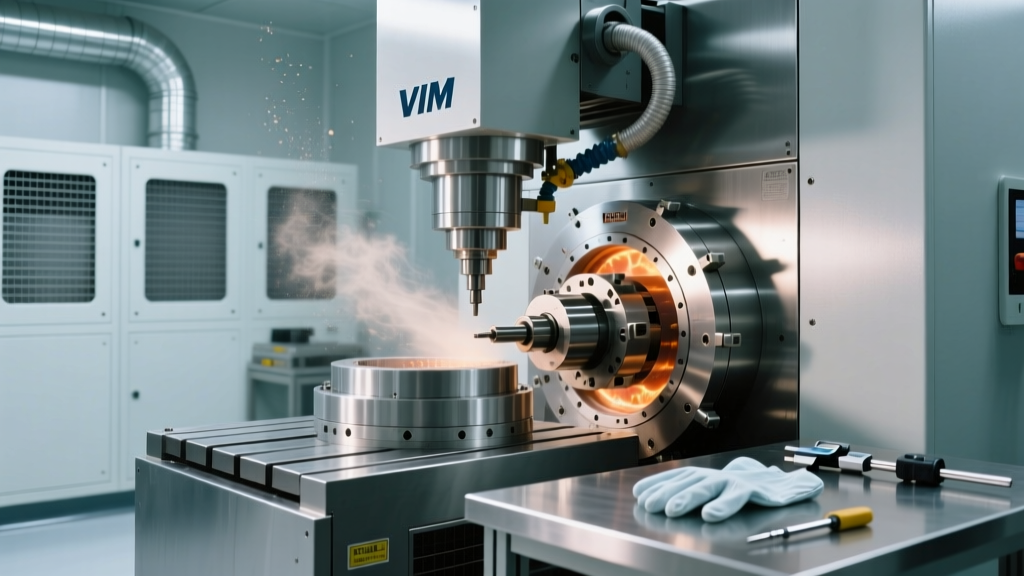
Precision casting for medical implants (e.g., Ti-6Al-4V orthopedic joints) and single-crystal aerospace turbine blades demands absolute particulate exclusion. While traditional sand casting operates in open-air environments, advanced investment casting requires ISO Class 7 or 8 cleanrooms for wax pattern assembly, ceramic shell drying, and vacuum induction melting (VIM) cooling chambers. When a specialized foundry equipment manufacturer designs VIM systems for these controlled environments, standard heavy-industry repair protocols will compromise the cleanroom integrity.
This guide details advanced troubleshooting procedures for cleanroom-integrated foundry equipment, focusing on vacuum seal degradation, HVAC pressure conflicts, and deionized (DI) water cooling loop failures specific to 2026 precision casting facilities.
Cleanroom Foundry Baseline Parameters (ISO Class 7)
- Particulate Limit: ≤ 10,000 particles/m³ at 0.5 µm
- Room Pressure: Positive +0.05 to +0.08 in. w.g. relative to adjacent corridors
- Temperature/Humidity: 68°F ± 2° / 45% ± 5% RH (critical for ceramic shell drying)
- Air Changes per Hour (ACH): 30–60 ACH via HEPA-filtered ceiling plenums
Diagnosing Vacuum Seal Degradation in ISO Class 7 VIM Furnaces
The most critical failure mode in cleanroom VIM furnaces (such as the ALD VIM 800 or Consarc VIM 1000 series) is micro-leakage in the primary melting chamber. In a standard foundry, a minor air leak causes surface oxidation. In a cleanroom medical foundry, a leak rate exceeding 1x10⁻⁴ mbar·L/s introduces nitrogen and oxygen that embrittles titanium alloys, leading to catastrophic fatigue failure in orthopedic implants.
Step-by-Step Helium Mass Spectrometer Leak Detection
- Isolate the Chamber: Close all pneumatic gate valves separating the VIM furnace from the cleanroom pass-through boxes. Standard cleanroom pass-through airlocks often mask vacuum leaks by feeding HEPA-filtered air into the pump exhaust.
- Perform a Rough Pump-Down: Engage the mechanical rotary vane pump to reach 1x10⁻¹ mbar. Do not engage the Roots blower or diffusion pump until this baseline is stable.
- Inject Tracer Gas: Using a calibrated helium sniffer (flow rate 2x10⁻⁶ std cc/s), sweep the main flange O-rings, induction coil feedthroughs, and thermocouple ports.
- Analyze the Feedthroughs: Induction coil copper feedthroughs are notorious failure points. The thermal cycling from 1600°C melting to rapid argon quenching degrades the epoxy seals. If the leak originates here, the feedthrough must be replaced with a modern ceramic-to-metal brazed seal (Kovar alloy), which costs approximately $1,400–$1,800 per phase but eliminates outgassing.
Never use standard Buna-N or Viton O-rings on cleanroom VIM furnace flanges. Outgassing from these elastomers will contaminate the ISO Class 7 environment during chamber venting. Specify Kalrez 4079 or 7075 perfluoroelastomer O-rings. While expensive ($65–$95 per linear foot), they withstand 300°C bake-outs and emit virtually zero volatile organic compounds (VOCs).
HEPA Filtration and Argon Gas Quenching Integration Faults
Following the pour, VIM furnaces utilize high-pressure argon gas quenching to rapidly cool the casting and refine the grain structure. In a cleanroom, venting this argon back into the room or improperly exhausting it disrupts the HVAC positive pressure balance, causing HEPA filters to stall or unfiltered corridor air to infiltrate the cleanroom.
| Symptom | Root Cause | Repair Action & Cost Estimate |
|---|---|---|
| Cleanroom Magnehelic gauge drops below +0.02 in. w.g. during argon quench. | Furnace exhaust damper fails to open, forcing heavy argon into the room and disrupting laminar airflow. | Replace pneumatic damper actuator with a fail-open spring-return model (e.g., Belimo AF24-SR). Cost: $850. |
| Spike in 0.5 µm particle counts on the HEPA monitoring system post-vent. | Furnace vent valve opens too rapidly, creating a micro-shockwave that dislodges particles from the HEPA filter media. | Reprogram the Siemens S7-1500 PLC to ramp the vent valve opening over 4.5 seconds instead of an instant solenoid dump. |
| Argon backflow into the cleanroom during pump-down. | Check valve on the argon supply line is fouled with ceramic dust from the crucible. | Install a sintered 316L stainless steel inline filter (5 µm) upstream of the check valve. Cost: $220. |
Induction Coil Cooling Water Contamination and Resistivity Drops
VIM induction coils require continuous cooling to prevent the copper windings from melting under high-frequency (2,000–10,000 Hz) electromagnetic fields. In standard foundries, closed-loop glycol or municipal water is sufficient. In cleanroom medical foundries, Deionized (DI) water is mandatory to prevent electrical tracking and to ensure that if a micro-leak occurs in the coil, the water introduced to the vacuum chamber contains no dissolved minerals that could alloy with the medical-grade titanium.
Troubleshooting DI Water Loop Resistivity
The target resistivity for a VIM cooling loop is > 2.0 MΩ·cm. If the PLC triggers an alarm for resistivity dropping below 1.0 MΩ·cm, immediate troubleshooting is required to prevent stray electrical currents from arcing through the cooling water to the grounded cleanroom floor.
- Check the Mixed Bed Resin: DI water polishers use a mixed bed of cation and anion exchange resins. In high-heat foundry applications, thermal degradation of the resin occurs 30% faster than the manufacturer's rated lifespan. If the water temperature exiting the coil exceeds 45°C, the resin bed is exhausted. Fix: Replace the 50L resin cartridge ($1,100–$1,400) and install a secondary heat exchanger to drop the return water temperature to 25°C before it hits the DI bed.
- Inspect for Copper Oxide Leaching: If the DI water pH drops below 6.0, the water becomes slightly acidic and begins leaching copper from the induction coil itself, creating a conductive loop. Fix: Dose the loop with a trace amount of cleanroom-approved benzotriazole (BTA) corrosion inhibitor, maintaining a concentration of 15–20 ppm.
- Verify Flow Meter Calibration: Ultrasonic flow meters on DI water lines often lose calibration due to the lack of ions in the water, which affects certain acoustic transit-time sensors. Switch to a Coriolis mass flow meter (e.g., Endress+Hauser Promass) for absolute accuracy, ensuring the coil never starves for coolant during a 45-minute melt cycle.
"The most overlooked source of particulate contamination in a cleanroom foundry isn't the melting process itself—it's the crucible ramming and knockout procedures. Maintenance teams must use localized HEPA-filtered extraction hoods during alumina crucible demolition, as the mechanical shock generates millions of sub-micron ceramic particles that will permanently foul the room's ceiling HEPA filters."
— Institute of Environmental Sciences and Technology (IEST) Contamination Control Guidelines
Decision Matrix: Repair vs. Replace Cleanroom Foundry Components
Because cleanroom-integrated foundry equipment operates under stricter tolerances than standard heavy machinery, the threshold for replacing versus repairing components is heavily skewed toward replacement to avoid validation failures.
| Component | Repair Threshold | Mandatory Replacement Trigger |
|---|---|---|
| Viewports (Quartz/Borosilicate) | Minor surface pitting on the outer (cleanroom side) glass. | Any spalling or micro-fracture on the vacuum side; risk of implosion and metal vapor contamination. |
| HEPA Filter Banks | Never repair. HEPA media cannot be patched. | DOP/PAO leak test failure > 0.01% penetration, or physical damage to the aluminum frame. |
| Vacuum Chamber Bell Jar | Superficial scoring on the sealing flange (can be machined flat if < 0.5mm deep). | Thermal warping exceeding 0.005 inches across the flange diameter, preventing O-ring compression. |
Validating the Repair
Any repair performed on a cleanroom foundry system requires re-validation before production resumes. This involves a 24-hour empty-chamber bake-out at 150°C to drive off moisture and VOCs, followed by an ISO 14644-1 particle count verification and a helium leak check confirming a leak rate of < 1x10⁻⁵ mbar·L/s. Skipping validation risks introducing inclusions into multi-million-dollar aerospace casting runs, negating any cost savings from the repair.