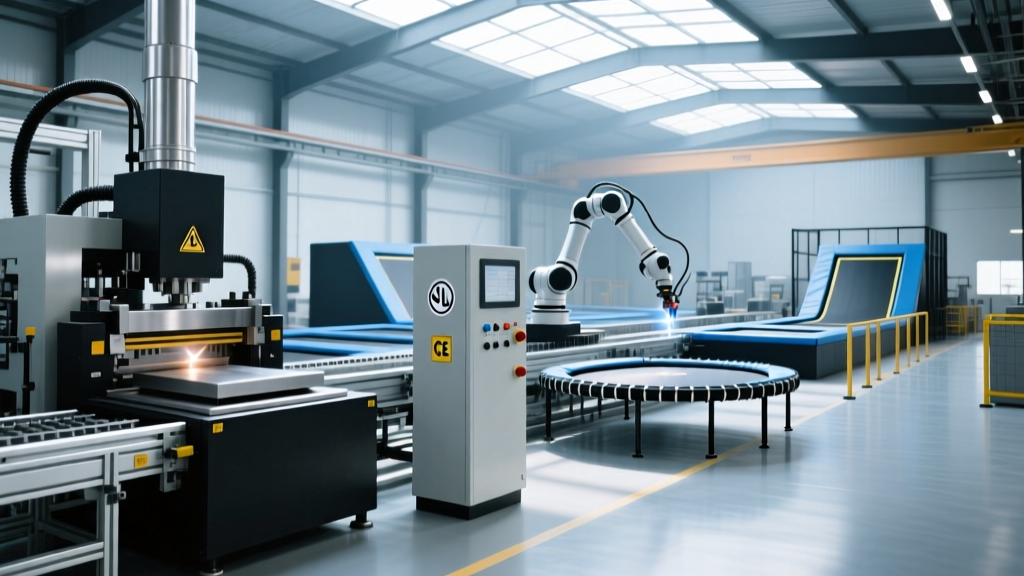
Manufacturer for Trampoline Parks Equipment: CE & UL Compliance
Discover how a top manufacturer for trampoline parks equipment navigates CE, UL, and CSA compliance to ensure safe, globally certified indoor play structures.
Commercial trampoline parks generate over $1.2 billion annually in North America alone, but the margin between a profitable family entertainment center and a catastrophic liability lawsuit is measured in millimeters of steel and grams of foam density. When a facility owner or investor sources gear, selecting a verified manufacturer for trampoline parks equipment is not just about negotiating the price per square foot—it is about securing verifiable, internationally recognized compliance marks.
Navigating the labyrinth of global safety certifications requires a deep understanding of regional engineering standards. A piece of equipment that passes inspection in Texas might fail structural audits in Toronto or Berlin. This guide breaks down the exact compliance pathways, material specifications, and hidden costs associated with CE, UL, and CSA marks, utilizing a cross-border expansion case study to illustrate real-world application.
The Global Compliance Matrix: CE vs. UL vs. CSA
Before engineering a single steel frame, a manufacturer must align its design parameters with the target market's regulatory framework. The table below outlines the primary certification marks required for commercial trampoline and ninja-course equipment across major markets.
| Certification Mark | Primary Standard(s) | Key Engineering Focus | Estimated Cost (Per Product Line) | Average Timeline |
|---|---|---|---|---|
| UL (US) | ASTM F2970, UL 508A (Electrical) | Impact attenuation, spring tension, court padding density | $18,000 - $32,000 | 12 - 16 Weeks |
| CSA (Canada) | CSA Z614, CSA C22.2 | Entrapment hazards, cold-weather material brittleness, electrical | $15,000 - $28,000 | 10 - 14 Weeks |
| CE (Europe) | Machinery Directive 2006/42/EC, EN 1176 | Structural steel calculations (Eurocode 3), moving parts guarding | $8,000 - $15,000 | 8 - 12 Weeks |
Case Study: Scaling North American Operations into the EU
Consider the operational pivot of a mid-sized manufacturer for trampoline parks equipment—referred to here as AeroBounce Manufacturing—transitioning from a domestic US supplier to a global exporter. Their flagship product, a modular 'Ninja Warrior' obstacle course integrated with trampoline bays, required simultaneous UL, CSA, and CE certification to fulfill a 15-park franchise contract spanning three continents.
Phase 1: Conquering the North American Market (UL & ASTM F2970)
In the United States, the gold standard for trampoline court design is ASTM F2970, heavily supported by IAAPA safety guidelines. To secure UL listing, AeroBounce had to prove their equipment met rigorous impact and structural thresholds.
- Frame Specifications: The primary structural boxes were upgraded to 100x100mm hot-dip galvanized square tubing with a minimum 3.5mm wall thickness, yielding a static load capacity of 550kg per bay.
- Padding Density: Standard 1-inch foam was rejected. The UL-approved spec required a dual-layer system: 1.5 inches of closed-cell EPE (Expanded Polyethylene) foam for shock absorption, encased in a 2-inch 18oz PVC vinyl cover with a 10,000 double-rub Wyzenbeek abrasion rating.
- Bed Tensile Strength: The Permatron polypropylene webbing (2x2 weave) had to pass a 400-lb dynamic drop test from a height of 3 meters without seam delamination.
Phase 2: Bridging the Canadian Gap (CSA Z614)
While similar to ASTM, the CSA Group's Z614 standard introduces strict parameters for entrapment and environmental degradation. Canadian inspectors focus heavily on the 'probe test'—ensuring no gap in the steel framing or ninja-course rigging measures between 3.5 inches and 9 inches, which could trap a child's head or neck.
Furthermore, the electrical blowers powering the inflatable ninja obstacles required CSA C22.2 certification. AeroBounce had to replace their standard US-spec 110V motors with dual-voltage, thermally protected blowers featuring IP55-rated enclosures to prevent dust ingress from the chalk and foam pits common in these facilities.
Phase 3: Cracking the European Code (CE Marking)
The CE mark is not a quality award; it is a legal declaration that the machinery meets the EU's Machinery Directive 2006/42/EC. For heavy structural play equipment, European Notified Bodies require exhaustive structural calculations based on Eurocode 3 (Design of steel structures).
AeroBounce's engineering team had to submit finite element analysis (FEA) reports proving that the trampoline frames could withstand dynamic wind loads (for semi-outdoor installations) and seismic shear forces, alongside a comprehensive risk assessment documenting every potential crushing or shearing hazard in the moving parts of the mechanical launch pads.
⚠️ WARNING: The 'Paper Certificate' Trap
A critical failure mode in this industry is the procurement of equipment from overseas factories offering 'CE certificates' generated by unaccredited, non-Notified testing agencies. A valid CE mark for structural amusement equipment requires a Technical Construction File (TCF) audited by an EU-recognized body. Always verify the Notified Body's 4-digit ID number on the NANDO database before signing a purchase order.
Hidden Costs and Timelines in Equipment Certification
Facility developers often budget for the equipment itself but fail to account for the compliance maintenance required by a legitimate manufacturer for trampoline parks equipment. Certification is not a one-time fee; it is an ongoing operational expense.
- Initial NRTL Testing Fees: Nationally Recognized Testing Laboratories (like UL or Intertek) charge between $18,000 and $32,000 for the initial destructive testing and documentation review of a new trampoline bay design.
- Factory Production Control (FPC) Audits: To maintain the UL or CSA mark, the manufacturer must submit to unannounced quarterly factory audits. These audits verify that the steel being welded on a Tuesday morning matches the exact metallurgical composition of the steel tested in the lab. Audit fees range from $2,500 to $4,000 per visit, plus travel expenses for the inspector.
- Component Traceability: If the manufacturer switches their foam supplier to cut costs, the new foam must be re-tested for flame retardancy (CAL 117) and impact attenuation. Unauthorized component changes will result in an immediate suspension of the certification mark.
Technical Decision Framework: Evaluating a Manufacturer's Compliance Posture
When issuing an RFP (Request for Proposal) to potential suppliers, facility owners should use the following framework to separate compliant manufacturers from those cutting corners.
1. Request the Technical Construction File (TCF) Index
Do not just ask for a certificate. Ask for the TCF index. A serious manufacturer will readily provide a redacted index showing they possess the FEA structural reports, material safety data sheets (MSDS) for all foams and plastics, and third-party lab test results for the polypropylene bed webbing.
2. Verify the Welding Procedure Specifications (WPS)
Trampoline frames endure millions of high-impact cyclical loads. The manufacturer must provide WPS documentation proving their welders are certified (e.g., AWS D1.1) and that they use continuous MIG welding with ER70S-6 wire on the primary load-bearing gussets, rather than spot-welding or using under-gauged steel.
3. Inspect the Spring Retention System
Spring failure is a leading cause of court injuries. Require the manufacturer to demonstrate a secondary retention system. Top-tier manufacturers use a Kevlar-reinforced webbing loop threaded through the spring eyelet, ensuring that if the steel spring snaps at the hook, the bed remains tethered to the frame, preventing the jumper from falling through the court.
'The difference between a catastrophic structural failure and a 15-year lifespan in a trampoline park comes down to the manufacturer's adherence to cyclical load testing. We mandate a minimum of 1.5 million compression cycles on the spring-to-frame connection points before we even look at the foam padding.' — Director of Engineering, Leading Global Amusement Safety Auditor
Summary: The True Cost of Non-Compliance
Partnering with a fully certified manufacturer for trampoline parks equipment requires a higher initial capital expenditure—typically 15% to 25% more than non-certified alternatives. However, this premium purchases more than just a plaque on the wall. It secures structural integrity validated by independent metallurgical and kinetic testing, ensures insurability for the facility, and provides a legal defense rooted in documented adherence to ASTM, CSA, and CE standards. In an industry where gravity is the primary adversary, verified compliance is the only acceptable baseline.