Relocation Tech for Commercial Trampoline Park Equipment Manufacturers
How commercial trampoline park equipment manufacturers use digital twins, AR rigging, and laser calibration to relocate heavy CNC machinery in 2026.
The Scaling Challenge in Recreation Manufacturing
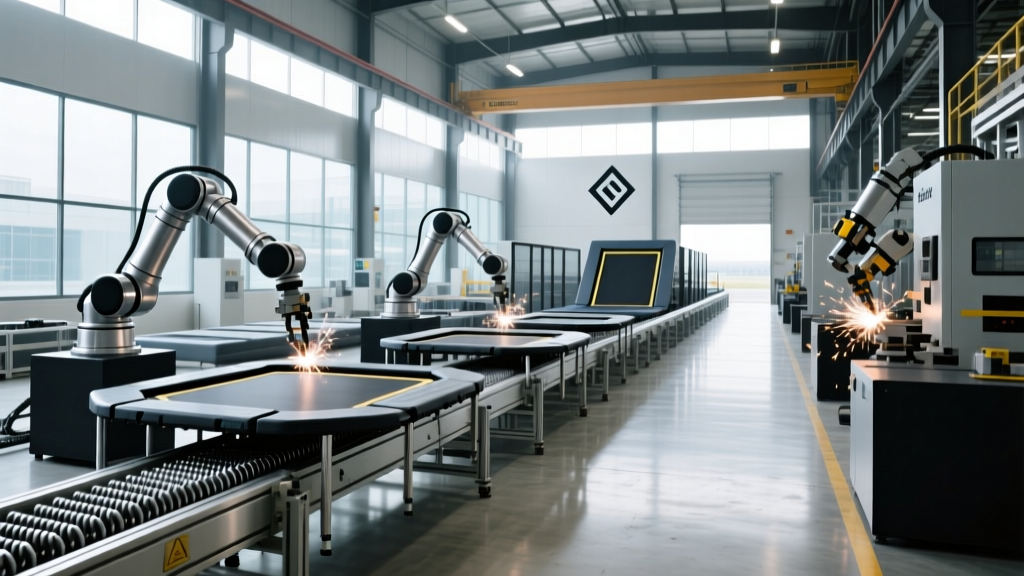
When commercial trampoline park equipment manufacturers scale operations to meet the surging global demand for modular indoor entertainment facilities, they face a massive logistical hurdle: relocating heavy fabrication machinery. Building the structural backbone of a modern trampoline park requires bending and cutting high-tensile galvanized steel tubing (typically 2.5-inch to 4-inch OD) with extreme precision. The factory floor is anchored by massive 5-axis laser tube cutters, CNC press brakes, and robotic welding cells.
Moving a 24,000-pound BLM LASERTUBE LT8.20 or a Trumpf TruLaser system across the country is not a standard freight job. If the machinery loses its sub-millimeter calibration during transit, the modular trampoline frames will fail to align during on-site park assembly, leading to catastrophic project delays. In 2026, forward-thinking manufacturers are abandoning legacy relocation methods in favor of spatial computing, digital twins, and automated metrology to ensure zero-defect equipment installation.
The Tolerance Problem in Modular Recreation
Unlike general structural steel, trampoline park frameworks rely on interlocking modular nodes. A standard 10,000-square-foot trampoline court requires thousands of interconnected steel members. If a CNC tube bender is misaligned by just 1.5mm after a factory relocation, the cumulative tolerance stack-up across a 40-foot truss will prevent the installation of the jumping mats and spring arrays.
Therefore, the relocation and installation of the manufacturing equipment itself must be treated with the same rigor as aerospace component fabrication. This requires a fundamental shift from "move and hope" to "measure, map, and verify."
Phase 1: LiDAR Scanning and Digital Twin Pre-Planning
Before a single machine is unbolted, modern facility engineers deploy terrestrial LiDAR scanners, such as the Leica RTC360, to capture the new facility. This generates a high-density point cloud that is imported into platforms like Autodesk Digital Twin Solutions to create a millimeter-accurate 3D replica of the new factory floor.
Why Digital Twins Prevent Installation Failures
- Clash Detection: Identifies if the 40-foot bed of a laser tube cutter will interfere with overhead crane rails or HVAC ducting in the new building.
- Utility Routing: Pre-maps the exact drop points for 480V 3-phase power, compressed air lines, and dust collection ducts, eliminating day-one installation bottlenecks.
- Load Path Simulation: Simulates the movement of heavy machinery through facility doors and aisles, ensuring the concrete slab can handle the dynamic point-loads of the transport skates.
Phase 2: AR-Guided Rigging and Placement
Heavy machinery rigging is inherently dangerous and prone to placement errors. According to OSHA Material Handling Guidelines, improper rigging and load misalignment are leading causes of industrial accidents. In 2026, rigging crews utilize Augmented Reality (AR) headsets, such as the Microsoft HoloLens 2 or Apple Vision Pro enterprise editions, integrated with spatial mapping software.
As the crane lowers a 15-ton robotic welding cell into place, the AR overlay projects the machine's exact center of gravity (CG), designated lifting points, and the target footprint onto the physical floor. Riggers can see a virtual "ghost" of the machine and guide the crane operator to lower it within 2mm of the designated anchor bolts.
Traditional vs. Tech-Enabled Relocation Metrics
| Metric | Legacy Relocation (Pre-2022) | Tech-Enabled Relocation (2026) |
|---|---|---|
| Placement Accuracy | ±15mm (requires manual crowbar adjustments) | ±2mm (AR-guided crane drops) |
| Utility Hookup Time | 3-5 days (field measuring and cutting) | 4-8 hours (pre-fabricated via Digital Twin) |
| Foundation Curing Delays | Frequent (misplaced anchor bolts) | Eliminated (LiDAR-verified templates) |
| Rigging Safety Incidents | Industry average 1.2 per 100 moves | Near zero with CG spatial mapping |
Phase 3: Foundation Prep and Vibration Isolation
Commercial trampoline park equipment manufacturers utilize heavy stamping and laser cutting equipment that generates significant harmonic vibration. If a laser tube cutter is installed on a slab that vibrates, the laser focal point will oscillate, resulting in dross-heavy, rough cuts on the galvanized steel.
Sub-Slab and Grouting Specifications
Proper installation requires isolating the machinery from the main warehouse slab. The standard protocol for heavy fabrication equipment in 2026 involves:
- Isolated Pads: Pouring independent concrete pads (minimum 4,000 PSI) separated by a 2-inch expansion joint filled with high-density polyurethane.
- Epoxy Grouting: Using high-modulus epoxy grout, such as Masterflow 648, to secure the machinery base to the pad. Unlike cementitious grouts, epoxy does not shrink and transfers dynamic loads uniformly.
- Active Dampening: Installing elastomeric vibration isolation pads (e.g., Fabreeka) under the leveling feet of CNC press brakes to prevent low-frequency vibrations from traveling to sensitive robotic welding arms nearby.
Phase 4: Automated Laser Interferometer Calibration
The final and most critical step in manufacturing equipment installation is re-calibrating the CNC axes. Moving a 5-axis machine across the country subjects the ball screws, linear guides, and granite beds to torsional stress and thermal shock. Manual dial-indicator calibration is obsolete for high-precision recreation manufacturing.
Today, metrology technicians deploy automated laser interferometers, such as the Renishaw Machine Tool Calibration XL-80 system. This device fires a highly stable laser beam along the X, Y, and Z axes of the machine, measuring positioning errors down to the nanometer level. The software automatically generates a compensation map that is uploaded directly into the CNC controller (e.g., Siemens Sinumerik or Fanuc 31i), correcting any geometric twists induced by the move.
Thermal Compensation Mapping
Because large warehouses lack the strict climate control of cleanrooms, manufacturers must map the machine's thermal growth. Technicians run the laser interferometer while cycling the machine's spindle and axes, recording how the steel frame expands as it heats up. This data is fed into the controller's thermal compensation algorithm, ensuring that a trampoline frame cut at 6:00 AM in a 55°F warehouse is dimensionally identical to one cut at 2:00 PM when the ambient temperature rises to 78°F.
Financial Breakdown: 2026 Relocation Economics
Upgrading to technology-driven relocation requires upfront capital, but the return on investment is realized through drastically reduced downtime and the elimination of post-installation troubleshooting. Below is a cost comparison for relocating a mid-sized trampoline manufacturing line (one 5-axis tube laser, two CNC press brakes, and a robotic welding cell) over a 500-mile distance.
- LiDAR Scanning & Digital Twin Modeling: $6,500
- AR Rigging Software & Hardware Lease: $4,200
- Contracted Laser Interferometer Calibration: $5,500 per machine ($16,500 total)
- Traditional Rigging & Freight: $85,000
- Total Tech-Enabled Move Cost: ~$112,200
While a traditional move might cost $95,000 in pure freight and rigging, it typically results in 12 to 16 days of factory downtime due to utility clashes, manual alignment, and test-cut recalibrations. At an average production value of $18,000 per day, a 14-day delay costs $252,000 in lost output and delayed park installations. The tech-enabled approach compresses installation and calibration to 4 days, saving over $180,000 in recovered production time and preventing costly on-site trampoline park assembly failures.