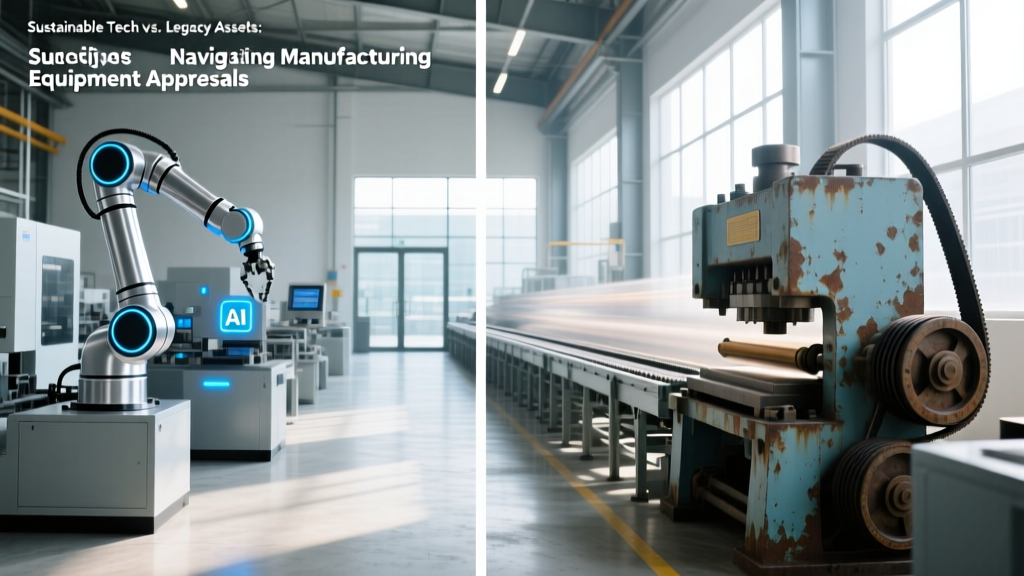
Sustainable Tech vs. Legacy Assets: Navigating Manufacturing Equipment Appraisals
Compare sustainable manufacturing equipment appraisals against legacy assets. Discover valuation differences, retrofit alternatives, and green tech ROI.
As of 2026, the integration of sustainable manufacturing equipment and green technology is no longer just a corporate social responsibility initiative; it is a critical balance sheet variable. With the expansion of Carbon Border Adjustment Mechanisms (CBAM) and stringent Scope 3 emissions reporting, energy-efficient machinery commands a distinct premium in the secondary market. Consequently, manufacturing equipment appraisals have evolved. Appraisers can no longer rely solely on age and physical condition; they must now quantify energy efficiency, carbon footprint reduction, and software-enabled sustainability metrics.
For plant managers and CFOs, understanding how green technology is valued compared to legacy assets is essential for capital planning, insurance coverage, and potential liquidation scenarios. This analysis breaks down the valuation divide, compares specific equipment classes, and explores retrofit alternatives to maximize asset value.
The Valuation Divide: Green Tech vs. Legacy Machinery
Traditional manufacturing equipment appraisals rely on three primary methodologies. The introduction of green technology skews each of these approaches in distinct ways:
- Cost Approach: Calculates Replacement Cost New (RCN) minus depreciation. Green tech (e.g., all-electric drives) has a higher initial RCN but often exhibits slower physical depreciation due to reduced mechanical friction and the elimination of hydraulic fluids.
- Market Approach: Relies on comparable secondary market sales. This is challenging for specialized green tech, as the secondary market for 5-year-old sustainable equipment is thinner than for ubiquitous legacy machines, often forcing appraisers to rely on broader industrial indices.
- Income Approach: Capitalizes the net income generated by the asset. This is where sustainable equipment shines. Lower utility consumption and reduced maintenance directly increase the net operating income attributed to the machine, yielding a significantly higher appraised value.
Industry Insight: According to guidelines supported by the EPA's Pollution Prevention (P2) program, equipment that demonstrably reduces energy and material waste qualifies for preferential treatment in corporate environmental accounting, which increasingly informs specialized asset appraisals for ESG-focused buyers.
Comparison Matrix: All-Electric vs. Hydraulic Injection Molding
To illustrate the divergence in manufacturing equipment appraisals, consider the 150-ton Injection Molding Machine (IMM) class. We compare a legacy hydraulic model against a modern all-electric alternative at the 5-year mark of their lifecycle.
| Metric | Legacy Hydraulic (e.g., Boy 155 E) | All-Electric (e.g., Arburg Allrounder 470 E) |
|---|---|---|
| Original Purchase Price (2021) | $110,000 | $195,000 |
| Year 5 Fair Market Value (FMV) | $44,000 (40% retention) | $136,500 (70% retention) |
| Annual Energy Consumption | ~120,000 kWh | ~45,000 kWh |
| Maintenance Cost (Year 1-5) | $18,000 (fluid, seals, filters) | $4,500 (grease, toggle belts) |
| Appraisal Method Preference | Market Approach | Income / Cost Approach |
The Income Approach Math in Action
Assuming a 2026 industrial electricity rate of $0.14/kWh, the legacy hydraulic IMM costs $16,800 annually to power, while the all-electric Arburg costs $6,300. The annual savings of $10,500, discounted over a 10-year remaining useful life at an 8% capitalization rate, adds approximately $70,000 in present value to the machine under the Income Approach. This mathematical reality explains why all-electric IMMs defy traditional steep depreciation curves.
Alternatives Analysis: Buy New Green Tech vs. Retrofit Legacy Assets
When preparing for an appraisal or planning capital expenditures, manufacturers face a critical decision: purchase new sustainable equipment or retrofit existing legacy assets. Appraisers classify retrofits as "capital improvements" that can extend the Useful Life (UL) of a machine, positively impacting its Orderly Liquidation Value (OLV).
Here is a decision framework for common retrofits versus full replacements:
- Variable Frequency Drives (VFDs) on CNC Coolant Pumps:
- Retrofit Cost: $3,500 - $5,000 for a 50HP motor.
- Impact: Reduces pump energy consumption by 35% and decreases mechanical stress on impellers.
- Appraisal Effect: Adds minimal direct FMV, but extends the UL of the CNC by 3-5 years by preventing premature motor burnout.
- Servo-Driven Hydraulic Pump Upgrades:
- Retrofit Cost: $12,000 - $18,000 for legacy stamping presses.
- Impact: Eliminates constant idling energy draw, cutting hydraulic power use by up to 60%.
- Appraisal Effect: Highly valued in the secondary market; appraisers will often add 50-70% of the retrofit cost to the machine's FMV if documentation is provided.
- Compressor Heat Recovery Systems:
- Retrofit Cost: $8,000 - $15,000.
- Alternative: Buying a new oil-free, water-cooled compressor with integrated heat recovery ($85,000+).
- Appraisal Effect: If the facility utilizes the recovered heat for boiler feedwater or space heating, the Income Approach valuation of the entire compressed air system increases significantly.
The Hidden Appraisal Trap: Software-Locked Green Features
A non-obvious edge case in modern manufacturing equipment appraisals involves software-locked sustainability features. Advanced CNC machining centers, such as those utilizing Siemens SINUMERIK or DMG MORI's CELOS interface, often include energy-monitoring and optimized-pathing modules that reduce power draw by 15-20%.
Warning: The Software Transfer GotchaThese energy-saving modules are frequently tied to digital software licenses registered to the original purchaser. If the machine is sold at auction or appraised for liquidation, and the license is not explicitly transferred (which can cost $2,500 to $5,000 in OEM transfer fees), the "green" capability is effectively bricked. Appraisers aware of this will deduct the transfer cost from the FMV or value the machine as a standard, non-optimized asset. Always ensure software license transferability is documented in your asset registers prior to an appraisal.
Aligning with Global Standards
To ensure that sustainable manufacturing equipment appraisals reflect the true value of green technology, facilities must align their data collection with recognized frameworks. Adhering to ISO 50001 (Energy Management Systems) provides appraisers with verified, auditable data regarding a machine's energy baseline and performance improvements. Similarly, leveraging resources from the NIST Advanced Manufacturing portal can help engineering teams quantify the exact material and energy savings of specific processes, providing the hard data appraisers require to justify a "green premium" under the Income Approach.
Actionable Framework for Plant Managers
To maximize the appraised value of your sustainable manufacturing equipment and green technology assets, implement the following protocol 90 days before an appraisal:
- Audit Energy Meters: Ensure sub-metering on high-draw equipment (e.g., furnaces, chillers, IMMs) is calibrated and logging data. Appraisers cannot apply the Income Approach without verified utility reduction data.
- Compile Retrofit Documentation: Gather all invoices, engineering specs, and OEM certifications for VFDs, servo-upgrades, and LED lighting integrations. Label these clearly as "Capital Improvements" rather than "Routine Maintenance."
- Verify Software Licenses: Contact your OEM representatives to audit the transferability of all energy-optimization software modules tied to your CNCs and automated cells.
- Document Utility Rebates: If you received municipal or state utility rebates for purchasing energy-efficient equipment, document the net capital cost. Appraisers using the Cost Approach need to know if the RCN should be adjusted based on subsidized acquisition costs.
By treating energy efficiency as a quantifiable, data-backed asset attribute rather than an abstract environmental benefit, manufacturers can ensure their sustainable equipment appraisals accurately reflect the true financial superiority of green technology over legacy alternatives.