Eco-Friendly Ice Cream Manufacturing Equipment: 2026 Alternatives
Compare sustainable ice cream manufacturing equipment alternatives for 2026. Analyze CO2 freezers, thermal recovery pasteurizers, and low-water CIP systems.
The Regulatory and Economic Drivers of Green Dairy Processing
The procurement criteria for dairy processing lines have fundamentally shifted. Driven by the aggressive phase-down of high-GWP (Global Warming Potential) hydrofluorocarbons (HFCs) under the EPA AIM Act and escalating industrial energy tariffs, plant managers can no longer justify legacy equipment based solely on upfront capital expenditure. Sustainable ice cream manufacturing equipment is no longer a niche corporate social responsibility initiative; it is a baseline requirement for operational viability and regulatory compliance in 2026.
This analysis compares traditional setups against modern green alternatives across the three most resource-intensive stages of ice cream production: continuous freezing, pasteurization, and clean-in-place (CIP) operations. We evaluate specific thermodynamic properties, exact CapEx premiums, and real-world operational savings to provide a concrete procurement framework.
Continuous Freezers: Natural Refrigerants vs. Legacy HFCs
The continuous freezer is the most energy-dense unit in an ice cream plant, responsible for whipping and freezing the mix from 4°C down to -5°C to -7°C while maintaining precise overrun (air incorporation). Historically, these systems relied on R404A or R507 refrigerants. With R404A carrying a GWP of 3,922, its use in new commercial refrigeration is heavily restricted or banned in multiple jurisdictions.
Comparing R744 (CO2) and R717 (Ammonia) Alternatives
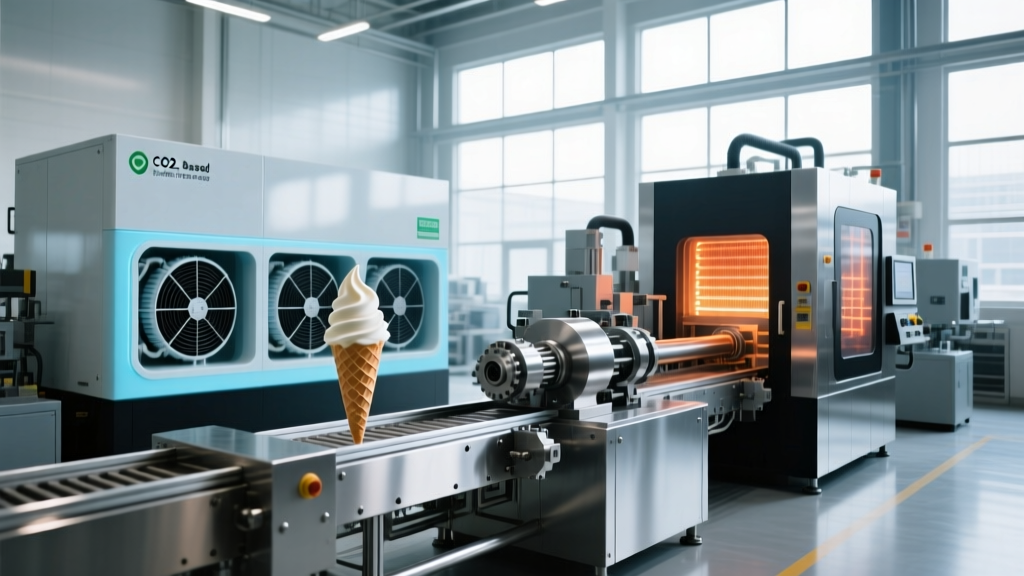
Modern sustainable ice cream manufacturing equipment utilizes natural refrigerants. The two dominant alternatives are Carbon Dioxide (R744) and Ammonia (R717). Selecting between them depends on plant size, safety infrastructure, and ambient climate conditions.
| Parameter | Legacy R404A Systems | R744 (CO2) Cascade Systems | R717 (Ammonia) Systems |
|---|---|---|---|
| Global Warming Potential (GWP) | 3,922 | 1 | 0 |
| Operating Pressure (Evaporator) | ~4.5 bar | ~12 to 15 bar | ~1.5 bar |
| Coefficient of Performance (COP) at -35°C | 1.8 - 2.1 | 2.4 - 2.7 | 2.8 - 3.2 |
| CapEx Premium vs. Legacy | Baseline | +15% to +22% | +10% to +18% |
| Primary Safety / Infrastructure Constraint | High GWP regulatory fines | High-pressure piping requires heavy-walled stainless steel | Toxicity requires OSHA PSM ventilation and leak detection |
Thermal Energy Recovery in Pasteurization Lines
Pasteurization requires heating the ice cream mix to at least 79°C (175°F) for 25 seconds to eliminate pathogens and stabilize proteins. In legacy plate heat exchanger (PHE) setups, raw mix is heated using live steam, and the pasteurized mix is cooled using chilled glycol or ice water, wasting massive amounts of thermal energy.
Regenerative Heat Exchange Matrices
Sustainable pasteurizers, such as the SPX Flow APV and Tetra Pak Tetra Therm lines, integrate advanced regenerative heating sections. In these systems, the hot pasteurized product transfers its heat to the incoming cold raw mix across corrugated stainless steel plates.
- Standard Legacy PHE: Achieves 70% to 75% thermal regeneration. Requires significant steam boiler output and heavy chiller loads.
- High-Efficiency Green PHE: Achieves 90% to 94% thermal regeneration. The outgoing hot mix pre-heats the incoming cold mix, meaning only 6% to 10% of the total thermal energy must be supplied by the steam boiler.
According to data from the U.S. Department of Energy's Advanced Manufacturing Office, optimizing thermal regeneration in dairy processing can reduce natural gas consumption for pasteurization by up to 35%. For a standard 5,000-liter-per-hour ice cream line running two shifts, upgrading from a 75% to a 92% regenerative PHE saves approximately 14,000 therms of natural gas annually, translating to roughly $11,000 to $14,000 in direct fuel savings depending on regional utility rates.
Water and Chemical Reduction in CIP Systems
Clean-in-place (CIP) operations account for up to 30% of a dairy plant's total water footprint and a significant portion of its chemical and thermal utility usage. Traditional single-pass CIP systems flood the piping and freezer barrels with caustic soda, acid, and rinse water, sending it directly to the drain.
Membrane Recovery and Automated Valve Routing
Modern green CIP alternatives focus on fluid optimization and chemical recovery. The integration of automated mix-proof valves, such as the Alfa Laval ThinkTop series, allows for precise routing of cleaning fluids, eliminating the 'dead legs' in piping where fluid pools and requires excessive flushing.
Warning on Rotary Spray Heads: When upgrading CIP systems, do not simply increase pump pressure to compensate for poor coverage. High-impact rotary spray heads (like the Alfa Laval Toftejorg series) are engineered to operate at lower flow rates (10-15 m³/h) while generating higher mechanical impact force on the tank walls. Running these at excessive pressures causes fluid atomization, which reduces cleaning efficacy and wastes water.Furthermore, advanced sustainable plants are adopting membrane-based caustic recovery systems. These systems filter the post-clean caustic solution, removing fats, proteins, and suspended solids, allowing the sodium hydroxide to be reused for 3 to 5 subsequent CIP cycles. This reduces caustic chemical procurement by up to 60% and significantly lowers the biological oxygen demand (BOD) of the plant's effluent wastewater, reducing municipal discharge fees.
CapEx vs. OpEx: Calculating the 5-Year Green ROI
The primary barrier to adopting sustainable ice cream manufacturing equipment is the initial capital outlay. Green technologies require specialized materials, higher-pressure components, and advanced automation. However, evaluating the Total Cost of Ownership (TCO) over a standard 5-year depreciation cycle reveals a compelling financial case.
| Equipment Category | Legacy System Baseline Cost | Green Alternative Cost | CapEx Premium | Est. Annual OpEx Savings | Payback Period |
|---|---|---|---|---|---|
| Continuous Freezer (R744 vs R404A) | $280,000 | $330,000 | $50,000 (18%) | $18,500 (Energy) | 2.7 Years |
| Pasteurizer (92% Regen vs 75% Regen) | $140,000 | $165,000 | $25,000 (18%) | $12,000 (Gas/Chiller) | 2.1 Years |
| CIP System (Automated/Recovery vs Single-Pass) | $90,000 | $125,000 | $35,000 (38%) | $14,000 (Water/Chemicals) | 2.5 Years |
Strategic Procurement Framework for 2026
When specifying sustainable ice cream manufacturing equipment for new builds or line expansions, engineering teams must move beyond vendor marketing claims and demand verified performance data. Use the following framework during the RFP (Request for Proposal) process:
- Demand Thermodynamic Guarantees: Require freezer OEMs to provide guaranteed COP (Coefficient of Performance) metrics at your specific ambient summer temperatures and targeted -35°C evaporating temperatures, not just standardized catalog ratings.
- Audit Regeneration Efficiencies: Require pasteurizer suppliers to calculate the exact steam and glycol utility loads based on your specific ice cream mix formulation (high-fat and high-sugar mixes have different specific heat capacities than standard milk).
- Verify CIP Impact Velocities: Require CIP engineers to provide computational fluid dynamics (CFD) or empirical spray coverage maps for your specific aging tank geometries to ensure mechanical cleaning action without water waste.
- Factor in Carbon Pricing: When calculating ROI, include projected regional carbon taxes or HFC phase-down compliance costs, which will severely penalize legacy refrigerant leaks and high-emission energy usage in the coming years.
Transitioning to green dairy processing technology is an exercise in applied thermodynamics and fluid optimization. By prioritizing natural refrigerants, maximizing thermal regeneration, and automating CIP fluid routing, manufacturers can insulate their operations against utility volatility while future-proofing their facilities against tightening environmental regulations.