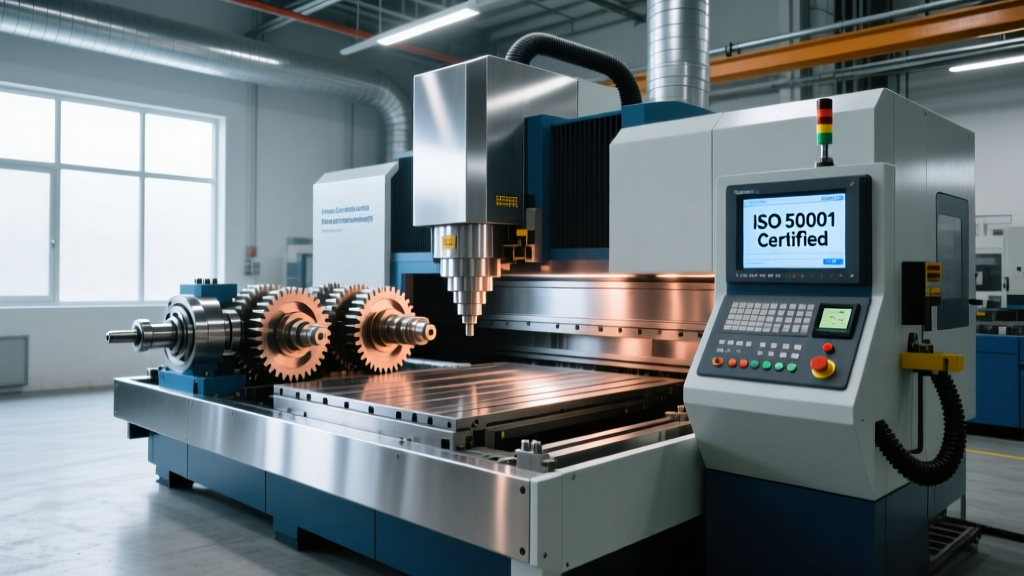
Startup Compliance: Supplying Oil & Gas Equipment Manufacturers
Navigate API and ASME safety compliance when using small-scale manufacturing equipment to supply major oil & gas equipment manufacturers.
The High-Stakes Reality of Micro-Manufacturing in O&G
Startups entering the energy supply chain often operate out of 2,000-square-foot micro-factories. They rely on small-scale manufacturing equipment—such as benchtop 5-axis mills, compact Swiss lathes, and bound-metal 3D printers—to produce prototype valve trim, sensor housings, and wellhead components. However, the regulatory bodies governing the energy sector do not offer a 'prototype exemption' for critical path components. When your startup supplies major oil & gas equipment manufacturers, a failure in a $50 machined flange can trigger a catastrophic blowout, leading to millions in liabilities and immediate blacklisting from vendor registries.
As of 2026, major operators require even Tier-3 and Tier-4 prototype suppliers to demonstrate foundational compliance with API Q1 management systems and strict material traceability. This guide details how startups can configure small-scale manufacturing equipment and shop-floor protocols to meet the rigorous safety standards demanded by oil & gas equipment manufacturers without exhausting early-stage capital.
Small-Scale Equipment Selection Matrix for API Compliance
Choosing the right small-format machine is not just about footprint; it is about process capability (Cpk) and the ability to hold tolerances on exotic alloys like Inconel 718 or Duplex 2205 stainless steel. Below is a compliance-focused evaluation of popular small-scale machines used by O&G startups.
| Equipment Model | Process & Footprint | Tolerance Capability | O&G Compliance Hurdle | Est. Cost (2026) |
|---|---|---|---|---|
| Haas DS-10-2SS | Small CNC Mill (10x14 travel) | ±0.0005" | Rapid tool wear on Inconel requires strict in-process probing to avoid out-of-t scrap. | $68,000 |
| Markforged Metal X | Bound Metal Deposition | ±0.002" (post-sinter) | ASME BPVC Section VIII restricts voids; parts require Hot Isostatic Pressing (HIP) for pressure ratings. | $125,000 |
| Citizen L20-XII | Compact Swiss Lathe | ±0.0002" | Chip evacuation in deep-hole drilling for subsea sensor ports requires custom high-pressure coolant retrofits. | $195,000 |
Material Traceability on a Startup Budget
One of the most frequent compliance failures among small machine shops supplying oil & gas equipment manufacturers is the loss of Material Test Report (MTR) chain of custody. API 6A (Wellhead and Christmas Tree Equipment) mandates strict heat-number traceability for all pressure-containing members. If a startup buys a 10-foot bar of 17-4 PH stainless from an online metal marketplace and cuts it into fifty valve stems, losing the physical MTR link to each individual part renders the entire batch unsellable to prime contractors.
Digital MTR Integration for Micro-Factories
Startups cannot afford $150,000 enterprise ERP systems. Instead, utilize mid-market shop management software like ProShop ERP or JobBOSS2 (typically $300–$600 per month in 2026). These platforms allow you to scan a barcode on the raw material stock upon receipt, instantly linking the supplier's MTR PDF to the digital work order. When the small-scale CNC mill completes the part, the operator scans the finished component, generating a serialized Certificate of Conformance (CoC) that automatically appends the original MTR. This digital thread satisfies API Q1 clause 7.5.3 requirements for product traceability.
⚠️ CRITICAL WARNING: The PSL-3 Valve Body TrapStartups prototyping valve bodies often assume standard machining practices apply to API 6A Product Specification Level (PSL) 3 or 4 components. PSL-3 requires volumetric non-destructive examination (NDE) such as ultrasonic testing (UT) to verify internal soundness. If your small-scale 5-axis mill introduces micro-stresses that cause subsurface cracking during heat treatment, and you ship without UT verification, the part will fail at the prime contractor's receiving dock. Always outsource NDE to an ISO 9712-certified local lab ($150–$300 per batch) before shipping PSL-3 prototypes.
The Metrology Bottleneck: CMM vs. Vision Systems
Verifying the complex geometries of O&G components—such as the API 5B threading profiles on small tubing couplings—requires precision metrology. Historically, this meant purchasing a Coordinate Measuring Machine (CMM). A benchtop Zeiss Contura CMM costs upwards of $90,000 and requires a climate-controlled room (68°F ±2°F), which most startup micro-factories lack.
The 2026 Alternative: Optical vision measuring systems like the Keyence IM-8000 series (approx. $38,000) have become the standard for small-scale O&G suppliers. These systems measure 2D and surface 3D profiles in seconds without physical contact, eliminating probe-induced errors on soft seals or delicate elastomeric grooves. While they cannot replace a CMM for deep-bore concentricity checks, they cover 85% of the inspection requirements for small valve trim and sensor housings, dramatically reducing inspection bottlenecks while maintaining ISO 17025 calibration standards.
OSHA Compliance: LOTO and the Small Machine Hazard
While API and ASME govern the product, OSHA governs the factory floor. Small-scale manufacturing equipment poses unique Lockout/Tagout (LOTO) hazards. Machines like the Tormach 1100MX or benchtop lathes often ship with standard plug-in power cords and lack integrated, lockable main disconnect switches. This is a direct violation of OSHA 1910.147 Control of Hazardous Energy.
When audited by a safety inspector—or worse, when a prime contractor conducts a vendor site audit—missing LOTO points will result in an immediate fail. Startups must retrofit every small machine with a NEMA-rated rotary disconnect switch (e.g., Allen-Bradley 194R series, approx. $450 installed). Furthermore, pneumatic energy stored in small machine air cylinders must be bled via lockable dump valves before maintenance. Documenting these specific energy control procedures (ECPs) for each micro-machine is a non-negotiable requirement for passing vendor safety questionnaires.
ATEX and IECEx Considerations for In-House Testing
If your startup manufactures electronic sensor housings or actuators for hazardous environments, you may be required to perform in-house functional testing using pressurized hydrocarbon gases. Doing this in a standard job shop violates National Electrical Code (NEC) Article 500. You must establish a clearly demarcated Class I, Division 1 or Division 2 testing zone. This requires installing intrinsically safe barriers (e.g., MTL4500 series) and explosion-proof lighting, which can add $15,000 to your facility build-out. Never test live O&G electronics with volatile gases outside of a certified blast chamber.
Step-by-Step Compliance Audit for Micro-Factories
Before bidding on prototype contracts from major oil & gas equipment manufacturers, run your small-scale facility through this actionable audit checklist:
- Verify Calibration Certs: Ensure all micrometers, bore gauges, and torque wrenches carry active ISO 17025 certificates. Expired certs invalidate all dimensional data.
- Audit the MTR Chain: Pull three random finished parts from inventory. Trace them backward to the raw material heat number and the original supplier MTR within 5 minutes.
- Inspect LOTO Hardware: Physically test the lockable disconnect on every CNC mill, lathe, and 3D printer sintering furnace. Verify that the machine cannot receive power when locked.
- Review Coolant Management: O&G alloys require specific cutting fluids. Ensure your small CNC's coolant concentration is logged daily (using a refractometer) to prevent metallurgical contamination or surface oxidation on critical sealing faces.
- Check NDE Vendor SLAs: Confirm your outsourced ultrasonic and dye-penetrant testing labs have turnaround times that align with your prototype delivery schedules.
Supplying the energy sector as a startup is highly lucrative but unforgiving of shortcuts. By aligning your small-scale equipment capabilities with the stringent safety and traceability standards of the industry, you transform your micro-factory from a risky prototype shop into a trusted, compliant tier-supplier. For deeper technical specifications on material grading and design validation, refer to the API Engineering Services portal and the ASME Boiler and Pressure Vessel Code documentation.