Choosing a Coil Processing Equipment Manufacturer for Startups
Discover how hardware startups select a coil processing equipment manufacturer for small-scale lines. Includes footprint specs, costs, and a real case study.
The Startup Dilemma: Manual Blanking vs. Compact Coil Lines
Hardware startups transitioning from prototype to low-volume production often rely on pre-cut blanks or manual sheet feeding into stamping presses. While viable for initial runs of 500 to 1,000 units, this approach caps throughput at roughly 15 to 20 parts per minute and generates up to 18% material scrap from sheet edges. When a startup begins evaluating a coil processing equipment manufacturer, the goal is to secure a compact cut-to-length (CTL) or blanking line that fits within a constrained 2,000-square-foot facility while delivering Tier-1 precision.
Unlike legacy manufacturing plants that run 60-inch wide, 0.250-inch thick high-strength steel at 300 feet per minute, small-scale manufacturers typically process 12-inch to 24-inch wide coils of 1018 Cold Rolled Annealed (CRCA) steel or 5052-H32 aluminum in thicknesses ranging from 0.035 to 0.125 inches. The equipment must be scaled down, but the precision requirements remain absolute.
Cost-Benefit Breakdown: Pre-Cut Blanks vs. Entry-Level Coil Line
| Metric | Pre-Cut Blanks (Manual Feed) | Compact 12-inch CTL Line |
|---|---|---|
| Material Cost per lb | $1.85 - $2.10 | $0.95 - $1.15 |
| Scrap Rate | 14% - 18% | 2% - 4% |
| Throughput (12x12 blanks) | 18 parts/min | 45 parts/min |
| Capital Expenditure | $0 (Press only) | $115,000 - $145,000 |
| Payback Period | N/A | 14 - 18 Months |
Case Study: Scaling a Tier-2 EV Bracket Manufacturer
To understand the practical application of small-scale coil lines, we examined an Ohio-based startup manufacturing battery enclosure brackets for electric vehicles. The company initially purchased pre-cut 5052-H32 aluminum blanks, manually feeding them into a 150-ton Minster press. As order volumes scaled to 40,000 units per month, the manual feeding process became a critical bottleneck, and the premium paid for sheared blanks eroded their profit margins.
The Bottleneck and Material Realities
The startup faced a specific metallurgical challenge: 5052-H32 aluminum exhibits significant coil set memory and is highly susceptible to surface marking. Standard entry-level straighteners with 5 or 7 rolls failed to flatten the material adequately, resulting in a 9% rejection rate at the final welding stage due to dimensional warping. Furthermore, standard steel feed rolls left micro-abrasions on the aluminum surface, ruining the cosmetic finish required by the OEM.
Selecting the Right Coil Processing Equipment Manufacturer
Selecting the right coil processing equipment manufacturer requires looking past the brochure specifications and focusing on application-specific engineering. The startup needed a vendor willing to customize a compact line for non-ferrous, high-surface-quality materials. They evaluated three vendors and ultimately selected a mid-tier US-based manufacturer that offered a specialized 9-roll straightener and tungsten-carbide coated servo feed rolls.
'Startups often over-spec the tonnage and width of their first coil line, wasting capital and floor space. The real ROI is found in the feeder accuracy and straightener roll configuration, not the sheer size of the decoiler.'
— Senior Manufacturing Engineer, NIST MEP Network
According to resources provided by the NIST Manufacturing Extension Partnership (MEP), small manufacturers can often leverage state-level grants to offset up to 50% of the capital cost for advanced manufacturing equipment that reduces material waste, a factor that heavily influenced the startup's financial modeling.
Space, Power, and Rigging Constraints in Small Facilities
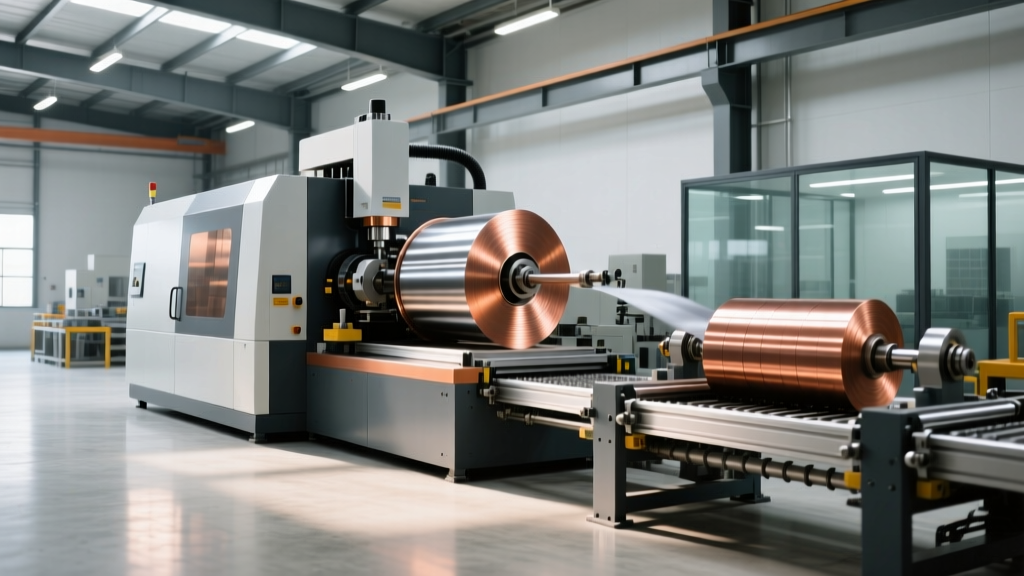
Startups rarely have the luxury of 100-foot long, reinforced concrete pits required for traditional coil lines. A compact 12-inch CTL line must be engineered for low-profile installation and standard industrial power grids.
Real-World Footprint and Utility Specs
When planning the facility layout, founders must account for the following exact specifications typical of a modern, small-scale servo-driven coil line:
- Total Line Length: 38 to 45 feet (from decoiler mandrel to shear blade).
- Width Requirement: 10 feet minimum clearance for operator walkways and scrap bin removal.
- Power Supply: 480V, 3-Phase, 60-Amp minimum. Unlike older hydraulic lines that require 150+ Amps, modern servo-driven decoilers and feeders drastically reduce peak amperage draw.
- Air Supply: 90 PSI at 15 CFM for pneumatic clutch/brake systems on the decoiler and the hold-down clamps on the shear.
- Floor Loading: 4,500 lbs per square foot. Standard 6-inch reinforced concrete slabs are generally sufficient, eliminating the need for expensive foundation trenching.
Hidden Costs and Edge Cases in Entry-Level Coil Lines
When negotiating with a coil processing equipment manufacturer, startups frequently overlook the ancillary systems required to make the line production-ready. The base price of $115,000 for the decoiler, straightener, and feeder is only the beginning. Industry data highlighted by The Fabricator consistently shows that material handling and scrap management are where small shops lose their profitability.
Warning: The True Cost of Ownership
Founders must budget an additional 25% to 35% above the base equipment cost for the following critical integrations:
- Scrap Conveyors ($8,500 - $12,000): Without an under-press oscillating scrap conveyor, operators will spend 45 minutes per shift manually digging skeleton scrap out of the press bolster, destroying the throughput gains of the coil line.
- Loop Control Systems ($4,200): Optical loop sensors or ultrasonic pit sensors are mandatory to synchronize the decoiler speed with the servo feeder, preventing material stretching or birdnesting.
- Coil Loading Cars ($14,000): A 2,000 lb coil cannot be safely loaded onto a mandrel via forklift without risking damage to the expansion segments. A motorized V-block coil car is a non-negotiable safety requirement.
- MTConnect Integration ($6,000): As noted by the Society of Manufacturing Engineers (SME), adopting MTConnect protocols allows startups to track Overall Equipment Effectiveness (OEE) in real-time, linking the coil line's feed data directly to the shop's ERP system.
Evaluation Framework for Founders
To systematically vet potential partners, use this decision matrix during the vendor selection process. This framework prioritizes long-term operational stability over initial capital savings.
| Evaluation Criteria | Minimum Acceptable Standard | Red Flags to Avoid |
|---|---|---|
| Straightener Roll Config | 9-roll minimum for HSLA; 7-roll for mild steel. | 5-roll straighteners (cannot remove deep coil set). |
| Feeder Drive Mechanism | Direct-drive servo with +/- 0.002 inch pitch accuracy. | Mechanical clutch feeders (prone to slippage and wear). |
| Control Interface | HMI with recipe storage for 50+ part numbers. | Manual dial adjustments (guarantees setup errors). |
| Local Service Support | Factory-trained tech within a 4-hour drive radius. | Overseas-only support with 48-hour response times. |
Final Verdict for Small-Scale Manufacturers
For hardware startups, the transition to automated coil processing is the definitive bridge between a prototype shop and a scalable manufacturing enterprise. By targeting a 12-inch to 24-inch compact line, founders can achieve a 14-month ROI through drastic reductions in material costs and scrap rates. The key to success lies in selecting a coil processing equipment manufacturer that understands the unique constraints of small-scale facilities—prioritizing servo-driven precision, low-profile footprints, and modern data integration over raw, high-volume horsepower. Do not compromise on the straightener roll configuration or the scrap management systems; these are the hidden variables that will ultimately dictate your line's daily uptime and your startup's profitability.