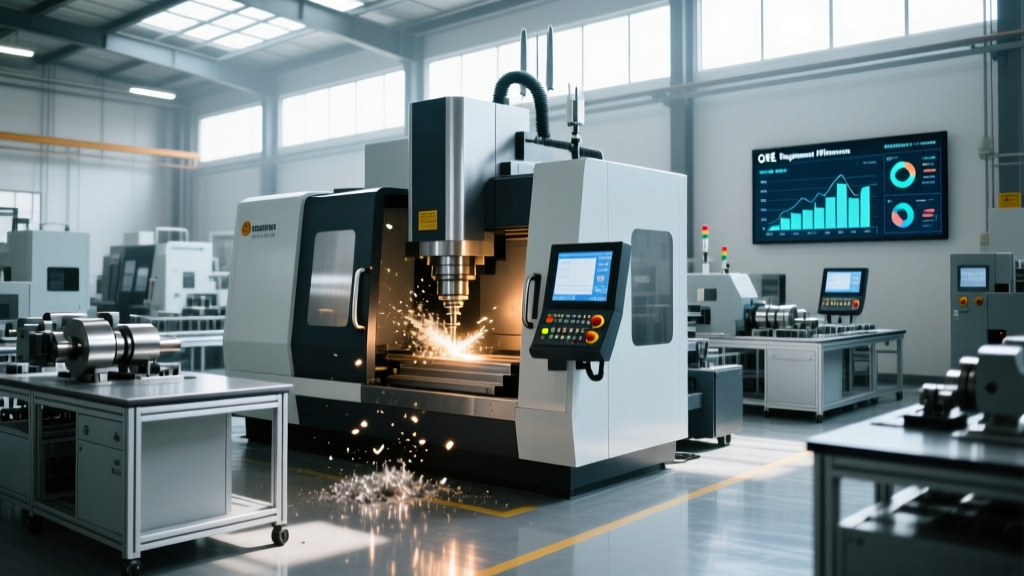
Manufacturing Process Equipment Spare Parts Inventory Management
Optimize manufacturing process equipment spare parts inventory by aligning min/max levels with preventive maintenance schedules and MTBF data.
The Financial Impact of Misaligned Process Equipment Spares
Misaligned spare parts inventory for manufacturing process equipment drains capital through excess carrying costs or halts production via catastrophic stockouts. In continuous process environments—such as chemical extrusion, pharmaceutical blister packaging, or food and beverage pasteurization—a single missing component like a Siemens SIMATIC S7-1500 PLC module or a specialized Danfoss VLT AutomationDrive FC 302 frequency converter can idle an entire production line. At an average downtime cost of $12,000 to $25,000 per hour in high-volume process manufacturing, reactive purchasing is financially indefensible.
Effective inventory management must transition from historical run-rate forecasting to predictive alignment with maintenance and service schedules. As of 2026, modern Computerized Maintenance Management Systems (CMMS) integrated with Tier-1 ERPs allow facility managers to map spare parts directly to Preventive Maintenance (PM) routes and Mean Time Between Failures (MTBF) degradation curves.
Warning: The Hidden Carrying Cost TrapIndustry benchmarks indicate that annual inventory carrying costs range from 22% to 27% of the total inventory value. This includes warehousing, insurance, obsolescence, and capital opportunity cost. Holding $500,000 in unoptimized, slow-moving process equipment spares effectively burns $110,000 to $135,000 annually in hidden overhead.
Categorizing Spares: VED-ABC Matrix for Maintenance Criticality
Standard ABC analysis (based purely on part cost and volume) fails in process manufacturing because a $15 O-ring can cause the same line stoppage as a $15,000 gearbox. To align inventory with maintenance schedules, reliability engineers utilize a combined VED-ABC matrix. VED classifies parts by criticality: Vital (stops production immediately), Essential (can run temporarily but degrades quality/safety), and Desirable (no immediate impact).
| Part Category | Example Component | VED Class | ABC Class | Maintenance Schedule Link | Inventory Strategy |
|---|---|---|---|---|---|
| Control Systems | Siemens CPU 1515-2 PN | Vital | A (High Cost) | Run-to-Failure / PdM | Keep 1 on-site; vendor guaranteed 4-hr replacement |
| Drive Mechanics | SKF 22210 E Spherical Roller Bearing | Vital | B (Med Cost) | PM Schedule (Annual swap) | Min/Max based on PM route frequency + lead time |
| Pneumatics | Festo DSBC Cylinder Seal Kit | Essential | C (Low Cost) | PM Schedule (6-month rebuild) | Bulk EOQ (Economic Order Quantity) purchasing |
| Auxiliary Sensors | IFM O5D100 Photoelectric Sensor | Desirable | C (Low Cost) | Run-to-Failure | Vendor Managed Inventory (VMI) or local distributor |
Calculating Reorder Points via Schedule-Driven Consumption
Most inventory software calculates Reorder Points (ROP) using average daily consumption. This is fundamentally flawed for manufacturing process equipment where consumption is dictated by maintenance schedules, not daily production output. A seal kit isn't used daily; it is consumed exactly when the 5,000-hour PM work order triggers.
The PM-Triggered Reorder Formula
For schedule-driven spares, the ROP must account for the PM interval and the supplier lead time, ensuring the part arrives before the maintenance window opens.
- Identify the PM Interval: Determine the exact time or cycle count between mandatory replacements (e.g., every 180 days).
- Calculate Lead Time Demand: Unlike daily usage, this is binary. If the part takes 45 days to arrive, and the PM is in 180 days, the lead time demand is 1 unit, triggered at Day 135.
- Add Schedule Safety Stock: Account for maintenance schedule shifts. If production demands push the PM window forward by 14 days, safety stock must cover this variance.
If you operate three identical extrusion lines requiring the same heating bands every 6 months, stagger their PM schedules by 8 weeks. This flattens the inventory demand curve, reducing the maximum concurrent stock requirement from 3 sets to 1 set, drastically lowering peak capital outlay.
Integrating MTBF Data for Run-to-Failure Spares
Not all parts are on a PM schedule. For run-to-failure components, inventory levels must be derived from MTBF data and statistical variance. According to ISO 14224:2016 standards for reliability and maintenance data, equipment failure rates follow a Weibull distribution rather than a simple linear average.
To calculate the safety stock for a non-scheduled spare, use the standard deviation of the lead time and the standard deviation of the failure rate:
Safety Stock = Z * √(Lead Time * σ_demand² + Demand_avg² * σ_leadtime²)
Where Z is the service level factor (1.65 for a 95% service level). If a specific valve fails on average every 200 days (σ = 40 days), and lead time is 30 days (σ = 5 days), plugging these variables into the formula prevents both premature ordering and emergency air-freight expediting.
Real-World Scenario: Optimizing a Pharmaceutical Packaging Line
Consider a mid-sized pharmaceutical manufacturer operating a continuous blister packaging line. Historically, the maintenance team kept $140,000 in spare parts on-site, yet still experienced 18 hours of unplanned downtime annually due to missing specific forming molds and specialized Teflon-coated sealing jaws.
By auditing their CMMS and aligning inventory with the actual maintenance schedule, the reliability team executed the following changes:
- Eliminated Phantom Stock: Removed $45,000 of obsolete spares for a legacy cartoner that was decommissioned in 2024 but never purged from the ERP.
- Implemented Kitting: Grouped all components required for the 1,000-hour major service into a single physical 'kit' in the storeroom, barcode-linked to the specific PM work order.
- Negotiated Consignment: Shifted high-cost, low-turnover servo motors to a local vendor consignment model, removing $60,000 from the company balance sheet while guaranteeing 2-hour delivery.
The result was a 34% reduction in total inventory value and a reduction in schedule-induced downtime to zero over the following 12 months.
'The ultimate goal of spare parts management is not to minimize inventory, but to minimize the total cost of ownership, which includes the cost of the part, the cost of holding it, and the risk cost of not having it when the maintenance schedule demands it.' — Society for Maintenance & Reliability Professionals (SMRP) Best Practices Guidelines.
Leveraging Modern CMMS for Automated Alignment
Manual spreadsheet tracking cannot support the dynamic nature of modern process manufacturing. Platforms like Fiix and other enterprise CMMS solutions now feature automated BOM (Bill of Materials) linking. When a technician opens a work order for a centrifuge vibration check, the system automatically soft-reserves the required SKF bearings and gaskets from inventory.
If the reserved stock drops the available quantity below the calculated ROP, the CMMS automatically generates a purchase requisition in the linked ERP (such as SAP S/4HANA or Oracle NetSuite). This closed-loop system ensures that maintenance schedules dictate procurement, completely removing human guesswork and emotional 'just-in-case' hoarding by floor supervisors.
Frequently Asked Questions
How do we handle spare parts for equipment with no historical MTBF data?
For new manufacturing process equipment, rely on the OEM’s recommended spare parts list (RSPL) for the first 12 to 18 months. Tag these parts in your CMMS as 'New/Unverified'. After the first major lifecycle, recalculate your min/max levels based on actual wear telemetry and observed PM consumption rates.
Should we use 3D printing for obsolete process equipment parts?
Industrial 3D printing (additive manufacturing) is highly viable for non-structural, low-stress components like custom guards, cable carriers, or specific pneumatic fittings. However, for high-stress process parts like extruder screws or high-pressure valve bodies, metallurgical integrity requirements mandate traditional CNC machining or OEM sourcing.
What is the best way to manage shared spares across multiple production lines?
Implement a 'Super BOM' in your CMMS. If three lines share the same Festo pneumatic valves, calculate the ROP based on the combined MTBF and the most aggressive PM schedule of the three lines. Physically store shared spares in a centralized, secure crib rather than decentralizing them to individual line-side shadow boards to prevent localized hoarding.