Smart Relocation of Semiconductor Manufacturing Equipment in 2026
Discover 2026 tech trends in semiconductor manufacturing equipment relocation, featuring digital twins, IoT vibration tracking, and automated precision rigging.
The High-Stakes Reality of Moving Nanoscale Assets
Relocating semiconductor manufacturing equipment (SME) is arguably the most complex logistical challenge in modern industrial operations. When a single High-NA EUV lithography system costs upwards of $350 million and weighs over 150 tons across multiple modular blocks, traditional heavy machinery rigging falls dangerously short. In 2026, the paradigm has shifted from brute-force mechanical moving to cyber-physical orchestration. Fab operators and specialized rigging firms now rely on digital twins, active IoT damping, and AI-assisted recalibration to ensure that multi-million-dollar optics and vacuum chambers survive the journey from the loading dock to the sub-fab without losing sub-nanometer alignment.
Critical Risk Alert: Micro-fractures in EUV optical mirrors caused by transient shock events during transit are often invisible to the naked eye but will catastrophically degrade wafer yield. According to ASML's EUV system specifications, optical modules must be maintained in strict nitrogen-purged environments and isolated from VC-G vibration thresholds throughout the entire relocation lifecycle.Pre-Move Simulation: Digital Twins and Virtual Commissioning
Before a single caster touches the cleanroom floor, the entire relocation sequence is executed in a virtual environment. Leading fabs now mandate the use of Siemens Digital Twin technology to simulate the kinematic path of multi-axis automated guided vehicles (AGVs) navigating the sub-fab. These simulations account for dynamic weight distribution, turning radii in tight waffle-slab corridors, and structural load limits of elevator lifts.
- Clash Detection: LiDAR-scanned point clouds of the facility are merged with the equipment's 3D CAD model to identify spatial conflicts with overhead AMHS (Automated Material Handling System) tracks.
- Center of Gravity (CoG) Mapping: As modular blocks are unbolted, the CoG shifts. Digital models calculate real-time load distribution on custom air-ride skates to prevent tipping on inclined ramps.
- Thermal Drift Modeling: Simulating the thermal expansion of the tool's granite baseplates during the 4-hour transition from the climate-controlled cleanroom to the ambient loading dock.
IoT Vibration and Shock Monitoring During Transit
The most critical metric in SME relocation is vibration control. Semiconductor tools are categorized by their sensitivity to ground and transient vibrations, measured against Vibration Criterion (VC) curves. Moving a 2026-era metrology tool requires maintaining a VC-G or VC-H profile (sub-micro-inch per second velocity) even while rolling over dock levelers.
| Equipment Tier | Example Tool Type | Target VC Curve | Velocity Limit (8-80 Hz) | Required Transit Isolation |
|---|---|---|---|---|
| Tier 1 (Extreme) | High-NA EUV Lithography | VC-H | 0.25 µin/sec | Active air-ride + gyroscopic damping |
| Tier 2 (High) | CD-SEM Metrology, E-Beam | VC-G | 0.50 µin/sec | Wire-rope isolators + active suspension |
| Tier 3 (Moderate) | Plasma Etch, CVD | VC-E | 2.00 µin/sec | Pneumatic isolators + elastomeric pads |
| Tier 4 (Standard) | Wet Benches, Sorters | VC-C | 8.00 µin/sec | Standard mechanical skates |
To enforce these limits, rigging teams deploy wireless IoT triaxial accelerometers directly bolted to the tool's baseframe. These sensors stream 10kHz telemetry to a cloud dashboard, triggering automatic halts if transient shocks exceed predefined thresholds, in strict adherence to SEMI S2 and S8 environmental and safety guidelines.
Automated Precision Rigging and Cleanroom Integration
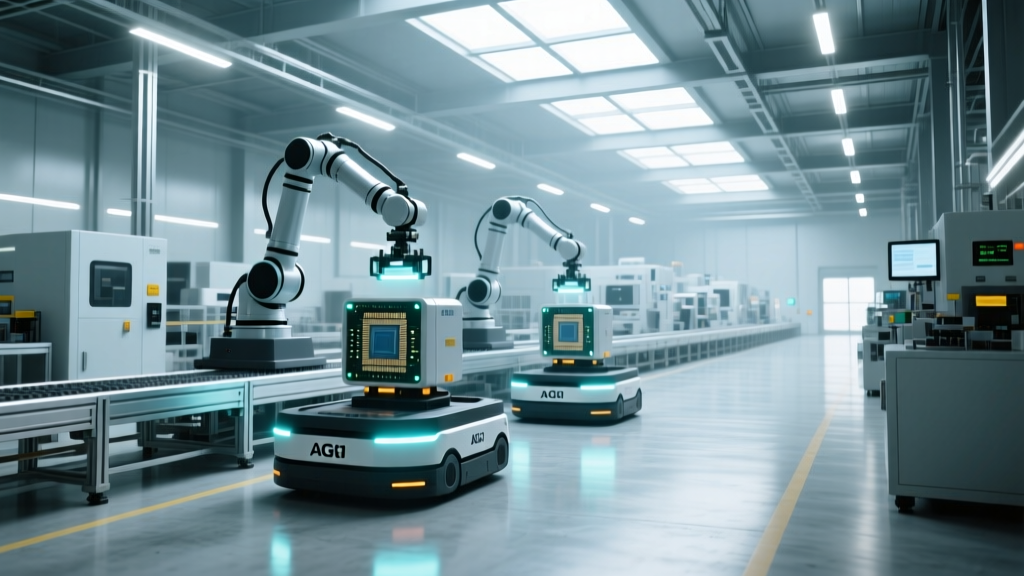
The physical movement of SME in 2026 relies heavily on omni-directional AGVs equipped with mecanum wheels and automated hydraulic lifting masts. Unlike traditional forklifts or manual skates, these AGVs can strafe laterally into tight sub-fab bays with millimeter precision, eliminating the need for manual push-bars that introduce human-induced harmonic vibrations.
2026 Rigging Cost Baseline: The average cost to de-install, purge, transport, and re-install a single Tier 1 EUV lithography module cluster ranges from $3.2 million to $4.8 million. This includes specialized nitrogen-purging logistics, cleanroom-certified rigging personnel, and post-move metrological baseline verification.The Airlock Transition Protocol
Transitioning equipment from the gray-space corridor into the ISO Class 3 or Class 4 cleanroom requires rigorous contamination control. The 2026 standard protocol involves:
- Automated Wipe-Downs: Robotic gantries apply IPA (Isopropyl Alcohol) vapor-phase cleaning to the exterior shipping shrouds.
- Positive Pressure Staging: The equipment airlock is pressurized to +0.05 inches of water column relative to the corridor to prevent particulate ingress when doors open.
- Shroud Stripping: Outer polyethylene vapor barriers are removed in the staging zone, leaving only the inner nitrogen-purged foil intact until the tool reaches its final pedestal.
Cost and Timeline Matrix: Relocation Expectations
Fab planners must account for both the hard costs of rigging and the soft costs of tool downtime. The integration of AI-assisted calibration has drastically reduced the timeline from dock-to-first-wafer-out.
| Tool Category | Est. Rigging Cost | Physical Move Time | Recalibration Time | Total Downtime |
|---|---|---|---|---|
| Lithography (EUV/Immersion) | $3.2M - $4.8M | 7 - 14 Days | 4 - 6 Weeks | ~2 Months |
| Deposition / Etch | $450K - $800K | 3 - 5 Days | 2 - 3 Weeks | ~4 Weeks |
| Ion Implant | $600K - $950K | 4 - 6 Days | 2 - 4 Weeks | ~5 Weeks |
| Inspection / Metrology | $150K - $300K | 1 - 2 Days | 1 - 2 Weeks | ~2.5 Weeks |
Post-Installation: AI-Assisted Alignment and Calibration
Historically, re-leveling and recalibrating a relocated lithography scanner took up to six months of manual optical tweaking by vendor engineers. In 2026, machine learning algorithms embedded within the tool's onboard diagnostic suite have compressed this timeline to roughly six weeks.
'The integration of reinforcement learning into equipment self-calibration routines means the tool actively maps its own structural drift post-transit. It runs thousands of micro-adjustments to its magnetic bearing stages and optical lenses autonomously, referencing golden wafer maps stored in the edge server.' — Director of Fab Integration, TSMC Arizona Operations (2025 Symposium on Advanced Manufacturing)
By leveraging edge-computing nodes installed directly in the sub-fab, the equipment processes terabytes of interferometer data locally, adjusting for micro-torsional shifts in the facility's waffle-slab foundation caused by the installation of neighboring heavy pumps and chillers. This ensures that the semiconductor manufacturing equipment achieves baseline yield performance faster, protecting the massive capital expenditure of the relocation project.