Manufacturing Nearshoring Impact on Equipment Suppliers: Safety Guide
Explore the manufacturing nearshoring impact on equipment suppliers and how startups must navigate safety compliance for small-scale machinery.
The Compliance Squeeze on Micro-Factory Hardware
As hardware startups increasingly establish micro-factories in North America and Mexico to capitalize on localized supply chains, the procurement of small-scale manufacturing equipment has become a critical operational bottleneck. The manufacturing nearshoring impact on equipment suppliers is most visible in the rigorous safety and compliance upgrades now required for benchtop CNC mills, compact injection molders, and desktop laser cutters. Unlike the unregulated procurement channels of the previous decade, nearshored facilities in 2026 demand strict adherence to regional occupational safety frameworks. For startups, purchasing small-scale machinery without verified compliance documentation is no longer just a legal risk; it is an insurability and operational liability.
⚠️ Insurance & Liability Warning: Most commercial property and workers' compensation insurers in the US and Mexico now require proof of UL 508A or equivalent certification for industrial control panels on machinery. Operating an uncertified small-scale CNC or laser cutter can result in immediate policy cancellation or denial of claims following a workplace incident.Decoding the Manufacturing Nearshoring Impact on Equipment Suppliers
Historically, suppliers of small-scale and hobbyist-grade manufacturing equipment bypassed rigorous industrial certifications, marketing their machines to garages and makerspaces. The nearshoring boom has forced a market correction. As startups deploy these exact same small-scale machines into leased industrial parks in Monterrey, Mexico, or light-industrial zones in Texas, equipment suppliers have had to completely re-engineer their entry-level product lines to meet commercial safety codes.
This shift means suppliers are now integrating Category 3 safety relays, hardwired E-stop circuits, and polycarbonate interlocked enclosures into machines that previously relied on basic software limits and acrylic splash guards. Consequently, the baseline cost for compliant small-scale equipment has risen, but it provides startups with turnkey readiness for commercial facility inspections.
| Compliance Domain | United States (OSHA/NFPA) | Mexico (NOM/STPS) | Supplier Equipment Adaptation |
|---|---|---|---|
| Machine Guarding | OSHA 1910.212 | NOM-004-STPS-1999 | Fixed polycarbonate shields with magnetic interlock switches. |
| Electrical Panels | UL 508A / NFPA 79 | NOM-029-STPS-2005 | Enclosed VFDs, proper wire ferruling, and ground fault monitoring. |
| Laser Safety | ANSI Z136.1 / CDRH | NOM-016-STPS-1993 | Class 1 enclosed housings for CO2 and Fiber lasers. |
| Emergency Stops | NFPA 79 (Category 0/1) | ISO 13850 adoption | Hardwired, positively opened E-stop buttons (no software reliance). |
Core Safety Standards for Small-Scale Equipment
When evaluating small-scale machinery for a nearshored startup facility, founders and operations managers must look beyond the machine's cutting speed or payload capacity. The electrical and mechanical safety architecture dictates whether the machine can legally operate on a commercial floor.
1. Electrical Control Panel Certification (UL 508A)
The most common failure point for imported small-scale equipment is the electrical control panel. Under NFPA 79, the electrical standard for industrial machinery, control panels must be built to specific wire-bending space, short-circuit current rating (SCCR), and component spacing rules. Equipment suppliers responding to the nearshoring demand are now shipping small-scale machines with UL 508A listed panels. If a supplier offers a machine with a standard CE mark but lacks a UL or cUL listing, the startup will likely be forced to pay a third-party panel builder between $2,500 and $4,000 to retrofit and certify the enclosure before local inspectors will approve it.
2. Machine Guarding and Interlocks
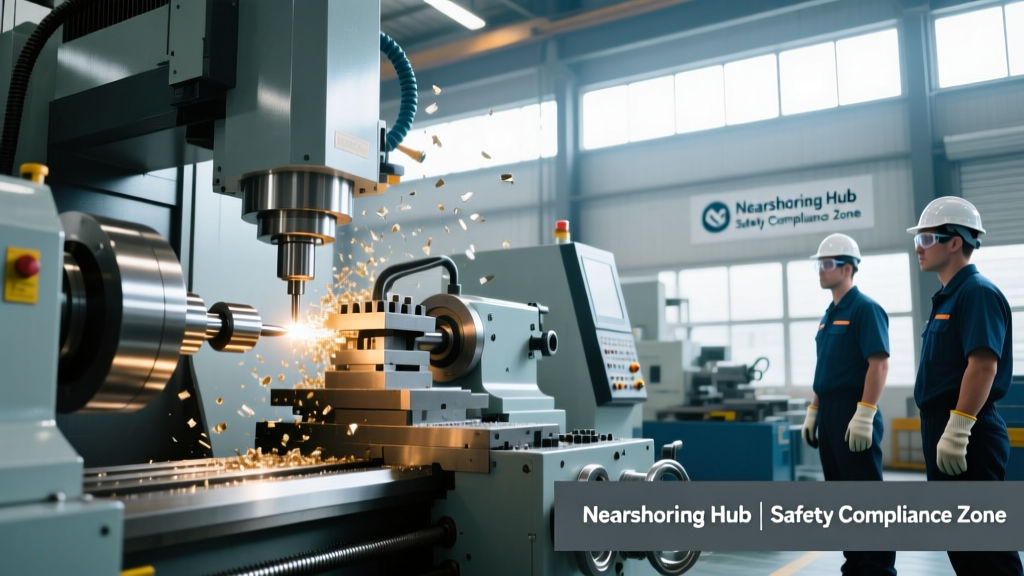
According to OSHA 1910.212(a)(1), one or more methods of machine guarding shall be provided to protect the operator and other employees in the machine area from hazards such as those created by point of operation, ingoing nip points, rotating parts, flying chips, and sparks. For small-scale benchtop CNCs (like the Tormach PCNC 440 or similar 4-axis mills), this means suppliers must provide full enclosures with safety interlocks. If the polycarbonate door is opened during a cycle, the interlock must immediately halt spindle rotation and axis movement via a safety relay, not just a software pause command.
Real-World Equipment Compliance Profiles
To understand how the manufacturing nearshoring impact on equipment suppliers has altered product offerings, consider these common small-scale machines used in startup micro-factories:
- Desktop 5-Axis CNC Mills (e.g., Pocket NC V2-50): Originally designed for open-air desktop use, nearshoring compliance requires these units to be fitted with custom extruded aluminum and polycarbonate enclosures to contain coolant mist and broken endmill shrapnel, upgrading them from educational tools to OSHA-compliant production assets.
- Compact Fiber Laser Markers (e.g., Omtech 50W): Suppliers now integrate Class 1 safety enclosures with specialized OD6+ viewing windows. Without this enclosure, the bare laser is a Class 4 hazard, requiring a dedicated laser safety officer and controlled room access—overhead that most startups cannot afford.
- Benchtop Injection Molders (e.g., Holipress or Buster Beagle): Thermal guarding is the primary compliance hurdle. Suppliers have redesigned these small units with insulated, lockable barrel shrouds to prevent accidental contact with 300°C+ nozzles, satisfying both US and Mexican thermal burn prevention standards.
"Startups often assume that because a machine is small, the safety regulations are relaxed. This is a fatal misconception. A 400-lb benchtop mill carries the exact same OSHA compliance weight as a 10,000-lb vertical machining center when deployed in a commercial, revenue-generating facility."
— Industrial Safety Auditor, Nearshoring Compliance Task Force (2025)
The Startup Procurement Audit: A 5-Step Framework
Before signing a purchase order for small-scale manufacturing equipment, startup procurement teams must execute this compliance audit to ensure the supplier has adequately addressed nearshoring safety requirements.
- Request the SCCR Calculation: Ask the supplier for the Short-Circuit Current Rating of the main control panel. If they cannot provide a documented SCCR calculation, the panel is likely not UL 508A compliant and will fail inspection in high-fault-current industrial parks.
- Verify Interlock Wiring Topology: Demand the electrical schematic. Verify that door interlocks and E-stops are wired through a dedicated safety relay (e.g., Pilz or Sick) or a safety-rated PLC, rather than being routed through standard low-voltage DC logic or software limit switches.
- Check for Grounding Continuity: Small-scale machines often use aluminum extrusions for framing. Ensure the supplier includes a formalized PE (Protective Earth) bonding grid, as anodized aluminum does not conduct electricity and will fail ground-fault testing without proper star washers and bonding straps.
- Audit Thermal and Laser Classifications: For lasers and thermal equipment, require the CDRH (Center for Devices and Radiological Health) accession number or the equivalent Mexican NOM safety certification. Do not accept 'CE compliant' as a standalone substitute for North American laser safety registration.
- Review the Manual's Safety Matrix: The operator manual must include a localized risk assessment matrix detailing residual risks. If the manual only contains generic warnings translated from overseas manufacturing, the supplier has not adapted the equipment for North American compliance standards.
The Financial Reality of Compliance
The manufacturing nearshoring impact on equipment suppliers has inevitably driven up the capital expenditure for small-scale machinery. A fully compliant, enclosed, and UL-listed benchtop CNC mill that cost $8,500 in 2022 may now command $12,000 to $14,500 in 2026 due to the integration of safety relays, certified enclosures, and localized control panels. However, startups must weigh this upfront premium against the cost of non-compliance. OSHA penalties for serious machine guarding violations now exceed $16,500 per instance, and a single workplace injury involving an uncertified machine can trigger comprehensive facility shutdowns and immediate voiding of commercial liability insurance. By demanding rigorously certified small-scale equipment from the outset, startups protect their operational continuity and ensure their micro-factories are built on a foundation of industrial-grade safety.