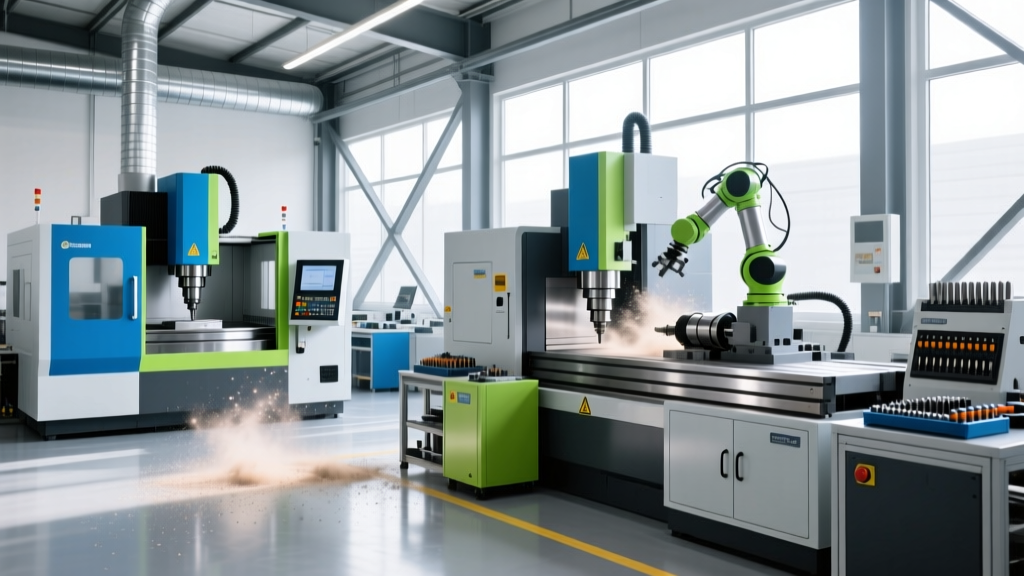
Production Tracking Solutions for Industrial Equipment Manufacturing
Discover how contract manufacturers select machinery based on operator training overhead and production tracking integration capabilities.
The Hidden Cost of HMI Complexity in Contract Shops
When contract manufacturers (CMs) evaluate new capital equipment, the initial focus almost always lands on kinematic specifications: spindle torque, rapid traverse rates, and positional accuracy. However, in high-mix, low-volume (HMLV) contract environments, the true bottleneck is rarely the machine's physical capability. It is the operator's ability to interface with the machine and the facility's ability to extract real-time telemetry. As of 2026, the average turnover rate for skilled CNC machinists in North America hovers around 18%, making the Time-to-Proficiency (TTP) metric just as critical as cycle time.
Selecting equipment without evaluating the Human-Machine Interface (HMI) and native data extraction capabilities leads to severe operational drag. A machine that requires 120 hours of supervised training to achieve basic autonomy is a liability in a shop that rotates operators across 15 different jobs weekly. Furthermore, if the equipment lacks native APIs to feed modern production tracking solutions for industrial equipment manufacturing, the shop floor remains a data black hole, rendering Overall Equipment Effectiveness (OEE) calculations purely speculative.
Operator Training Callout: The 80/20 HMI RuleIn contract manufacturing, 80% of setup errors occur within the first 20% of an operator's interaction with a new controller. Modern HMIs like the Haas Next Gen Control or Mazak's SmoothG reduce this error rate by utilizing tablet-like, capacitive touch interfaces with graphical conversational programming, cutting average setup training time from 40 hours to under 12 hours compared to legacy text-heavy interfaces.
Evaluating Production Tracking Solutions for Industrial Equipment Manufacturing
Integrating production tracking solutions for industrial equipment manufacturing requires more than just bolting an external IoT sensor to a spindle housing. True integration demands native protocol support that allows the machine's CNC controller to broadcast cycle states, alarm codes, and part counts directly to the facility's Manufacturing Execution System (MES) or cloud-based tracking platforms like MachineMetrics or Plex.
The two dominant protocols in 2026 are MTConnect and OPC-UA. MTConnect, an open-source standard heavily backed by the MTConnect Institute, utilizes HTTP/XML to provide a universal language for machine tools. OPC-UA, conversely, offers a more robust, secure, and complex architecture often favored by European OEMs and advanced robotics. When selecting equipment, CMs must verify not just if the machine supports these protocols, but whether the required software licenses are included in the base price or gated behind expensive annual subscriptions.
| OEM Controller | Native Protocol | Adapter / License Requirement | Avg. Training Cost per Operator |
|---|---|---|---|
| Haas Next Gen Control | MTConnect | None (Built-in, no license fee) | $1,200 (Basic 3-Axis) |
| Fanuc 31i-B5 | FOCAS / MTConnect | FOCAS Library License + Edge Gateway | $3,800 (5-Axis / Macro B) |
| Siemens Sinumerik 840D sl | OPC-UA | None (Native via Operate HMI) | $2,500 (Mill-Turn) |
| Mazak SmoothG / Ai | MTConnect | None (Built-in via Smooth Monitor) | $1,500 (Integrex Series) |
The 4-Point Contract Manufacturing Selection Framework
To systematically evaluate machinery through the lens of operator usability and data tracking, procurement teams should apply the following decision matrix before signing a purchase order.
- Verify Native API Accessibility: Do not accept "we can add an IoT gateway later" as a satisfactory answer. Require the OEM to demonstrate a live MTConnect or OPC-UA data stream from the exact controller model on the showroom floor to a third-party dashboard. If the data stream requires a $4,000 annual FOCAS license, factor that into the Total Cost of Ownership (TCO).
- Audit the HMI for Conversational Fallback: In HMLV environments, CAM-generated G-code is standard, but operators frequently need to make manual edge-breaks or probe adjustments at the machine. Ensure the controller features an intuitive conversational interface (e.g., Mazak's Mazatrol or Haas' Visual Quick Code) that allows operators to generate simple geometries without returning to the CAD/CAM station.
- Test RFID/Badge Integration for Shift Tracking: Advanced production tracking relies on knowing exactly who is running the machine. Verify that the machine's HMI supports USB or integrated RFID badge readers. When an operator badges in, the system should automatically log their ID to the tracking software and restrict access to advanced macro variables based on their certification level.
- Evaluate Alarm Code Granularity: Basic tracking solutions only log "Cycle On" and "Cycle Off." High-tier tracking solutions parse specific alarm codes (e.g., Fanuc Alarm 411: Servo Error) to automatically categorize downtime. Ensure the controller's data dictionary maps these alarms to the tracking software's API without requiring custom regex parsing by your IT team.
Edge Case: The Air-Cutting Data Blind Spot
A critical failure mode in standard production tracking is the "Air-Cutting Blind Spot." When a machine executes a G-code program, the controller broadcasts a "Cycle Active" state. However, if the toolpath contains excessive rapid traverses or the operator manually overrides the feed rate to zero while the spindle is still engaged, the tracking software inaccurately logs this as productive machining time.
Real-World Troubleshooting Insight: To solve this, advanced contract shops configure their tracking solutions to monitor Z-axis servo load and spindle amperage. By establishing a baseline threshold (e.g., spindle load > 15%), the software can differentiate between actual material removal and air-cutting. According to NIST Advanced Manufacturing research on smart machining, integrating spindle load telemetry with cycle tracking improves true OEE accuracy by up to 22% in aerospace milling operations.
Training Best Practices for High-Mix Environments
Once the equipment is selected and integrated with your production tracking architecture, the focus shifts to operator onboarding. The goal is to decouple operator knowledge from tribal memory and embed it into the machine's digital workflow.
- Implement Digital Work Instructions (DWI): Platforms like Tulip or ShopFloorConnect can push setup sheets, tooling maps, and 3D CAD models directly to the machine's secondary HMI screen. This reduces setup verification time by an average of 35% and eliminates paper-based routing travelers.
- Utilize Tracking Data for Targeted Micro-Training: Use the downtime categorization from your tracking software to identify specific skill gaps. If the data shows Operator A generates 40% more "Probe Calibration" alarms than the shop average, you can deploy targeted, 15-minute micro-training modules specifically on Renishaw OMP60 probe routines, rather than forcing them through a generic 8-hour CNC seminar.
- Standardize Tool Library Naming Conventions: A major source of tracking inaccuracy and setup crashes is mismatched tool data. Enforce a strict, machine-agnostic naming convention in your CAM software (e.g.,
EM-0.500-4FL-ALfor a half-inch, 4-flute endmill for aluminum). Map this exact string to the machine's tool table so the tracking software can verify that the physical tool loaded matches the digital requirement before the cycle start button is enabled.
Ultimately, the most precise 5-axis machining center is useless if the operator cannot efficiently program a work offset, or if the facility cannot accurately track its utilization. By prioritizing HMI usability and native data extraction during the equipment selection phase, contract manufacturers can drastically reduce training overhead and ensure their production tracking solutions reflect the true reality of the shop floor.