Manufacturing Equipment Appraisal: Energy Efficiency Ratings
Learn how energy efficiency ratings impact manufacturing equipment appraisal. Discover frameworks to calculate TCO and value IE4 motors and all-electric drives.
The Hidden Variable in Manufacturing Equipment Appraisal
Traditional manufacturing equipment appraisal relies heavily on age, physical condition, and remaining useful life (RUL). However, as industrial electricity rates climb to an average of $0.13 per kWh in 2026, energy efficiency ratings have become a primary driver of Fair Market Value (FMV) and liquidation value. An appraiser who ignores the specific energy consumption (SEC) of a machine risks undervaluing high-efficiency assets by 10% to 15%, while overvaluing obsolete, power-hungry equipment that buyers will heavily discount due to operational expenditure (OPEX) liabilities.
Integrating energy metrics into a manufacturing equipment appraisal requires moving beyond the nameplate. It demands an understanding of motor efficiency classes, drive systems, and real-world degradation curves. This guide provides the technical frameworks and specific data points required to accurately appraise modern manufacturing assets based on their energy performance.
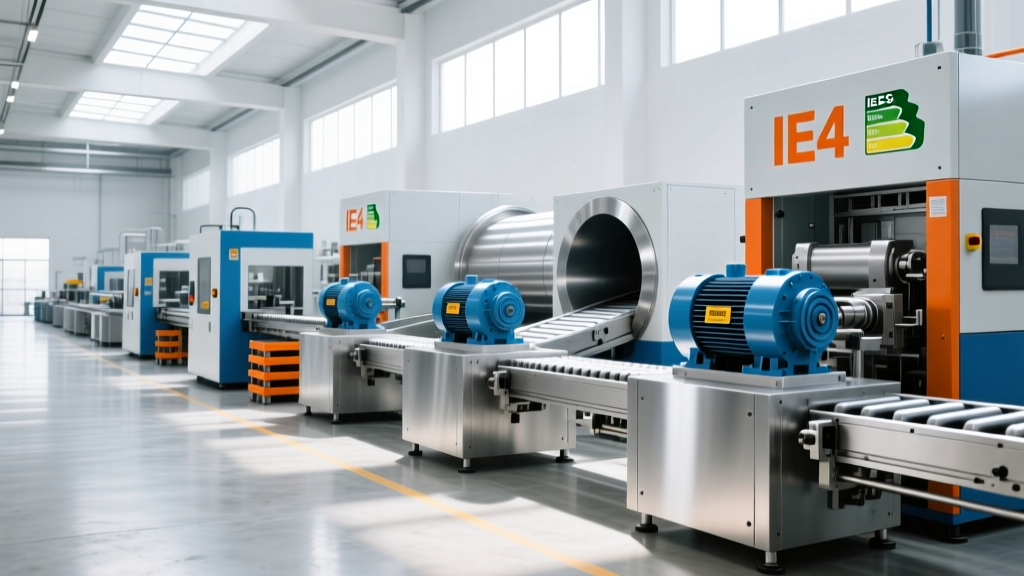
DATA HIGHLIGHT: The IE3 vs. IE4 Valuation PremiumAccording to lifecycle analyses from the U.S. Department of Energy's Advanced Manufacturing Office, upgrading from an IE3 (Premium) to an IE4 (Super Premium) motor on a continuous-duty 50 HP application saves approximately $1,800 annually in electricity. Over a 10-year appraisal horizon, this $18,000 OPEX savings directly supports a higher residual value and justifies a 12-18% appraisal premium for equipment factory-equipped with IE4 or IE5 synchronous reluctance motors.
Decoding Energy Efficiency Standards for Appraisers
To accurately appraise equipment, you must identify the governing efficiency standard stamped on the machine's drives and motors. The two dominant global frameworks are the IEC (International Electrotechnical Commission) and NEMA (National Electrical Manufacturers Association). Misidentifying these classes leads to flawed TCO (Total Cost of Ownership) calculations.
| Efficiency Class | IEC Designation | NEMA Equivalent | Appraisal Impact & Market Reality (2026) |
|---|---|---|---|
| Standard | IE1 | Energy Efficient (EE) | Severe Discount. Banned in new sales in the EU and US. Appraised at scrap or heavy refurbishment cost. |
| High | IE2 | High Efficiency | Baseline. Standard for older used equipment. No premium applied; valued strictly on mechanical condition. |
| Premium | IE3 | Premium Efficient | Market Standard. Expected in machinery built between 2016-2022. Holds baseline FMV. |
| Super Premium | IE4 | Super Premium | Value Add. Commands an 8-12% FMV premium due to verifiable OPEX reductions in continuous-duty applications. |
| Ultra Premium | IE5 | Ultra Premium (Emerging) | Top Tier. Found in advanced servo and synchronous reluctance drives. Highly sought after in ESG-mandated buyouts. |
Step-by-Step Framework: Calculating the Energy Premium
When conducting a manufacturing equipment appraisal for a facility acquisition or insurance placement, use this four-step framework to quantify the energy efficiency premium or penalty.
- Establish the Baseline Specific Energy Consumption (SEC): Determine the machine's kWh per unit of production (e.g., kWh/kg for plastics, kWh/part for CNC machining). Consult the OEM's technical documentation for the 'ECO mode' or optimized cycle metrics, not just peak load.
- Apply the 2026 Local Utility Rate: Industrial rates vary wildly. Use the local blended rate (e.g., $0.09/kWh in Texas vs. $0.22/kWh in Germany). The geographic location of the equipment drastically alters the financial value of its efficiency rating.
- Factor in the Degradation Coefficient: Energy efficiency is not static. Hydraulic systems lose 1% to 2% of their volumetric efficiency annually due to seal wear and fluid shear. Variable Frequency Drives (VFDs) can suffer from harmonic distortion and capacitor aging, reducing power factor over time. Apply a 1.5% annual degradation penalty to the SEC for machines older than five years lacking documented maintenance.
- Cross-Reference with ISO 50001 Compliance: Equipment that features native API integrations for energy monitoring (e.g., OPC-UA energy dashboards) holds a higher liquidation value. Buyers operating under ISO 50001 Energy Management Systems will pay a premium for 'plug-and-play' data transparency.
Real-World Scenario: Appraising a 180-Ton Injection Molding Machine
Consider the appraisal of two 180-ton injection molding machines on a used equipment auction block: a 2018 servo-hydraulic model and a 2021 all-electric model (e.g., the Engel e-mac 180).
The servo-hydraulic machine has a specific energy consumption (SEC) of approximately 0.65 kWh/kg of processed polymer. The all-electric machine operates at an SEC of 0.32 kWh/kg. Assuming both machines process 1.5 million kg of resin annually in a region with $0.14/kWh electricity:
- Hydraulic OPEX: 975,000 kWh × $0.14 = $136,500 / year
- All-Electric OPEX: 480,000 kWh × $0.14 = $67,200 / year
- Annual Delta: $69,300 in pure energy savings.
Over a conservative 7-year remaining useful life, the all-electric machine yields $485,100 in energy savings. A competent appraiser will not value these two machines similarly just because they share the same clamping force. The all-electric machine's FMV will reflect a massive 'Green Premium,' often allowing it to appraise at 85% to 95% of its original MSRP, whereas the hydraulic unit will depreciate on a standard 10-year straight-line curve.
Red Flags: When Efficiency Ratings Mask Hidden Inefficiencies
Appraisers must be wary of 'nameplate shopping'—where sellers highlight a high-efficiency component while obscuring systemic losses. Watch for these specific edge cases during your physical inspection:
⚠️ APPRAISER WARNING: The Compressed Air TrapA machine may feature IE4 motors, but if it relies heavily on pneumatic actuators, its true efficiency is tied to the plant's air compressor. Generating 1 CFM of compressed air costs roughly $0.25 per hour. If the appraised equipment has undersized air lines, internal leaks, or operates at 110 PSI when only 80 PSI is required, the 'efficient' machine is actually driving massive upstream energy waste. Always audit the machine's CFM requirements and operating pressure during the appraisal.
- Oversized Spindles and Pumps: A CNC mill equipped with a 30 HP spindle that only ever cuts aluminum at 5 HP is suffering from poor power factor and low-load motor inefficiency. Appraise the machine based on its actual duty cycle, not its peak capability.
- Missing or Bypassed VFDs: Check the electrical cabinets. If an OEM installed a VFD on a coolant pump or conveyor, but maintenance staff bypassed it to run directly across the line (DOL) due to a fault, the machine's energy efficiency rating is effectively voided.
- Thermal Management Losses: For equipment requiring chillers (e.g., laser cutters, EDM machines), evaluate the chiller's COP (Coefficient of Performance). An older fixed-speed chiller can double the total energy footprint of an otherwise highly efficient laser resonator.
Integrating Energy Metrics into the Final Appraisal Report
To deliver a defensible, high-value manufacturing equipment appraisal, the final report must explicitly separate mechanical condition from energy performance. Use a bifurcated valuation matrix:
'In 2026, equipment valuation is no longer just about what a machine can make; it is about what it costs to run. Buyers are actively capitalizing energy savings into their purchase offers. An appraisal that fails to quantify the SEC and motor efficiency classes leaves money on the table for the seller, or exposes the buyer to hidden OPEX liabilities.'
— Industrial Asset Valuation Guidelines, 2026 Edition.
Include an 'Energy Liability Addendum' for older equipment. If a facility is selling a fleet of IE2 hydraulic presses, the appraiser should note the estimated capital expenditure required to retrofit them with servo-valves or IE4 motors to meet modern corporate ESG mandates. This transparency transforms the appraisal from a simple pricing exercise into a strategic financial tool, ensuring that the true cost of manufacturing equipment is accurately reflected in the market.