Managing Spare Parts From China Poultry Equipment Manufacturers
Optimize maintenance schedules and spare parts inventory for automated processing lines sourced from China poultry equipment manufacturers.
The Transpacific Lead-Time Reality in Poultry Processing
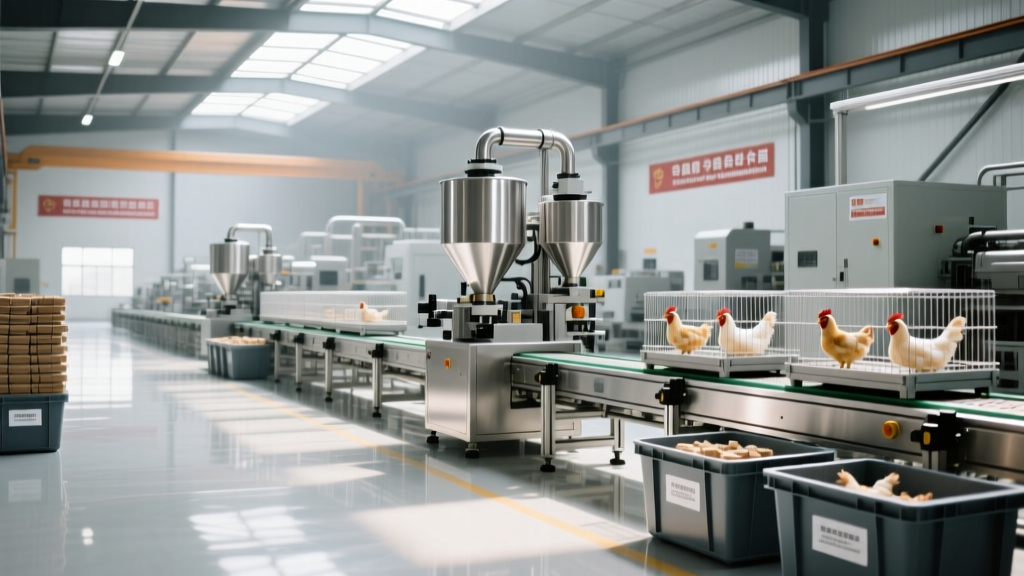
Operating a high-throughput poultry processing facility (8,000 to 12,000 birds per hour) requires relentless equipment uptime. When your primary processing lines—defeathering, evisceration, and chilling—are sourced from China poultry equipment manufacturers, your spare parts inventory management cannot rely on standard local industrial supply chains. A single failed drive gearbox on an automatic eviscerator carousel can halt the entire kill floor, costing upwards of $15,000 per hour in lost throughput, idle labor, and bird shrinkage.
As of 2026, transpacific ocean freight from major manufacturing hubs like Shandong and Guangdong to North American or European inland ports averages 35 to 48 days, including customs clearance and drayage. Air freight reduces this to 5 to 7 days but increases logistics costs by 400% to 600%. Therefore, maintenance managers must mathematically align their preventative maintenance (PM) schedules with precise inventory reorder points, ensuring that wear-part replacements arrive on the dock exactly when the OEM service schedule demands them.
⚠️ Critical Downtime Warning: Never rely on 'just-in-time' inventory for critical path components sourced from overseas OEMs. A delayed vessel from Qingdao port can easily trigger a 14-day stockout, forcing emergency local fabrication of non-OEM parts that may violate USDA or EU hygiene tolerances.VED Inventory Matrix for Automated Processing Lines
Standard ABC inventory analysis (based purely on cost) fails in heavy manufacturing environments. Instead, utilize the VED (Vital, Essential, Desirable) framework to categorize spare parts from China poultry equipment manufacturers. This ensures capital is tied up in parts that prevent catastrophic line stoppages, rather than just expensive but non-critical components.
| VED Category | Component Example | OEM Unit Cost | Min/Max Stock | Sourcing Strategy |
|---|---|---|---|---|
| Vital (V) | Main PLC CPU / Carousel Drive Gearbox | $2,400 - $8,500 | 1 / 2 | On-site secure crib; immediate replacement |
| Essential (E) | 316L Evisceration Spoons / Shackle Chains | $14 - $45 | 50 / 200 | Sea freight bulk; 45-day ROP trigger |
| Desirable (D) | TPU Plucker Fingers (Shore 85A) / Guide Rails | $0.18 - $1.20 | 500 / 2000 | Consolidated LCL sea freight; 60-day ROP |
Maintenance Schedules Tied to Inventory Consumption
Inventory management is only as effective as the maintenance schedule that drives it. Equipment from China poultry equipment manufacturers is generally robust but requires strict adherence to PM intervals due to the highly corrosive, high-pressure washdown environments inherent to poultry processing.
1. Rotary Plucker Drum Maintenance (Daily/Weekly)
Plucker drums utilize hundreds of food-grade Thermoplastic Polyurethane (TPU) fingers. In a 10,000 BPH line, a 34-disk plucker holds approximately 1,500 fingers. Friction and bird fat cause these to tear or lose their Shore 85A hardness profile.
- Daily PM: Visual inspection for snapped fingers. Missing fingers cause uneven defeathering, leading to downstream rework.
- Inventory Impact: Expect a 5% to 8% monthly attrition rate. For 1,500 fingers, this is 75 to 120 replacements per month. Set your CMMS (Computerized Maintenance Management System) to auto-generate a purchase order when on-hand stock drops below 400 units, triggering a 45-day sea freight reorder from the OEM.
2. Automatic Eviscerator Carousel (Monthly/Quarterly)
The eviscerator is the most critical sanitation point on the line. The drawing spoons must be manufactured from passivated 316L stainless steel to resist pitting from chlorinated washdowns. According to the USDA FSIS Sanitation Performance Standards, any micro-abrasions or pitting on food-contact surfaces that harbor pathogens require immediate component replacement.
- Monthly PM: Dye-penetrant testing on a random 10% sample of evisceration spoons to check for micro-fractures.
- Quarterly PM: Complete teardown and replacement of the UHMWPE (Ultra-High Molecular Weight Polyethylene) wear strips guiding the carousel. OEM strips cost roughly $85 each, compared to $160 for local aftermarket equivalents.
3. Spiral Chiller Drive Systems (Bi-Annual)
Spiral chillers operate in sub-40°F environments with constant moisture. Standard bearings fail rapidly here. Specify IP69K-rated sealed spherical roller bearings pre-packed with NLGI 2 food-grade grease from your Chinese OEM.
- Bi-Annual PM: Thermographic imaging of the main drive motor and gearbox to detect misalignment or bearing degradation before catastrophic seizure.
- Inventory Impact: Gearboxes are 'Vital' components. Keep one complete OEM drop-in replacement gearbox on-site at all times. Lead times for custom-ratio helical gearboxes from China can exceed 60 days if not stocked.
Calculating Reorder Points with Transpacific Variables
To prevent stockouts, maintenance planners must move beyond basic min/max levels and implement dynamic Reorder Point (ROP) calculations that account for overseas logistics. The Association for Supply Chain Management (ASCM) defines ROP as the precise inventory level that triggers a new replenishment order.
The Transpacific ROP Formula:
ROP = (Lead Time in Days × Average Daily Usage) + Safety Stock
Example Calculation for 316L Evisceration Spoons:
• Lead Time (Sea Freight + Customs): 45 days
• Daily Usage (Attrition + PM replacement): 2 spoons/day
• Safety Stock (Buffer for port delays): 30 spoons
ROP = (45 × 2) + 30 = 120 spoons.
When inventory hits 120, the PO is cut.
Integrating CMMS for Overseas OEM Tracking
Managing parts from China poultry equipment manufacturers requires rigorous digital tracking. Modern CMMS platforms like Fiix, UpKeep, or SAP PM must be configured to handle multi-currency, multi-lead-time vendor profiles.
- Vendor Lead Time Tagging: Assign specific lead-time metadata to each SKU. A local electrical supplier might have a 2-day lead time, while the Shandong-based OEM has a 45-day lead time. The CMMS must use these distinct variables for ROP triggers.
- Batch & Lot Tracking: For food safety compliance, track the heat numbers of stainless steel components and the curing dates of polyurethane parts. If an OEM batch of TPU fingers degrades prematurely due to a bad resin mix, batch tracking allows you to isolate and replace only the affected lot.
- Customs & Tariff Buffer: Factor in a 5-to-7-day administrative buffer in your CMMS lead-time settings to account for customs inspections, which are increasingly common for agricultural machinery parts.
OEM vs. Local Aftermarket: A Sourcing Decision Framework
When a critical part fails and the sea-freight container is still on the Pacific, the temptation to source locally is high. Use this framework to decide when to deviate from the China poultry equipment manufacturers' OEM supply chain.
✅ Stick with OEM (China)
- Complex Castings: Eviscerator carousels and custom gearboxes. Local foundries rarely match the exact metallurgical passivation processes.
- Proprietary Electronics: PLC boards and proprietary VFDs programmed with specific acceleration/deceleration ramps for bird handling.
- High-Volume Consumables: Plucker fingers and shackle chains. The per-unit cost savings of OEM bulk pricing easily justify the inventory holding costs.
⚠️ Source Local Aftermarket
- Standard Drive Components: V-belts, standard roller chains, and IP69K bearings. These are standardized globally (e.g., SKF, Gates) and do not require OEM branding.
- UHMWPE Wear Strips: Local CNC plastics shops can machine ultra-high molecular weight polyethylene guides in 24 hours, saving days of downtime.
- Pneumatic Fittings: Standard push-to-connect fittings and cylinders can be sourced from local fluid power distributors immediately.
Strategic Partnerships and Forward-Staging
For enterprise-level poultry processors operating multiple facilities, relying solely on direct-to-facility shipping from China is a logistical risk. Industry leaders are increasingly utilizing forward-staging warehouses. By contracting with a third-party logistics (3PL) provider located near a major port (e.g., Savannah, Los Angeles, or Rotterdam), you can consolidate sea-freight shipments from various China poultry equipment manufacturers into a single domestic hub.
This strategy reduces domestic LTL (Less-Than-Truckload) shipping costs to your individual plants and creates a centralized 'Vital' parts buffer. While it increases overall inventory holding costs by roughly 12%, the reduction in emergency air-freight expenses and line-down penalties yields a net-positive ROI within the first 18 months of implementation. For deeper insights into global poultry supply chain optimizations, publications like World Poultry regularly feature case studies on transnational equipment logistics and maintenance standardizations.