Commercial Confectionary Equipment Manufacturer USA: Lean Workstations
Compare lean workstation designs from top commercial confectionary equipment manufacturer USA options. Discover modular, ergonomic, and SMED-ready setups.
The Geometry of Waste in Candy Production
High-moisture gummy production and high-fat chocolate enrobing demand vastly different workstation geometries. In traditional confectionary plants, operators waste up to 22% of their shift navigating poorly designed batch kitchens, moving heavy syrup carboys, or performing arduous manual cleanouts between recipe changeovers. Lean manufacturing equipment and workstation design directly attack these inefficiencies by minimizing motion waste (Muda), standardizing workflows, and integrating Single-Minute Exchange of Die (SMED) principles directly into the physical hardware.
When sourcing from a commercial confectionary equipment manufacturer USA plant managers must look beyond the primary cookers and depositors. The connective tissue of the production line—the workstations, staging tables, and manual-assist cells—dictates overall equipment effectiveness (OEE). This analysis compares lean workstation architectures and evaluates how top US-based manufacturers engineer these critical touchpoints for modern candy and chocolate facilities.
Core Lean Workstation Configurations
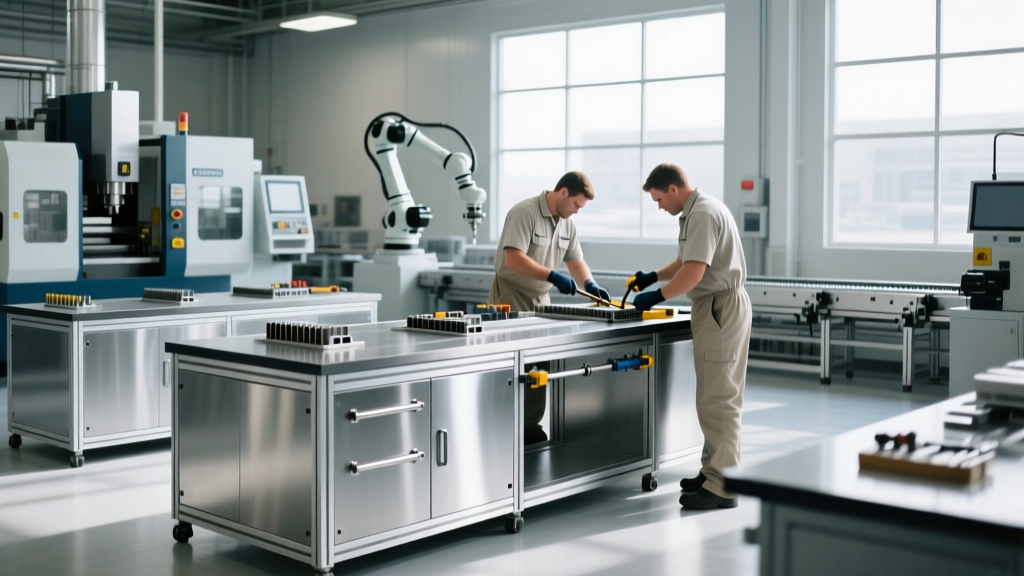
Lean workstations in food processing are not merely stainless steel tables; they are engineered environments designed around the NIOSH lifting equation and 5S methodology. Below is a comparison of the three primary workstation configurations used in modern confectionary lines.
| Configuration Type | Best Application | Avg. Changeover Time | Capital Cost (Per Cell) | Footprint |
|---|---|---|---|---|
| Fixed Automated Cell | High-volume chocolate enrobing, continuous hard-tack cooling. | 45 - 90 mins (CIP dependent) | $45,000 - $85,000 | Large (Fixed footprint) |
| Modular Manual-Assist | Artisanal truffles, low-volume gummy batching, R&D kitchens. | 15 - 30 mins (Tool-less) | $8,500 - $14,000 | Compact (Mobile casters) |
| Hybrid Lean Cell | Mid-tier panning, automated depositing with manual staging. | 20 - 40 mins (Quick-release pins) | $22,000 - $35,000 | Medium (Reconfigurable) |
Evaluating a Commercial Confectionary Equipment Manufacturer USA Facilities Trust
The US market features a mix of specialized candy machinery builders and industrial framing experts. Here is how the leading alternatives approach lean workstation design.
1. Savage Bros. Co. (St. Charles, IL)
Savage Bros. is a legacy name in confectionary, famous for their firemixers and batch cooking systems. From a lean perspective, their modern batch stations excel in ergonomic integration. Their tilting kettles are now paired with height-adjustable operator platforms that utilize pneumatic lift columns (costing roughly $3,200 to $4,500 per pair). This allows a 5'2" operator and a 6'1" operator to both maintain a neutral wrist posture while scraping high-viscosity caramel, drastically reducing shoulder fatigue and repetitive strain injuries.
2. SPX FLOW / APV (US Operations)
While SPX FLOW is a global entity, their US-based engineering teams design continuous inline mixing workstations that prioritize automated Clean-In-Place (CIP) integration. Their lean approach focuses on eliminating the waste of over-processing and waiting. By integrating CIP spray balls directly into the workstation staging tanks (an add-on cost of approximately $2,800 per vessel), they reduce manual wash-down times from 2 hours to 18 minutes. This is critical for facilities running allergen-free and dairy-based recipes on the same line.
3. Bosch Rexroth (Custom Lean Framing)
For highly customized packaging and inspection stations, many US confectionary plants bypass traditional candy builders and turn to Bosch Rexroth’s lean production systems. Using food-grade anodized aluminum and 304 stainless steel structural framing, plant engineers can build modular workstations that snap together without welding. This allows a facility to completely reconfigure a packaging workstation in a single weekend using standard hex keys, perfectly aligning with lean facility layout strategies.
Material Science and SMED in Confectionary Workstations
A critical failure point in confectionary workstation design is the misapplication of stainless steel alloys. Lean design requires equipment that lasts without requiring excessive maintenance or early replacement.
WARNING: Alloy Selection for High-Acid GummiesStandard 304 stainless steel is sufficient for chocolate and hard candy workstations. However, if your workstation handles high-acid gummy slurries (utilizing citric, malic, or tartaric acid coatings), the acidic residue will cause micro-pitting in 304 steel within 6 to 8 months. You must specify 316L stainless steel for all contact surfaces and workstation tabletops in sour candy zones. Expect a 20-25% premium on the base metal cost, but it prevents catastrophic surface degradation and bacterial harboring.
SMED (Single-Minute Exchange of Die) is where lean workstations prove their ROI. In traditional depositing lines, changing from a bear-shaped gummy mold to a worm-shaped mold requires tools, recalibration, and extensive cleaning. Modern lean workstations utilize quick-release star-knobs and spring-loaded detent pins. According to data published by the Lean Enterprise Institute, implementing tool-less changeover mechanisms on manual and semi-automated staging stations can reduce format changeover times by up to 74%. A changeover that previously took 140 minutes of line downtime is reduced to 18 minutes, unlocking thousands of dollars in recovered production capacity per month.
Ergonomics and the 15-Inch Rule
Confectionary manufacturing involves frequent manual additions of minor ingredients (colors, flavors, acids) to active batches. The National Institute for Occupational Safety and Health (NIOSH) emphasizes the importance of the primary reach zone in manual material handling.
Lean workstation design enforces the '15-Inch Rule': all critical controls, ingredient staging shelves, and depositing triggers must be within a 15-inch radius of the operator's neutral resting hand position. Workstations that violate this rule force operators into spinal twisting and shoulder extension, leading to a 300% increase in musculoskeletal disorder (MSD) claims in food processing environments. When specifying a workstation, require CAD drawings that map the operator's reach envelope against the physical hardware.
Cost Breakdown and ROI for Lean Retrofitting
Retrofitting an existing confectionary line with lean workstations requires precise capital allocation. Below is a realistic cost breakdown for upgrading a single manual-assist batching and staging cell in 2026:
- Base 316L Stainless Steel Modular Table (60" x 30"): $8,500 - $11,200
- Pneumatic Height-Adjustment Columns (Pair): $3,200 - $4,500
- Integrated CIP Spray Ball & Plumbing Manifold: $2,800 - $3,500
- Quick-Release Tool-less Shelving & Staging Racks: $1,400 - $2,100
- Anti-Fatigue, Chemical-Resistant Floor Matting (Ergonomic): $350
- Total Capital Investment per Cell: $16,250 - $21,650
The ROI Calculation: If the ergonomic and SMED upgrades save 45 minutes of changeover time per day, and 20 minutes of cleaning time per shift, you recover roughly 3.5 hours of production weekly. On a line generating $2,000 in gross margin per hour, this single workstation upgrade pays for itself in under 4 weeks.
Decision Framework: Selecting Your Workstation Architecture
Use this logic tree to determine which lean workstation alternative fits your specific confectionary operation:
- Are you producing high-acid sour gummies or citrus-based pectin jellies?
- Yes: Mandate 316L stainless steel for all surfaces. Reject any manufacturer offering standard 304 steel for the contact zones.
- No: 304 stainless steel is acceptable and will save 20% on capital costs.
- Do you run more than 3 distinct recipe formats or mold shapes per 8-hour shift?
- Yes: Prioritize SMED capabilities. Require tool-less quick-release pins and modular slide-out shelving for mold staging.
- No: Focus capital on automated CIP integration rather than quick-change mechanical hardware.
- Is your operator turnover rate above 15% annually?
- Yes: Invest heavily in pneumatic height-adjustable columns and strict 15-inch reach zone compliance to reduce training friction and physical fatigue.
Ultimately, the transition to lean manufacturing equipment in the confectionary sector is not about buying the most expensive automated robots. It is about engineering the physical space where human operators interact with the product. By selecting the right commercial confectionary equipment manufacturer and demanding rigorous adherence to SMED, ergonomic, and material science principles, US candy manufacturers can drastically reduce waste and protect their most valuable asset: their production workforce.