Lean Workstation Design at a Top Chocolate Equipment Manufacturer USA
Explore the exact technical specifications, ergonomic layouts, and poka-yoke fixtures used by a leading chocolate equipment manufacturer USA for lean assembly.
Engineering the Assembly Cell for Heavy Food-Grade Machinery
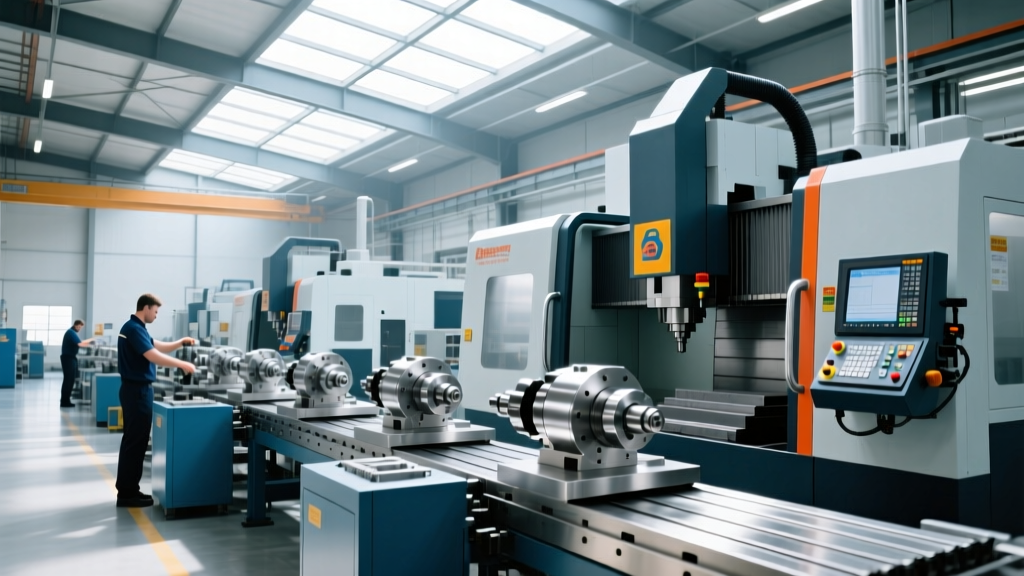
Assembling 4,000-pound chocolate enrobers, continuous tempering machines, and multi-ton ball mills requires a radical departure from standard electronics or light-mechanical workbenches. Operating as a specialized chocolate equipment manufacturer USA requires bridging heavy-duty structural fabrication with precision food-grade assembly. Lean manufacturing principles dictate that the workstation must eliminate motion waste (Muda), prevent overprocessing, and enforce single-piece flow. However, when the product involves sanitary stainless steel piping, high-torque drive motors, and strict FDA/FSMA compliance, the physical workstation must be engineered to exact technical specifications.
This guide deconstructs the technical architecture, material specifications, and ergonomic mechanics of a high-output lean assembly cell designed specifically for heavy chocolate processing equipment.
Base Frame and Surface Material Specifications
Standard carbon-steel workbenches introduce rust and particulate contamination risks, violating the sanitary environment required even during the assembly phase of food machinery. A compliant lean workstation utilizes specific alloys and polymers to maintain cleanroom-adjacent standards on the factory floor.
Core Material Matrix
- Structural Framing: 304-grade stainless steel T-slot extrusions (e.g., 80/20 40-Series equivalent in SS). Yield strength: 35,000 PSI minimum. This prevents iron contamination if the frame is struck during hoist operations.
- Work Surface: 1/2-inch thick UHMW-PE (Ultra-High Molecular Weight Polyethylene). UHMW-PE provides a low-friction, non-marring surface that will not scratch the polished #4 sanitary finish of chocolate vat cladding.
- Fasteners: 316L stainless steel socket head cap screws with nylon-insert lock nuts to withstand high-frequency pneumatic vibration without galvanic corrosion.
Pneumatic Lift and Height Adjustment Mechanics
Chocolate tempering machines feature heavy cast-iron or stainless-steel scraping mechanisms that must be installed at precise vertical alignments. Manual lifting is eliminated via integrated scissor-lift workstations. According to the OSHA Ergonomics eTool, maintaining work between elbow and shoulder height reduces lower back shear forces by up to 40%.
The standard specification for a heavy-duty chocolate machinery cell utilizes a pneumatic or hydraulic lift table, such as the Southworth PDSA-4896 series, integrated directly into the U-shaped assembly frame.
Technical Lift Parameters
- Load Capacity: 6,000 lbs (static), 4,500 lbs (dynamic rolling load).
- Lowered Height: 8.5 inches (allows pallet jack entry for raw machine base delivery).
- Raised Height: 36 inches (optimal ergonomic reach for internal baffle installation).
- Actuation: 90 PSI plant air supply, regulated down to 60 PSI via a localized FRL (Filter-Regulator-Lubricator) unit to ensure smooth, stutter-free elevation during delicate sanitary flange alignment.
- Cycle Time: 12 seconds full stroke up; 8 seconds gravity-assisted down.
The U-Shaped Single-Piece Flow Cell Layout
Linear assembly lines create massive transit waste for heavy equipment. The lean U-cell configuration brings the start and end of the assembly process within a 20-foot operator walking radius. For a 12-foot by 16-foot footprint, the cell is zoned into three distinct operational sectors.
Zone 1: Base and Drive Integration (Inlet)
Heavy gearmotors (e.g., SEW-Eurodrive or Nord) are pre-kitted on gravity-fed roller racks. The operator uses an overhead 2-ton Gorbel enclosed-track crane to lower the drive assembly into the machine base. The crane bridge is mounted on the workstation's 304 SS uprights, eliminating the need to wait for a shared facility overhead crane.
Zone 2: Sanitary Piping and Valve Assembly (Apex)
This is the highest-precision zone. The workstation features localized HEPA-filtered positive-pressure air drops to blow out any particulate matter from tri-clamp fittings before assembly. Tooling is suspended via zero-gravity balancers (e.g., Ingersoll Rand 6750 series) rated for 15-30 lbs, ensuring the operator exerts less than 2 lbs of force to maneuver heavy DC torque drivers.
Zone 3: Electrical and Wet-Test (Outlet)
The final leg of the U-cell handles control panel integration and functional testing. The NIOSH guidelines on workplace ergonomics emphasize minimizing awkward postures; thus, the electrical termination bench is angled at 15 degrees to prevent wrist extension when wiring PLC terminal blocks.
Poka-Yoke (Error-Proofing) in Food Machinery Assembly
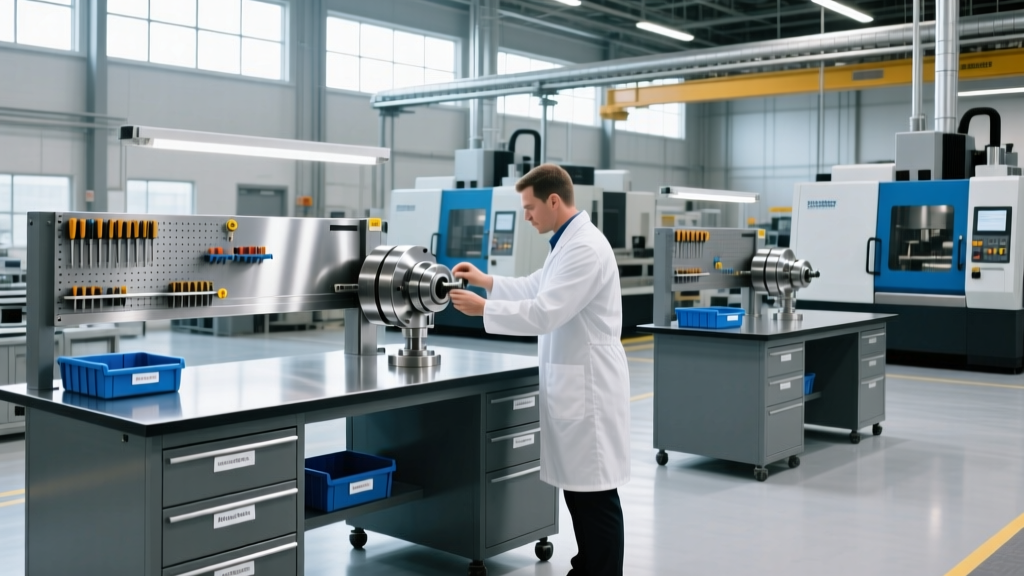
A single misaligned silicone gasket in a chocolate transfer pump can cause catastrophic product loss and bacterial harboring at the client's facility. Lean workstations for food equipment rely heavily on physical Poka-Yoke fixtures.
| Component | Potential Failure Mode | Lean Poka-Yoke Solution | Technical Specification |
|---|---|---|---|
| Sanitary Tri-Clamp Gaskets | Incorrect material (Buna-N instead of PTFE) | Shadow-board with physical thickness gauges | Go/No-Go aluminum gauge machined to 0.020" tolerance |
| Tri-Clamp Torque | Over-tightening causing gasket extrusion | Transducerized DC Torque Driver | Atlas Copco Tensor STB, programmed to 18 Nm max cutoff |
| Scraping Blade Alignment | Blade pitched wrong, destroying Teflon wipers | Magnetic alignment jig | Neodymium N42 magnets set to exact 14-degree pitch |
The integration of transducerized tools like the Atlas Copco Tensor STB ensures that every critical sanitary joint is tightened to the exact Newton-meter specification. The tool communicates via Bluetooth with the cell's PLC, preventing the machine from advancing to the testing phase unless all 24 critical flange torque readings are logged and verified.
Material Replenishment and Kanban Integration
To maintain single-piece flow, parts must arrive at the operator's fingertips without the operator leaving the cell. The workstation integrates 28mm tubular framing (e.g., Creform or Tritek) for dynamic Kanban racks.
Gravity Feed Pitch Specification: For standard plastic Kanban bins containing stainless steel hardware (bolts, clamps, pins), the gravity roller track must be pitched at exactly 3.5 to 4 degrees. A pitch below 3 degrees causes heavy metal hardware to stall; a pitch above 5 degrees causes bins to crash into the forward stopper, potentially damaging delicate sanitary O-rings stored in adjacent compartments.Empty bins are routed to the rear of the workstation via a dedicated return chute pitched at 6 degrees, triggering a visual Andon light (Patlite LR6 series) when a bin is removed, signaling the material handler to replenish from the supermarket inventory.
Wet-Testing Integration in a Lean Cell
Unlike standard machinery, chocolate equipment must be wet-tested to verify pump seals, jacketed heating integrity, and flow rates. Traditional testing involves moving the machine to a separate 'wet room,' creating massive transport waste.
The advanced lean workstation solves this by incorporating a localized, closed-loop wet-test manifold directly into Zone 3. The workstation floor features a 316L stainless steel grated deck with a 2-degree slope toward a centralized trench drain. A 50-gallon integrated reservoir holds a heated, food-grade testing fluid (typically a high-viscosity glycerin-water mixture that mimics the rheology of tempered chocolate at 88°F).
A 5HP rotary lobe pump circulates the fluid through the machine's internal piping. Because the testing fluid is continuously filtered through a 50-micron bag filter and returned to the reservoir, the cell achieves zero-discharge testing. This eliminates the 45-minute transport and cleanup waste associated with off-cell testing, aligning perfectly with the core tenets promoted by the Lean Enterprise Institute regarding the elimination of non-value-added movement.
ROI and Capital Expenditure Analysis
Outfitting a single heavy-duty lean assembly cell with 304 SS framing, integrated pneumatic lifts, zero-gravity tool balancers, and transducerized torque systems requires a capital expenditure between $22,000 and $34,000. However, the reduction in warranty claims related to sanitary joint leaks (often costing $10,000+ per field-service dispatch) and the 28% reduction in assembly cycle time typically yield a full ROI within 14 months of continuous single-shift operation. For any modern manufacturer, the workstation is not merely a table; it is a highly calibrated, error-proofing machine in its own right.