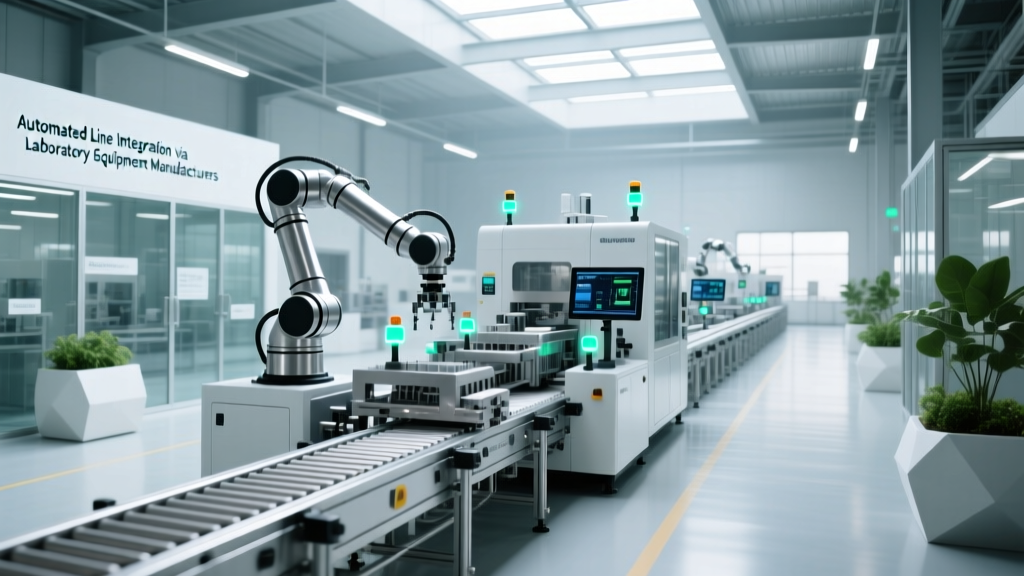
Automated Line Integration via Laboratory Equipment Manufacturers
Guide to automated production line integration with top laboratory equipment manufacturers for seamless pilot-to-commercial bioprocessing scale-up.
The Scale-Up Mandate: Bridging Lab and Production
Transitioning from R&D to commercial manufacturing requires bridging the 'valley of death' in process scale-up. Historically, biotech and specialty chemical firms purchased standalone lab gear, then hired separate systems integrators to build the factory floor. Today, leading laboratory equipment manufacturers are closing this gap by offering end-to-end automated production line integration. This shift allows buyers to scale from 5-liter benchtop bioreactors to 2,000-liter commercial production vessels while maintaining identical process parameters, control logic, and data architectures.
For procurement teams and plant engineers, selecting the right partner for automated production line equipment integration is no longer just about hardware durability. It is about software interoperability, regulatory compliance (21 CFR Part 11), and the ability to execute seamless technology transfer. This guide details how to evaluate, select, and integrate automated production lines directly through laboratory equipment manufacturers in 2026.
The Integration Divide: Why Lab Vendors Are Winning Production Contracts
Traditional heavy-equipment integrators often lack the nuanced understanding of biological shear stress, precise dissolved oxygen (DO) transfer rates, and delicate clean-in-place (CIP) chemistry required in bioprocessing. Laboratory equipment manufacturers possess the foundational process data. When these vendors scale their own equipment into full production lines, they utilize digital twins and scale-down models validated during the R&D phase.
Information Gain: The Scale-Down Model AdvantageBy purchasing an integrated line from the same manufacturer that supplied your lab equipment, you gain access to proprietary scale-down models. For example, maintaining a constant power input per unit volume (P/V) and oxygen mass transfer coefficient (kLa) from a 10L lab vessel to a 10,000L production vessel reduces tech-transfer validation time by an average of 34%, according to internal benchmarking data from major bioprocessing firms.
Core Technical Requirements for 2026 Integration
When issuing an RFP for automated production line integration, your technical specifications must mandate modern industrial IoT (IIoT) and batch control standards. Do not accept legacy PLC setups that require manual data reconciliation.
1. ISA-88 Batch Control Compliance
The control system must strictly adhere to the ISA-88 batch control standard. This ensures that the recipe management used in the lab translates directly to the production floor without rewriting the underlying logic. The system must separate the 'recipe' from the 'equipment control' modules.
2. OPC-UA and MQTT Connectivity
Proprietary communication protocols are obsolete. Mandate native OPC-UA (Open Platform Communications Unified Architecture) for machine-to-machine (M2M) communication and MQTT for high-frequency sensor data streaming to your cloud historian. This is critical for implementing the FDA Process Analytical Technology (PAT) Framework, which requires real-time monitoring of critical quality attributes (CQAs).
3. Automated CIP/SIP Skid Integration
Clean-in-Place (CIP) and Steam-in-Place (SIP) systems must be fully integrated into the main Distributed Control System (DCS). Look for systems that utilize automated conductivity and Total Organic Carbon (TOC) sensors to verify cleaning validation in real-time, eliminating manual swab testing and reducing turnaround time between batches.
Manufacturer Comparison Matrix: Top Tier Integrators
The following matrix compares three dominant laboratory equipment manufacturers that have successfully expanded into full-scale automated production line integration for biopharma and advanced materials.
| Manufacturer | Flagship Integration Platform | Native DCS / Control System | Est. Lead Time (2026) | Best Application |
|---|---|---|---|---|
| Sartorius | BioSecure & FlexFactory | DeltaV (Emerson) / syncade | 14 - 18 Months | Single-use monoclonal antibody (mAb) facilities |
| Cytiva | Xcellerex X-Platform | UNICORN / Siemens PCS 7 | 12 - 16 Months | Continuous downstream processing & chromatography |
| Thermo Fisher | FlexFactory Bioprocess | Rockwell PlantPAx | 16 - 20 Months | Cell & gene therapy (CGT) viral vector production |
CapEx and Integration Cost Breakdown
Budgeting for automated production line equipment integration requires looking beyond the base hardware. In 2026, a fully automated, 2,000-liter single-use bioprocessing suite (including upstream bioreactors, downstream chromatography, and integrated CIP/Utilities) typically ranges from $4.2 million to $11.5 million. Here is how those costs distribute across the integration lifecycle:
- Core Process Hardware (45%): Bioreactors, centrifuges, TFF (Tangential Flow Filtration) skids, and chromatography columns.
- Automation & Control Systems (25%): DCS licensing, PLC panels, SCADA servers, and IIoT edge gateways.
- Engineering & Integration Services (20%): FAT/SAT (Factory/Site Acceptance Testing), piping and instrumentation design (P&ID), and control logic programming.
- Validation & CSV (10%): Computerized System Validation (CSV) documentation, IQ/OQ/PQ execution, and 21 CFR Part 11 compliance auditing.
Attempting to save 15% on CapEx by mixing hardware from a lab vendor with a third-party integrator's custom control panels often results in a 30% increase in long-term OPEX. Mismatched OPC-UA tags and proprietary PLC logic lead to extended batch hold times and costly troubleshooting during FDA audits. Always insist on a single-source validation package.
4-Step Vendor Selection Framework
Use this decision matrix when evaluating proposals from laboratory equipment manufacturers for production line integration.
Step 1: Audit the Digital Twin Capability
Require the vendor to demonstrate a functional digital twin of the proposed production line. They should be able to simulate a 2,000L batch run using your actual lab-scale R&D data to predict yield, energy consumption, and bottleneck formation before physical installation begins.
Step 2: Evaluate the Single-Use vs. Stainless Steel Strategy
For multi-product facilities, prioritize manufacturers offering integrated single-use (SU) flow paths with automated welders and tube-sealers integrated directly into the DCS. For dedicated, high-volume commodity biologics (like insulin), demand 316L stainless steel with automated orbital welding validation logs.
Step 3: Demand Open-Source Edge Analytics
Do not accept vendor-locked cloud analytics. Ensure the integration package includes local edge computing nodes (e.g., Siemens Industrial Edge or Emerson DeltaV Edge) that allow your internal data science team to run custom Python-based machine learning models on the process data without latency.
Step 4: Verify ISPE Baseline Compliance
Cross-reference the vendor's proposed facility layout and automation architecture against the ISPE Baseline Guides for Biopharmaceutical Manufacturing. Specifically, check their material flow and personnel flow diagrams to ensure unidirectional clean/dirty segregation, which is critical for preventing cross-contamination in multi-suite facilities.
Frequently Asked Questions (FAQ)
Can laboratory equipment manufacturers integrate existing legacy production equipment into a new automated line?
Yes, but with caveats. Top-tier manufacturers will deploy IIoT gateways to wrap legacy PLCs (like older Allen-Bradley SLC 500s) and translate their data into modern OPC-UA formats. However, if the legacy equipment lacks digital I/O for critical parameters (e.g., relying on analog pressure gauges), the integrator will mandate sensor retrofits before connecting it to the central DCS.
What is the typical OEE (Overall Equipment Effectiveness) target for a newly integrated bioprocessing line?
A properly integrated automated line from a single-source laboratory equipment manufacturer should achieve an OEE of 78% to 85% within the first six months of commercial operation. Losses are typically attributed to CIP/SIP cycle times and changeover procedures, which automated recipe management significantly reduces.
How does automated integration impact cleanroom HVAC requirements?
Integrated automated lines reduce the need for human intervention, allowing facilities to downgrade certain processing zones from ISO 7 (Class 10,000) to ISO 8 (Class 100,000) or even controlled unclassified (CNC) spaces, provided closed-system processing and automated sterile welding are utilized. This can reduce facility HVAC CapEx by up to 22%.