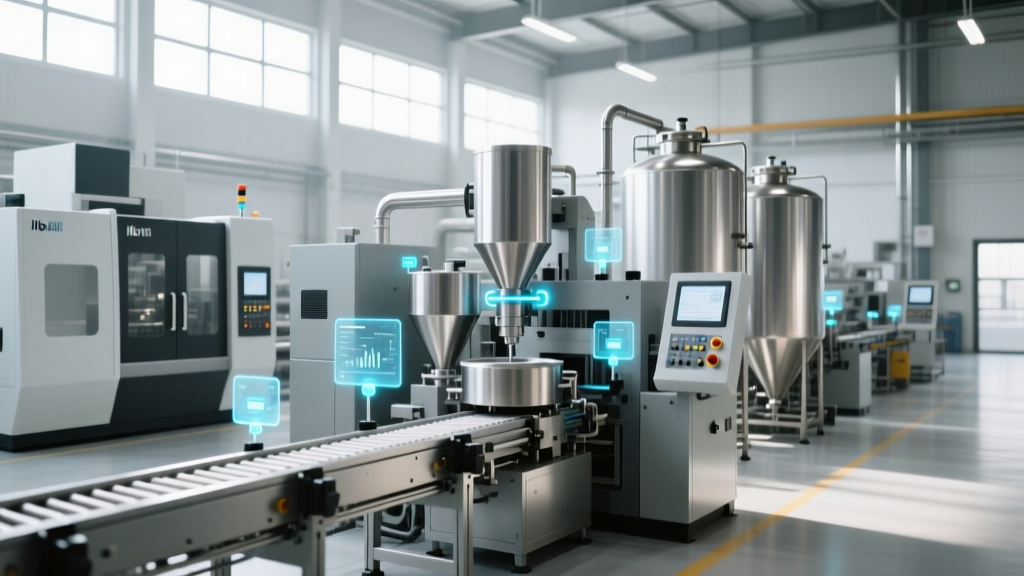
IoT Sensors for Complete Processing Equipment Solutions for Dairy Manufacturing Plants
Use IIoT sensors to optimize maintenance for complete processing equipment solutions for dairy manufacturing plants, ensuring uptime and FDA compliance.
The Financial and Operational Cost of Calendar-Based Maintenance
Operating complete processing equipment solutions for dairy manufacturing plants requires balancing strict sanitary compliance with maximum throughput. Historically, plant engineers have relied on calendar-based preventive maintenance (PM) schedules—servicing homogenizers, pasteurizers, and separators every 2,000 to 4,000 operating hours regardless of actual asset health. This approach leads to two critical failures: premature replacement of healthy components (wasting up to 30% of parts life) and unexpected breakdowns between scheduled intervals due to undetected thermal or mechanical stress.
In 2026, the integration of Industrial Internet of Things (IIoT) sensors has shifted the paradigm from preventive to predictive maintenance. By monitoring real-time condition data, dairy processors can reduce unplanned downtime by up to 45% and extend mean time between failures (MTBF) on critical rotating equipment. This transition is not merely an operational upgrade; it is a necessity for maintaining compliance with the FDA Pasteurized Milk Ordinance (PMO), which mandates rigorous, verifiable control over thermal processing and clean-in-place (CIP) parameters.
Critical IIoT Sensor Deployments for Dairy Processing Lines
Implementing a condition-based maintenance strategy requires deploying specific sensor topologies tailored to the unique mechanical and thermal profiles of dairy processing assets.
Vibration and Acoustic Emission Sensors on High-Pressure Homogenizers
High-pressure homogenizers, such as the GEA Ariete or Tetra Pak Alex series, operate at pressures up to 250 bar. The triplex plunger pumps within these units are highly susceptible to cavitation, valve seat wear, and bearing degradation. Mounting wireless triaxial vibration sensors (e.g., Emerson AMS 650 ATG or SKF Enlight AI) directly on the pump crankcase and motor drive-end allows for continuous monitoring of velocity (mm/s RMS) and high-frequency envelope acceleration.
- Normal Baseline: 1.8 to 2.5 mm/s RMS (ISO 10816-3 Zone A/B).
- Warning Threshold: 4.5 mm/s RMS triggers a work order for valve seat inspection.
- Critical Threshold: 7.1 mm/s RMS or distinct spikes at the Ball Pass Frequency Outer race (BPFO) indicates imminent bearing failure, requiring immediate line diversion.
Thermal Profiling and RTD Arrays for HTST Pasteurizers
High-Temperature Short-Time (HTST) pasteurization requires heating milk to exactly 72°C for 15 seconds. Over time, protein fouling and mineral scale (calcium phosphate) accumulate on the heat exchanger plates in the regeneration and heating sections. This fouling acts as an insulator, forcing the steam control valves to work harder and eventually failing to maintain the lethal temperature hold time.
Deploying precision Resistance Temperature Detectors (RTDs) like the Endress+Hauser iTHERM TM411 at the inlet and outlet of the regeneration section enables continuous delta-T monitoring. When the delta-T across the regeneration section degrades by more than 1.2°C from the clean baseline, the IIoT edge gateway automatically schedules an aggressive CIP cycle and flags the heat exchanger for physical plate inspection during the next scheduled downtime.
Conductivity and Turbidity Sensors for CIP Optimization
Clean-in-Place systems are the backbone of dairy sanitation. Traditional CIP schedules rely on fixed timers, often overusing caustic chemicals or under-cleaning complex piping matrices. Inline conductivity sensors (e.g., Mettler Toledo InPro 7108i) verify the exact concentration of 1.5% to 2.0% NaOH at 75°C, while optical turbidity sensors confirm the complete removal of fat and protein particulates before the final rinse phase. If turbidity remains above 5 NTU after the standard rinse cycle, the system dynamically extends the rinse time, preventing chemical carryover and saving thousands of gallons of water annually.
⚠️ Critical Compliance Warning: Data Integrity
Under the FDA PMO and ISO 55001 Asset Management Standards, any automated adjustment to pasteurization temperatures or CIP chemical dosing based on IIoT sensor data must be logged in an immutable, time-synced ledger. Ensure your edge gateways support local buffering to prevent data loss during network outages, as missing thermal logs can result in automatic product quarantine and severe regulatory penalties.
Dynamic Service Schedule Matrix: Traditional vs. IIoT-Triggered
The following matrix illustrates how IIoT integration transforms rigid maintenance calendars into dynamic, condition-based service schedules for complete processing equipment solutions for dairy manufacturing plants.
| Equipment Asset | Traditional PM Schedule | IIoT Condition-Based Trigger | Maintenance Action Required |
|---|---|---|---|
| Centrifugal Separator | Bowl desludging & bearing lube every 1,000 hrs | Vibration > 3.5 mm/s or bearing temp > 85°C | Inspect spindle bearings; check shock absorber pads |
| HTST Flow Diversion Valve (FDV) | Seat and seal replacement every 6 months | Acoustic leak detection during diversion test | Replace EPDM seals; recalibrate pneumatic actuator |
| Raw Milk Silo Agitator | Gearbox oil change every 12 months | Motor current signature analysis (MCSA) shows rotor bar fault | Rewind or replace induction motor; analyze oil for particulates |
| Positive Displacement Pumps | Stator replacement every 3,000 hrs | Discharge pressure drop > 15% at constant RPM | Inspect elastomer stator for swelling or abrasion |
Edge Computing Architecture and OT Cybersecurity
Dairy manufacturing environments are harsh, characterized by high humidity, aggressive washdown chemicals, and vast expanses of stainless steel that interfere with wireless RF signals. Relying solely on cloud-based analytics introduces unacceptable latency. If a pasteurizer's holding tube temperature drops below 72°C, the system must trigger the Flow Diversion Valve in milliseconds, not seconds.
Modern IIoT architectures utilize edge gateways (e.g., Cisco IR1101 or Siemens RUGGEDCOM) installed in IP69K-rated enclosures. These gateways process high-frequency vibration and thermal data locally, executing immediate machine-level shutdowns while simultaneously forwarding aggregated health data to the cloud for long-term trend analysis.
🔒 Securing the Dairy OT Network
Connecting legacy dairy processing equipment to IIoT networks expands the attack surface. Adherence to the NIST Cybersecurity for IoT Program and IEC 62443 standards is mandatory. Ensure all wireless sensor nodes utilize AES-256 encryption and that edge gateways are placed on a physically segregated VLAN, isolated from the plant's corporate IT and ERP networks to prevent lateral movement of ransomware.
2026 CAPEX and OPEX Implementation Estimates
Transitioning to a predictive maintenance model requires upfront capital, but the return on investment is typically realized within 14 to 18 months through avoided catastrophic failures and reduced chemical/water usage in CIP systems.
"The goal of IIoT in dairy processing is not to collect more data, but to eliminate the noise. A single homogenizer pump failure can halt an entire bottling line, costing upwards of $12,000 per hour in spoiled product and missed retail delivery windows. Predictive sensors pay for themselves the first time they catch a bearing defect three weeks before seizure."
Typical Cost Breakdown per Processing Line
- Wireless Triaxial Vibration Nodes: $1,200 - $1,600 per unit (IP69K rated for washdown).
- Inline RTD and Conductivity Sensors: $2,500 - $4,000 per point, including sanitary tri-clamp fittings and transmitters.
- Industrial Edge Gateway: $3,500 - $5,500 per unit (supports up to 50 local sensor nodes).
- Cloud Analytics SaaS Platform: $200 - $350 per node annually for machine learning fault-detection algorithms and API integration with CMMS (Computerized Maintenance Management Systems) like SAP PM or Fiix.
By strategically deploying these sensors across the most critical bottlenecks in complete processing equipment solutions for dairy manufacturing plants, facility managers can transform maintenance from a reactive cost center into a proactive driver of yield, quality, and regulatory compliance.